India’s election rulebook is governing a campaign ecosystem that no longer runs only on parties and candidates. As political persuasion shifts to platforms and intermediaries, regulation is struggling to keep pace with how votes are actually influenced. This disjunction surfaced in the Election Commission’s (EC) press note of October 14 on the Bihar Assembly elections, which mandated pre-certification of political advertisements by the Media Certification and Monitoring Committee (MCMC) and reiterated the requirement under Section 77(1) of the Representation of the People Act, 1951, that political parties disclose social media campaign expenditure.
Limited lens
What unites these directives is their point of address. They remain focused on parties and candidates, even as electoral outreach is increasingly mediated by third-party actors such as campaign firms, influencers, and interest groups operating outside formal regulatory structures.
A subsequent notification issued by the EC on October 21 sought to widen the regulatory net by requiring that no political party, candidate, organisation, or individual publish political advertisements in the print media on polling day or the preceding day without prior MCMC certification. While this acknowledged the changing campaign environment by including entities other than parties or candidates, it also exposed the limits of the Commission’s regulatory imagination. The restriction applies only to a narrow pre-poll window and remains confined to print media, even as electoral influence has decisively migrated to digital platforms.
Read together, these advisories foreground two unresolved questions: time, in an era where digital campaigns peak well before polling, and stakeholders, in a system shaped by actors beyond those formally regulated.
This analysis uses the Bihar Assembly election as a case study. Using Meta’s Ads Library, it examines digital political advertisements by advertisers spending over one lakh in Bihar during the 30 days ending on November 10, the day before the final phase of polling, distinguishing between official party, candidate pages, and third-party actors.
Who pays, who persuades
An analysis of party expenditure reports, published by The Hindu on May 6, 2024, shows that digital campaigning now dominates election spending. What remains less visible is how this expenditure is distributed beyond parties and candidates, a gap that becomes evident from digital advertising data from the Bihar Assembly election.
On Meta, 55 campaigners spent more than ₹1 lakh on digital political advertisements nationally during the period under analysis. Of these, only 23 were official parties or candidates. The remaining 32 were third-party or surrogate campaigners.
In digital elections, reach is shaped as much by who speaks as by how much is spent. Third-party actors not only outspent parties and candidates but also achieved far greater visibility. Despite near-identical average spending, their campaigns generated almost twice the average impressions of official parties and candidates (Table 1).
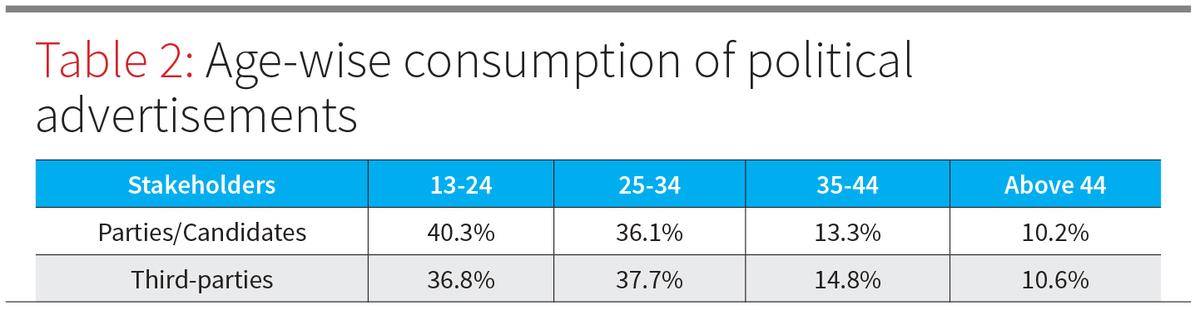
Nearly three-fourths of all digital outreach by parties and candidates (76.4%), as well as by third-party actors (74.5%), is consumed by individuals aged 13-34. However, the age-wise distribution of consumption diverges. Party and candidate advertisements remain sharply concentrated among the 13-24 and 25-34 age cohorts, while third-party advertisements show a more dispersed pattern, generating relatively higher impressions among those aged 25-44 and retaining a comparable presence beyond the age of 44 (Table 2).

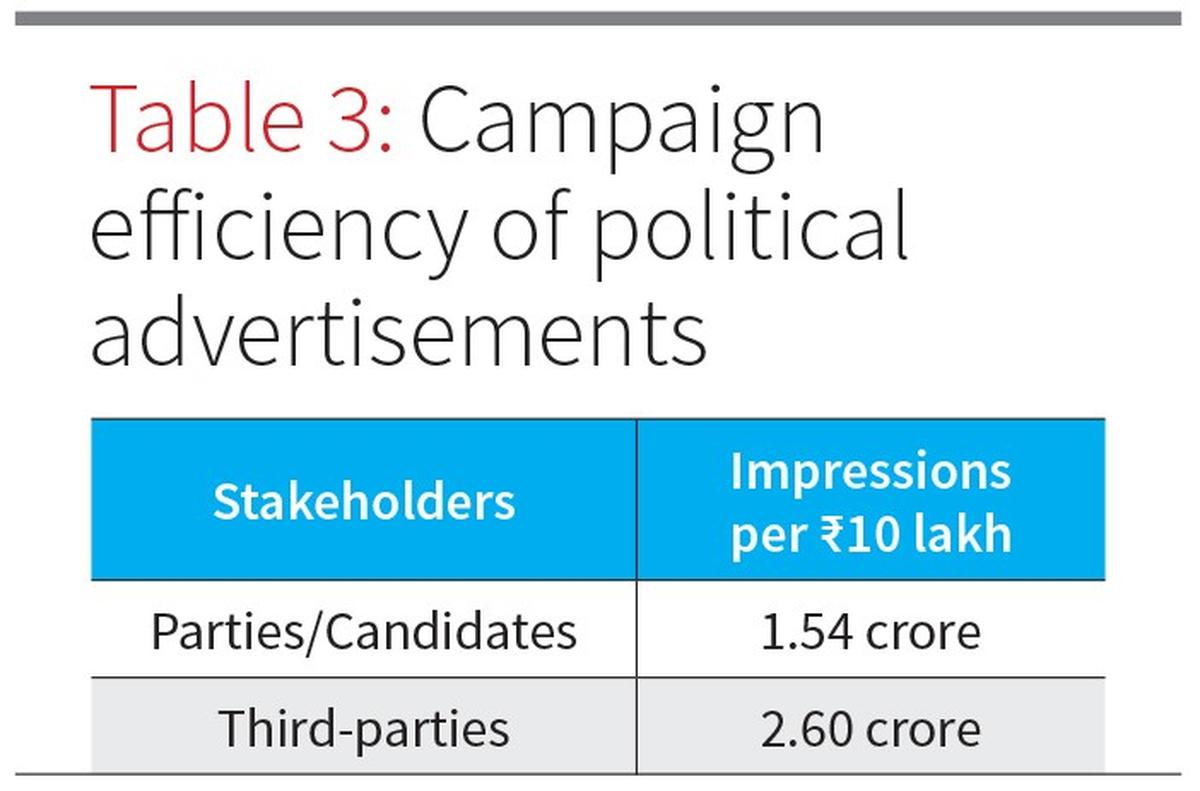
A clearer asymmetry between official and unofficial campaigning emerges when campaign efficiency is examined. Measured as impressions per ₹10 lakh spent, third-party advertisers are markedly more cost-efficient, generating an average of 2.60 crore impressions compared to 1.54 crore for party or candidate pages (Table 3). This shows that in digital campaigns, comparable spending produces unequal circulation, raising questions about where communicative power in online elections actually resides.

An unaccountable nexus
Beyond differences in reach and efficiency, the analysis reveals direct financial entanglements between political parties and third-party actors. In some cases, advertisements on official party pages were funded by external entities. For instance, advertisements on the official Meta page of the Janata Dal (United) were sponsored by an entity identified as “The Spectrum”.
This raises a deeper concern. Expenditure incurred by third-party entities to sponsor advertisements on official party pages may not be reflected in the expenditure statements submitted to the EC, risking an understatement of the true financial footprint of digital campaigning. More importantly, this pattern challenges the assumption that influence flows only from parties to third-party campaigners. Instead, it points to a dual-directional relationship in which third-party actors not only amplify political messaging but also directly finance it on official platforms, blurring the line between authorised expenditure and unaccounted influence.
Accountability gap
In Secretary, Ministry of Information and Broadcasting v. M/s Gemini TV (2004), the Supreme Court held that no individual or entity may publish advertisements for the benefit of any political party or candidate. By the same logic, advertisements directed against a party or candidate are equally impermissible, as such messaging inevitably benefits electoral competitors. Yet the guidelines issued by the EC ahead of the Bihar Assembly elections fall short of applying this standard to third-party actors, many of whom continued campaigning even on the evening of polling and on polling day itself.
Addressing this gap requires a recalibration of how electoral stakeholders are understood. Political campaigns are no longer confined to parties and candidates alone, but are shaped by a wider ecosystem of actors involved in content dissemination and campaign finance.
Unless regulatory obligations are extended — both in substance and scope — beyond parties and candidates, space will continue to exist for opaque, bi-directional arrangements that escape scrutiny.
The problem is compounded in the context of campaign finance. While parties are legally required to submit expenditure statements to the EC, digital spending is often disclosed ambiguously, with payments listed under platform names such as ‘Facebook’ rather than the specific entities that design or fund advertisements. More troubling still is the reverse flow of funding, where third-party entities pay for advertisements on the official page of a political party. Parties are required to report what they spend; they are not required to disclose what others spend on their behalf. This inversion poses an equal, if not greater, threat to the principles of transparency and fairness, allowing political influence to remain formally invisible.
Delayed regulation
Finally, the temporal framing of regulation remains inadequate. Electoral influence now builds over months through sustained digital exposure, rendering rules that activate only on the eve of polling ineffective against harms already set in motion. Each election conducted without a framework attuned to this reality carries clear costs in terms of the gradual erosion of trust in a fair digital democracy. The challenge now is no longer one of recognition, but of resolve.
Abhishek Sharma is a Senior Political and Policy Researcher. Vandita Gupta is an independent researcher
Published – December 28, 2025 10:36 pm IST