

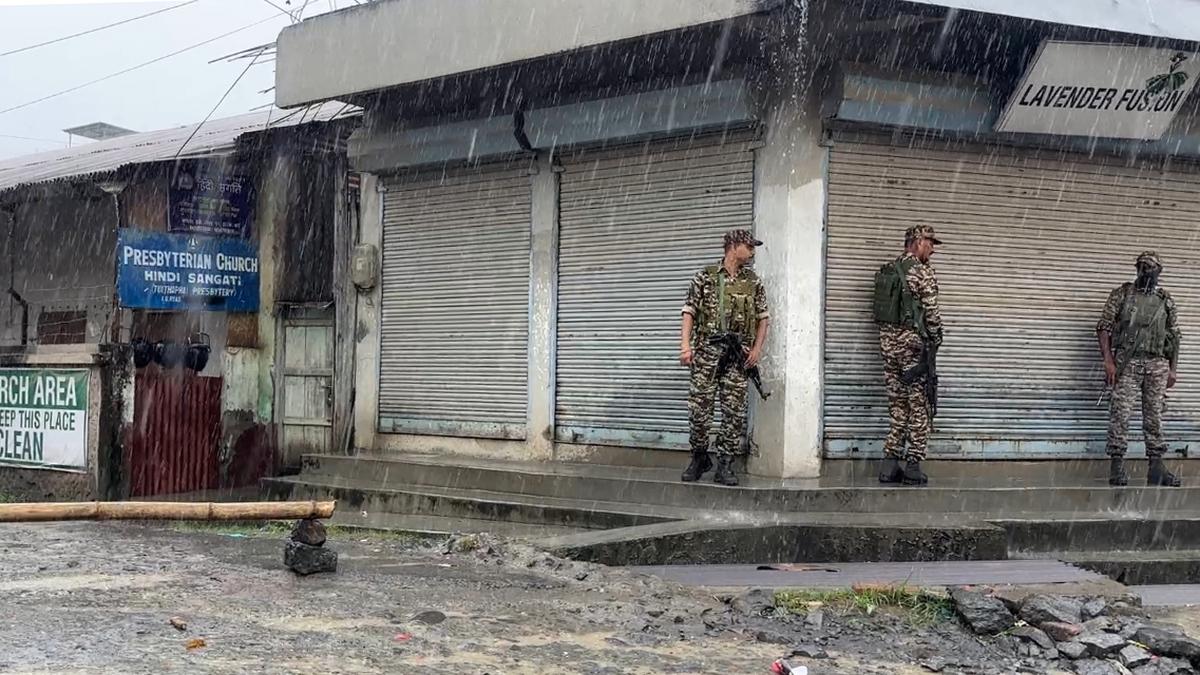
On May 3, 2023, ethnic violence erupted in Manipur, plunging the State into one of the longest-running internal conflicts in Independent India. Today, there is no resolution — only an uneasy silence, broken by sporadic violence, and bureaucratic inertia. Manipur remains a footnote, its crisis relegated to the periphery of national discourse.
The extension of President’s Rule in the State under Article 356 of the Constitution without meaningful political engagement, justice, or reconciliation exposes a deeper malaise: India’s democratic imagination excludes its northeastern frontier.
Myth of normalcy
The Union government has repeatedly claimed that “normalcy is returning” to Manipur. Yet, ground reports tell a different story as over 60,000 people remain displaced, living in squalid relief camps across hills and valleys. And over hundreds of villages lie deserted, with homes, churches, and schools reduced to ashes. So far, both the warring communities or so-called armed militias patrol so-called “buffer zones”, while state security forces remain passive or complicit.
The extension of President’s Rule for the second time is not a solution; it is a failure of governance. Article 356 was meant for exceptional breakdowns, not as a permanent administrative placeholder. If the Centre cannot restore order, why has it not initiated a truth commission, disarmament, or political dialogue?
Article 356 was intended as an emergency provision, but in Manipur, it has become a tool of political abdication. Even when a BJP-led government had been in power in the State amid the violence, the Centre’s response has been so shockingly passive that no credible investigation into mass killings, sexual violence, or arson has taken place. Nor any specific road map for peace between the Meitei and Zo (Kuki-Zomi-Mizo) communities has been drawn up. Sadly, neither is there a rehabilitation plan for the displaced people. They are being forced to find their own livelihood with no help or assistance. Instead, informal militarisation has replaced governance with less government. Amid all the chaos and the continuous crisis, the Armed Forces (Special Powers) Act (AFSPA), Internet shutdowns, and arbitrary detentions continue, while justice remains elusive.
Since 2023, attempts to discuss Manipur in Parliament have been blocked, diluted, or dismissed. In the 2023 Winter Session, Opposition MPs were suspended for demanding a debate. Even now, Manipur is treated as a regional footnote, not a national crisis. This silence is not accidental; it reflects the electoral marginality as Manipur sends just two Lok Sabha members and is easy to ignore in Delhi’s power calculus. Second, there is a media blackout with the national media covering the State sporadically, unlike Kashmir or other conflicts. Third, there is the perennial systemic indifference as the Northeast is often seen through a security lens, not as a place where citizens with equal rights live.
Pattern of neglect
Manipur is not an exception. India has a history of governing conflict zones through force, not dialogue, which is visible in many other States such as Kashmir where the AFSPA, mass arrests, and communication blackouts become the order of the day. Another example is Chhattisgarh, which became infamous for the Salwa Judum vigilante group, fake encounters, and displacement. And Nagaland had witnessed continuous decades of insurgency, followed by protracted peace talks.
In the context of Manipur, this translates into allowing ethnic militias to operate with impunity. The Internet shutdowns are rather a pretext for controlling the citizens. During the conflict, there have been many cases of sexual violence against women, yet the government refuses to take action on reports of sexual violence and extrajudicial killings. Even the Supreme Court’s interventions have been slow and limited, failing to enforce accountability.
Manipur is forgotten basically because of various factors arising from the geographical distance that makes the Delhi’s political class see the Northeast as remote and insignificant. There is a lack of political willingness to maintain peace and democracy. No major national party has made Manipur a priority. It may also be because of the ethnic divisions due to the huge representation of 33 recognised ethnic communities and the Meitei vs Zo binary. And lastly, the media apathy. Unlike the farmers’ protests or Hathras, Manipur lacks sustained media attention.
If India’s democracy is to mean anything, Parliament must debate the Manipur crisis urgently with a full-fledged discussion with testimonies from victims. And subsequently it should establish an independent truth commission, and not another government-controlled committee. The government must disarm all militias with international oversight. If necessary, ensure equal rehabilitation of Meitei and Zo communities, and protect press freedom. For long-lasting peace and tranquillity, threats to journalists and activists must end.
The people of Manipur have not been silent. They have marched, petitioned, and documented atrocities. The question is will Delhi listen. Democracy is not just about elections; it is about justice, accountability, and inclusion. If nearly 850 days of bloodshed do not compel action, what will? If India continues to treat Manipur as expendable, it betrays the very Constitution it claims to uphold.
Langthianmung Vualzong is an alumnus of the Centre for the Study of Law and Governance, Jawaharlal Nehru University, New Delhi; views expressed are personal
Published – September 24, 2025 12:20 am IST

