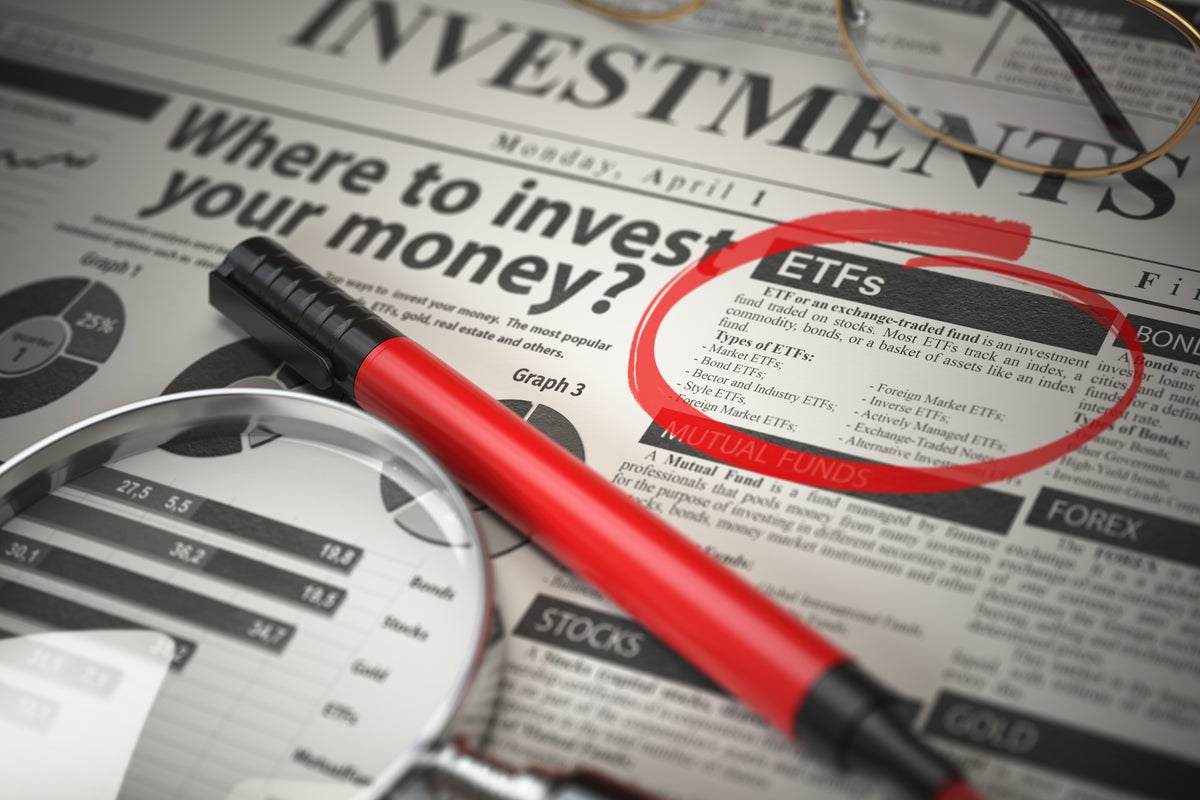
If you’re just starting out on your investing journey or wanting to know where to start, you need to know about Exchange-traded funds (ETFs).
These are a relatively simple, low-cost way to invest money in shares or other assets, and their popularity is rising fast.
Total assets in ETFs have climbed by over $4 trillion this year alone to top $18 trillion.
What are ETFs?
ETFs enable investors to buy shares in a pool of investable assets in the same way that you can buy shares in a single company.
They are created by investment firms buying a collection of assets, issuing shares backed by the pool, and listing those shares on a stock exchange to be bought or sold by investors.
For example, a firm will create a FTSE 100 ETF by acquiring shares in all the 100 biggest companies on the London Stock Exchange, pooling them together and creating shares in that pool for a lower entry cost than buying each company individually. As the FTSE 100 constituents change, the firm will adjust the underlying pool.
Another popular form of ETF is one which holds a particular commodity like gold or silver, or digital assets like cryptocurrency. These are sometimes called exchanged-traded products (ETPs) and work in a very similar way. The difference is they only have one asset in the underlying pool, rather than many.
Most ETFs provide what is called passive investment, meaning that they simply track the level of an index such as the FTSE 100 or S&P 500, or move in line with the price of an asset like gold.
Actively managed ETFs are similar, except they have fund managers selecting the stocks, bonds or other assets in the underlying pool based on a set of objectives. The assets in the pool will therefore change regularly.
There is also a third category of ETF. Thematic or ‘smart beta’ ETFs sit between active and passive.


Get a free fractional share worth up to £100.
Capital at risk.
Terms and conditions apply.
ADVERTISEMENT
Get a free fractional share worth up to £100.
Capital at risk.
Terms and conditions apply.
ADVERTISEMENT
They are more tailored than a purely passive ETFs, but do not go as far as having fund managers picking each asset backing the fund. For example, a biotechnology ETF would target only companies in and around that industry, but once the initial pool is determined there will be little active change in what is held.
How to buy ETFs
Shares in an ETF can be bought and held in SIPPs and ISAs in the same way as company shares. All the major UK and US investment platforms offer ETFs. To get started, you just have to spend a few minutes opening an account and then fund it with some money.
Deciding what to invest in is the important part. You should do plenty of research and seek professional advice if you need to. When you know what you want to buy it’s just a matter of following the prompts on the investment platform website.
Laith Khalaf, head of investment analysis at AJ Bell, says: “The indices some ETFs track are broad market indices, which will be well known to investors, such as the FTSE 100 or the MSCI World Index.
“However others will be more specialist, sometimes customised indices which require more scrutiny from potential investors to ensure they’re happy with the way the index is structured and with the risks implicit in it.
“There are also an increasing number of active ETFs, which don’t actually track an index, but rather invest according to the instructions of a fund manager trying to beat the market.
“ETFs which track broad market indices are generally appropriate for novice investors getting started. But the more specialist ETFs require more understanding and experience, and in some cases more risk appetite.”
What are the main advantages of ETFs?
ETFs are a cheap, cost-effective way to invest in most cases. Passive ETFs come with low fees that amount to a fraction of a per cent. More complex ETFs, such as the actively managed or thematic ETFs, will usually come with higher fees though.
Another key benefit is diversification. An index tracking ETF such as one pegged to the FTSE 100 or MSCI World index provide you with a one-stop diversified investment. This means money is spread across many different assets, which makes it low risk compared to buying stocks in individual companies.

There is also near-instant buying or selling. Because the shares in an ETF are traded on an exchange you can enter or exit your investment whenever you choose, within stock market trading hours. In the UK that is 8am to 4.30pm, Monday to Friday.
Khalaf says: “ETFs come in lots of shapes and sizes but at heart they offer investors a diversified investment which can be traded throughout the day. That’s unlike single shares, which are undiversified, and unlike other open-ended funds, which trade once a day on a forward-pricing basis.”
Differences between ETFs, funds and investment trusts
Traditional funds that are not traded on exchanges are called open-ended investment companies in the UK (OEICs) and mutual funds in the US. They are also pools of assets, but the difference is they do not issue shares which can be bought on stock exchanges.
Instead, they create fund units to give to investors and handle the buys and sells of these themselves, often via other firms or investment platforms. There can be a variable wait of a few hours to a few days or longer to get money in or out, depending on the type of fund.
A third commonly bought investment vehicle is an investment trust. They are similar to ETFs in that they issue shares to a stock exchange that can be bought or sold instantly during market hours.
They are very different in other ways though. Investment trusts are all individual listed companies in their own right, and they are always actively managed by a team. The portfolio managers buy and sell the assets in the trust according to a strategy and their own judgement.
Shares in an investment trust do not always track the value of the owned assets exactly. They can trade higher or lower than this value, which is known as a premium or a discount, respectively.
That makes it important to identify the area you want to invest in and whether you think the exact trust is the right one to consider buying into.
When investing, your capital is at risk and you may get back less than invested. Past performance doesn’t guarantee future results.