

we need to ask ourselves how true the words of the national song are
| Photo Credit: ANI
India has commenced celebrations of the 150th anniversary of Vande Mataram, the ballad that became a battle cry for India’s freedom. This is also an opportune time to ask how far we have realised Bankim Chandra Chatterjee’s immortal words — “Sujalam, Suphalam, Malayaja sheetalam, Sasya-shyamalam (translated as clear-watered, rich in fruits, cooled by mountain breeze, lush and green with its fields of harvest”).
A biodiverse land
Down the ages, India’s environment has been critical to its becoming the cradle of one of the world’s great civilisations. India’s population and its fertility rate owe much to the fertility of its soil, which was able to provide abundant harvests to support a large population. Even as India’s land area comprises just 2.4% of the land in the world, the Convention on Biological Diversity testifies that India is home to about 8% of the world’s species. Over 91,200 species of animals and 45,500 species of plants are found in India. And such has been the reliability of India’s rain-bearing winds that even before India gained independence, the renowned geographer Halford Mackinder spoke of the country as a ‘Monsoon power’ that will shape the future of the world.
How have we safeguarded elements of this priceless environmental heritage that birthed our civilisation — Sujalam, Suphalam, Malayaja sheetalam? India’s life-giving rivers are in deep crisis. Nearly 43% of river monitoring systems have found traces of heavy metal contamination.
The level of pesticide content in several Indian rivers is well above permissible limits. In Global Water Quality rankings, India ranks 120 out of 122 countries. Unsurprisingly, we do not trust the water sourced from our aquifers.
A survey last year found that 60% of Indian households use a filter for their tap water. The pollution in the Yamuna may now be the subject of memes, but there is no room for mirth in the misery we have created for ourselves.
Studies estimate that over 40% of food samples in India have pesticides in excess of permissible levels. Unsurprisingly, cancer cases are expected to rise by 12% over the next five years.
The crisis of our time
Not just Bankim Chandra, poets, from Kalidasa to Tagore, eulogised India’s fresh and fragrant air. What would they have to say today about Delhi’s Air Quality Index (AQI)? On October 30, Indian cities took up the top 40 spots in the world’s most polluted cities. Travel websites are now advertising destinations in India with the selling point of “an AQI less than 50”.
The fiscal burden of air pollution now equals nearly 9.5 % of India’s GDP, and threatens to erase the economic progress we have made in recent decades. Disturbingly, a Lancet study released in October found that 17 lakh Indians died prematurely in 2022 due to man-made air pollution, representing a spike of 38% from 2010.
Renowned for its spices and mineral riches, India’s richest treasure has always been its agricultural bounty. With at least 66 fruits and 29 cereals native to its land, India boasts of remarkable agri-diversity. Yet, India’s agriculture is fighting an uphill battle today against climate change and needs all the support it can get. The impact of climate change has manifested itself in myriad ways, from warmer temperatures to erratic rainfall that has affected soil quality. The result has been the lowering of Vitamin C levels in citrus fruits in Karnataka, the increase in sugars in grapes in Maharashtra, and the delayed flowering of apple trees in Himachal Pradesh.
Right to clean air and water
Vande Mataram was more than a rousing cry to rally people, or a slogan for independence. It was, and remains an article of faith to Indians. Its words represent a promise to the people of India about their homeland. We have seen several political debates over the years about how many stanzas of Vande Mataram should be sung. Perhaps it is time we had a debate — cutting across ideological and partisan lines — on how true our national song’s words ring today.
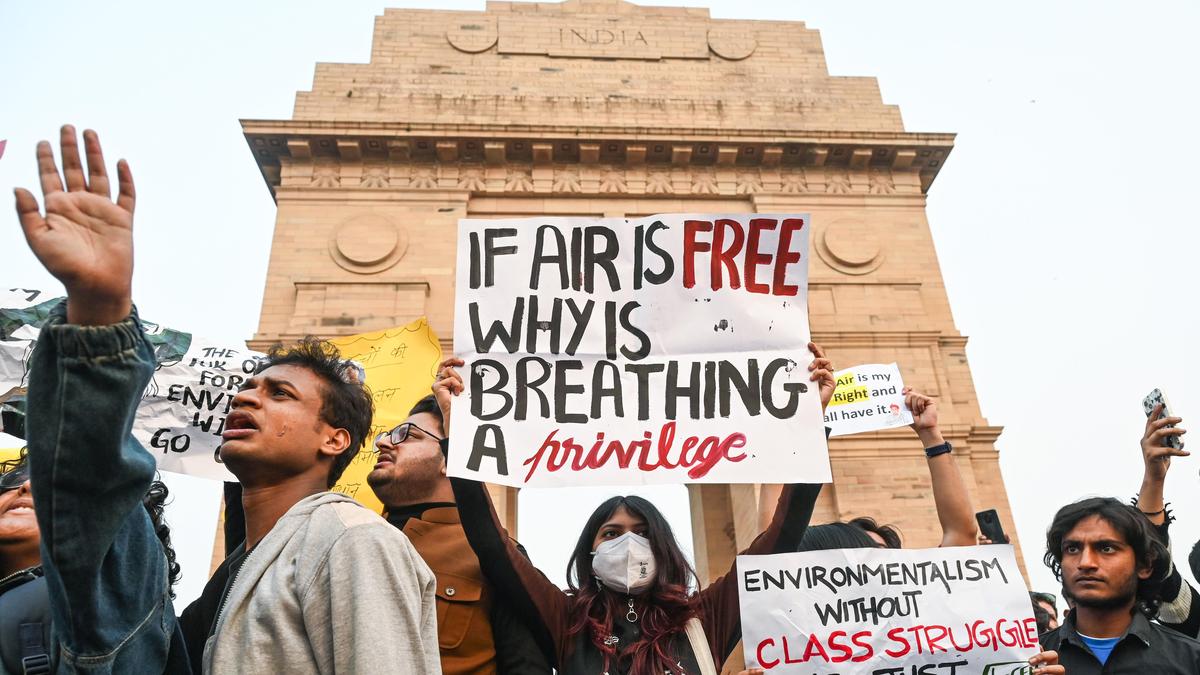
Equally, where our health, the longevity of our parents and the well-being of our children is at stake, every citizen needs to step up and speak out. The recent India Gate protest, against air pollution, may be just a sign. In “Anandamath”, Bankim Chandra describes a band of monks in 1770 determined to free their motherland from colonisers. In 2025, their spirit lives on in the young activists demanding a healthier environment. It is embodied in every placard and post asking for freedom from the scourges of pollution and inaction in the face of climate change in India.
Can there be a more opportune moment than the 150th anniversary of Vande Mataram to raise the call for a sujal, suphal and sasya-shyamal India? Not just for our right to clean air, it is time to ask those we elect to redeem the promise of Vande Mataram.
Raja Karthikeya crossed the Arctic and the Antarctic circles in 2017-18 to raise awareness for climate action in India
Published – November 26, 2025 04:10 pm IST

