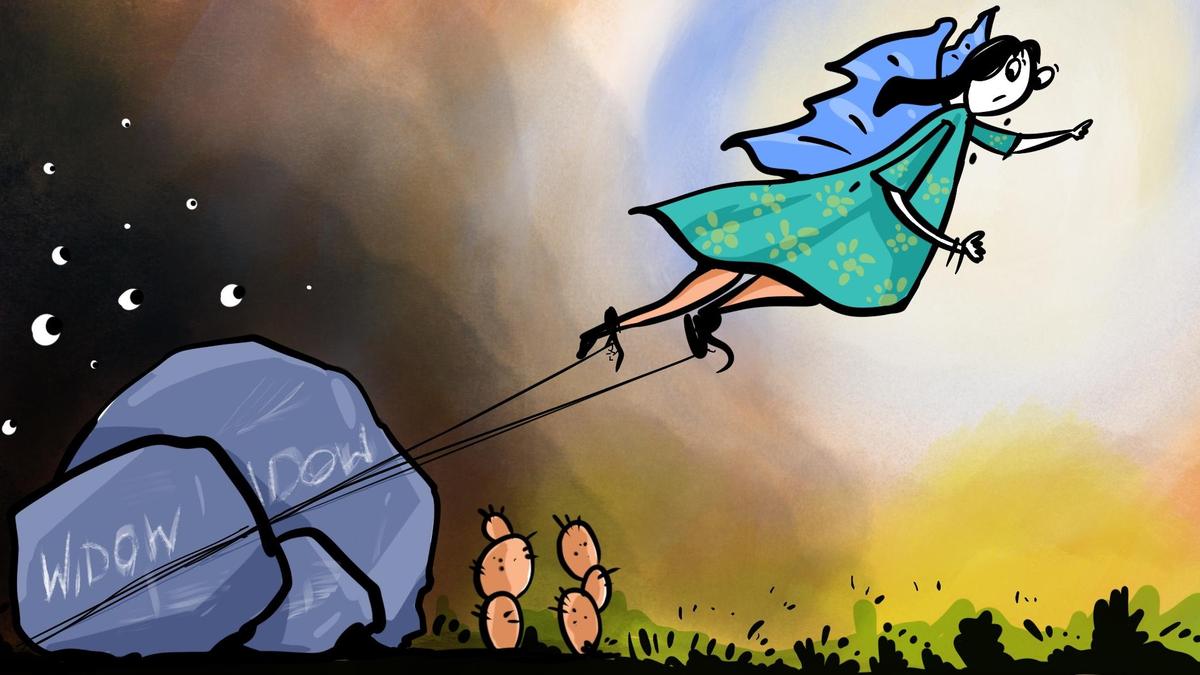
The labels ‘widow’ and ‘widower’ are dehumanising, crushing bereaved spouses into questioning their identity.
| Photo Credit: SREEJITH R. KUMAR
Sati was abolished more than a century ago and is a legal offence punishable by the court. Yet, in many ways, the practice continues — not by fire but by societal condemnation.
Recently, a woman I know lost her spouse, and the untimely death shattered the family. What struck me most was not just the depth of her grief but the cruel curiosity of the onlookers. The crowd that gathered seemed less interested in offering consolation but more eager to see how she cried, how she behaved, and how soon she would “move on”. After some days, when she started to regain composure and face reality with strength, whispers started that “she seems to be fine too soon”. Society does not want a woman to heal; it wants her to be in mourning perennially. She is thrown into a pyre of condemnation.
Today, a woman may not be physically burnt on the pyre of her husband, but society expects her to live in silence, stripped of colour, joy, and identity. Her life may be spared, but her existence is often reduced to a shadow of what it was once.
Society becomes judgmental over all her actions and activities — how she dresses, where she goes, what she eats, and even how she smiles. Judgment often comes from a lack of empathy and limited knowledge. People who have not experienced grief are quick to criticise without understanding the unique pain the person undergoes or challenges that person faces. In this moral policing, what is forgotten is that grief is personal, and there is no prescribed script for mourning.
The labels “widow” and “widower” are dehumanising, crushing bereaved spouses into questioning their identity. These names reduce their life to a single marital status rather than a continuing human journey, and cage them into a single tragic event.
Labelling theory suggests that when society assigns a label to a person, that individual may internalise it, which can influence their self-perception and future behaviour. So, when a woman is constantly referred to as a “widow”, she begins to view herself through that lens of loss instead of as a complete, capable individual.
Today, we live in a time when regressive societal practices are subject to criticism, and yet, society remains selectively blind, deaf, and mute when it comes to the everyday oppression of widows. Women empowerment speaks of increasing women’s self-worth and control over their lives, and having greater autonomy in public and private spheres. Does this actually happen? The same society which preaches these turns around and dictates how a bereaved woman should behave. True empowerment is not about slogans or symbolic gestures; it is about respecting a woman’s right to choose, how she wishes to grieve, heal, and live after loss.
Men, on the other hand, are seldom subjected to such scrutiny. A man who loses his wife continues to attend social gatherings, remarries if he wishes, and is often seen with sympathy rather than scrutiny. But a woman who loses her husband fears society regardless of her education or profession; the joys she enjoyed once are seen as sins after she becomes a widow.
Even in official documents such as job applications, school forms, and housing records, the term “widow” still appears, as if it holds some administrative importance. What purpose does this term serve other than reminding the woman her loss again and again? Widowhood is not a curse or a crime; it is a circumstance of life, much like marriage itself. The psychological judgment is immense. A woman who wishes to rebuild her life, who dreams of love and remarriage is shamed by criticism. Many suppress their desires fearing the harsh gaze of society, some even slip into depression and anxiety. Actually, the pressure to conform steals away the person’s individuality and freedom.
Death is inevitable, a natural conclusion to all our lives. To expect a woman to mourn all her life is to punish her for surviving. Grief and healing take their own time; some recover soon, others take years. Society must stop defining women by their loss and instead support their right to rebuild, to rediscover purpose, and to celebrate life once again. Widowhood should never be a label to limit their dreams. It’s time to shift our collective gaze.
mercyfamila@gmail.com
Published – November 09, 2025 03:30 am IST