
When you have a COVID-19 infection, you’re told to isolate and stay away from others until you’re better. But while many folks do improve at home thanks to a combination of medication, rest, hydration and time, others require additional medical intervention.
While we know the hallmark symptoms of COVID ― like coughing, fatigue, for example ― there are some COVID-19 symptoms that aren’t normal and shouldn’t be treated as such.
“What’s really important is making sure people look out for certain telltale signs and symptoms that may warrant hospital-level care or [care from] a health care provider, so that way they don’t face severe illness, even hospitalization and death,” said Dr. Syra Madad, an infectious disease epidemiologist and fellow at Harvard’s Belfer Center for Science and International Affairs.
Below, experts share what COVID-related issues should be instant red flags, plus some advice on what to do:
Breathing issues, high fever, dizziness and confusion are all reasons to get immediate medical care.
According to Dr. Natasha Bhuyan, the national medical director at Amazon One Medical, red flag symptoms include shortness of breath and trouble breathing.
“What we always say is if someone is actually having trouble breathing, so they’re actually gasping for breath, that would be an ER visit,” Bhuyan said.
When you have COVID, there’s a phase when the virus is quickly replicating, followed by an inflammatory response phase when your body fights off the virus, explained Dr. Mohammad Mahdee Sobhanie, an infectious diseases physician at The Ohio State University Wexner Medical Center. “And … sometimes that inflammation can affect other places, and the one we always worry about is the lungs.” If you have COVID and notice you’re struggling to catch your breath when you’re walking, sitting down or talking, it’s a reason to go to the ER, he noted.
Sobhanie also noted that chest pain is another red-flag-symptom that should trigger an ER visit. The same goes for blue-ish colored lips, Madad said.
If you have a pulse oximeter at home (or a smartwatch that informs you of your oxygen saturation) and you notice that your oxygen level is low, you should seek medical help, according to Sobhanie.
Problems like lightheadedness, confusion or dizziness require immediate medical attention as well. “Some of the really concerning symptoms … maybe someone in your household has COVID, and now they’re confused or they’re not making sense or they’re disoriented, I think those are reasons to go to the ER,” Bhuyan said.
Finally, pay attention to high fevers over 103 degrees Fahrenheit. A high fever can sometimes warrant an ER visit, but oftentimes can be managed by your primary care provider, Bhuyan added. If you’re ever unsure, it’s always best to seek help right away as a precaution.
valentinrussanov via Getty Images
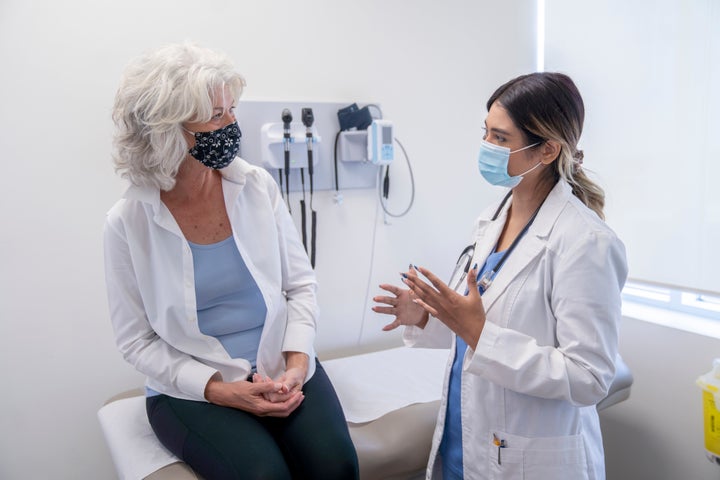
If you are high-risk, you should contact your doctor as soon as you test positive.
“I think also you have to be very aware of what other underlying conditions you have. The patient population I always worry about are immunocompromised patients … and those patients, if they ever have COVID, they need to talk to their doctors right away, because their doctors like to be very proactive early on when it comes to COVID,” Sobhanie said.
According to the Centers for Disease Control and Prevention, high-risk people include folks over 50, people with underlying health conditions like chronic obstructive pulmonary disorder and heart disease, and those who are immunocompromised, as Sobhanie mentioned above.
If your general symptoms get worse, you should let your doctor know.
“If you’re experiencing worsening symptoms, like a worsening sore throat or a cough, or worsening fever or headache, I think that certainly is another red flag that you should seek health care services,” Madad said.
In this case, you should let your doctor know what symptoms you’re experiencing and that they’re getting progressively worse, she said.
“What we typically expect, on the first day or two people might feel a little scratch in their throat, they might feel that they’re getting sick, [and] usually on day three or four, the symptoms are more severe, and they’re at their peak,” Bhuyan said. “From there, people tend to get better.”
It may take seven days for you to feel better, or it may take 10 to 14 days, and that is normal, she said. “But … if somebody is actually starting to get worse on day six or day seven, it’s really critical that they reach out to [a] primary care provider.” This could be a sign that the COVID infection is evolving into something like bacterial pneumonia in their lungs, Bhuyan added.
All in all, it’s never a bad idea to inform your doctor of your COVID infection. There are antiviral medications, for example, that could help your situation. Plus, it’s always good to keep your doctor informed of a COVID-19 infection so they can get you on a path to healing and monitor your progress.

FatCamera via Getty Images
The same COVID protocols remain important to stay healthy.
“The COVID vaccine is effective in preventing hospitalization and death … that being said, somebody might get the COVID vaccine, or they might have a prior COVID infection, and they might still get COVID,” Bhuyan said. The goal of the shot is to reduce the severity of the illness, not prevent it entirely.
Sobhanie said it’s not too late in the season to get your COVID vaccine if it’s still available to you. But you should talk to your doctor about the best timing for your shot — if you recently had a COVID infection, you have to wait a period of time before getting your jab.
Beyond vaccination, Madad recommended going back to the “Swiss cheese model of COVID defense.”
“That’s something that we’ve all been used to during the COVID-19 pandemic. The Swiss cheese model is layers of infection prevention that you’re stacking upon each other. As we know, no one layer is 100% protective,” Madad said.
This includes wearing a mask in crowded spaces, keeping your distance from others who could be sick and staying up to date on your vaccinations.
The winter season always comes with high viral activity, whether it’s COVID, the flu, RSV or other illnesses. And the measures mentioned above also apply when it comes to protecting yourself against all of the respiratory diseases that are circulating right now.