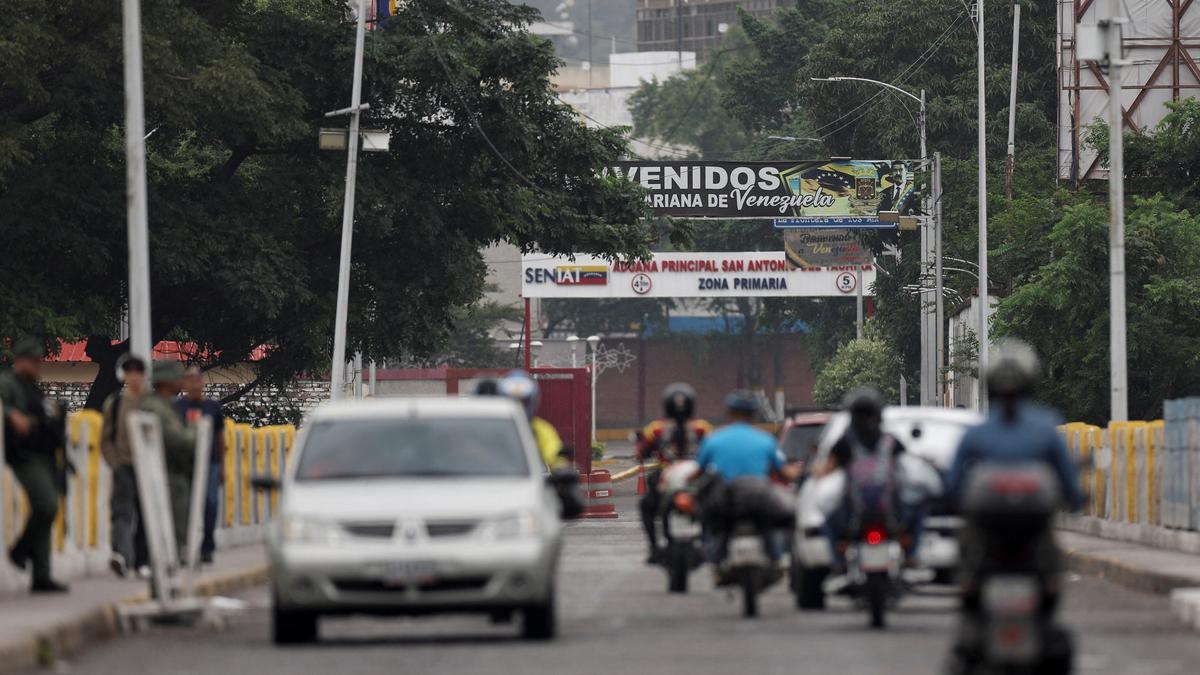
The United States, which on Saturday (January 3, 2026) attacked Venezuela and is said to have abducted its President, has a long history of military interventions and support for dictatorships in Latin America.
On multiple occasions the late Venezuelan President Hugo Chavez and his successor Nicolas Maduro — who Donald Trump says is now in U.S. hands — accused Washington of backing coup attempts.
Here are the main U.S interventions in Latin America since the Cold War.
1954: Guatemala
On June 27, 1954, Colonel Jacobo Arbenz Guzman, President of Guatemala, was driven from power by mercenaries trained and financed by Washington, after a land reform that threatened the interests of the powerful U.S. company United Fruit Corporation (later Chiquita Brands).
In 2003, the United States officially acknowledged the Central Intelligence Agency’s (CIA) role in this coup, in the name of fighting communism.
1961: Cuba
From April 15-19, 1961, 1,400 anti-Castro militants trained and financed by the CIA attempted to land at the Bay of Pigs, 250 kilometres (155 miles) from Havana, but failed to overthrow Fidel Castro’s communist regime.
The fighting left killed more than a hundred on each side.
In 1965, citing a “communist threat”, the United States sent Marines and paratroopers to Santo Domingo to crush an uprising in support of Juan Bosch, a leftist president ousted by generals in 1963.
1970s: support for dictatorships
Washington backed several military dictatorships, seen as a bulwark against left-wing armed movements in a world divided by Cold War rivalries.
It actively assisted Chilean dictator Augusto Pinochet during the September 11, 1973 coup against leftist President Salvador Allende.
U.S. Secretary of State Henry Kissinger supported the Argentine junta in 1976, encouraging it to quickly end its “dirty war,” according to U.S. documents declassified in 2003.
At least 10,000 Argentine dissidents disappeared.
In the 1970s and 1980s, six dictatorships (Argentina, Chile, Uruguay, Paraguay, Bolivia and Brazil) joined forces to eliminate left-wing opponents under “Operation Condor,” with tacit U.S. support.
1980s: wars in central America
In 1979, the Sandinista rebellion overthrew dictator Anastasio Somoza in Nicaragua. U.S. President Ronald Reagan, concerned about Managua’s alignment with Cuba and the USSR (Union of Soviet Socialist Republics), secretly authorised the CIA to provide $20 million in aid to the Contras (the Nicaraguan counter-revolutionaries), partly funded by the illegal sale of arms to Iran.
The Nicaraguan civil war, which ended in April 1990, claimed 50,000 lives.
Reagan also sent military advisers to El Salvador to crush the rebellion of the Farabundo Martí National Liberation Front (FMLN, far left) in a civil war (1980–1992) that resulted in 72,000 deaths.
1983: Grenada
On October 25, 1983, U.S. Marines and Rangers intervened on the island of Grenada after Prime Minister Maurice Bishop was assassinated by a far-left junta and as Cubans were expanding the airport, presumably to accommodate military aircraft.
At the request of the Organization of Eastern Caribbean States (OECS), Reagan launched Operation “Urgent Fury” with the stated goal of protecting a thousand U.S. citizens.
The operation, widely deplored by the UN General Assembly, ended on November 3, with more than a hundred dead.
1989: Panama
In 1989, after a contested election, president George W. Bush ordered a military intervention in Panama, resulting in the surrender of general Manuel Noriega, a former collaborator of U.S. intelligence, who was wanted by U.S. justice.
Some 27,000 GIs took part in Operation “Just Cause”, which officially left 500 dead.
NGOs put the toll significantly higher, in the thousands.
Noriega would spend more than two decades in prison in the United States for drug trafficking, before serving additional sentences in France and then Panama.
Published – January 03, 2026 07:12 pm IST