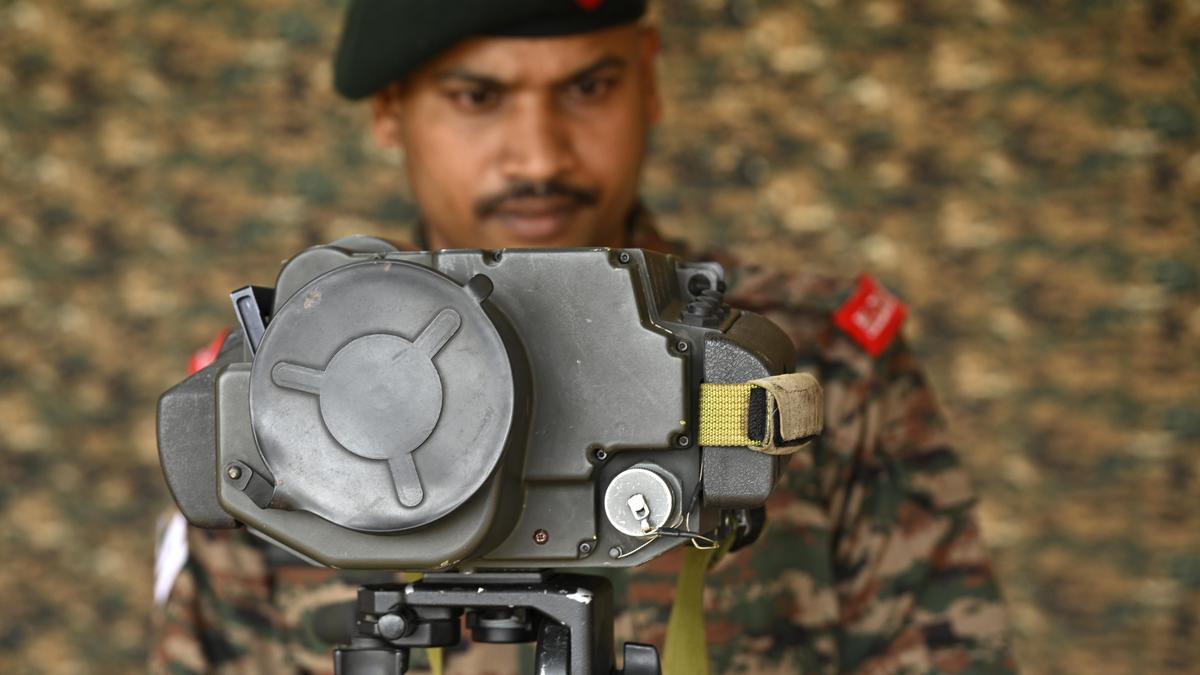
“For India, which faces persistent challenges along its borders and in the maritime domain, self-reliance in defence is not only desirable but also indispensable.” File
| Photo Credit: The Hindu
India’s aspiration to become a developed nation by 2047 rests not only on social and economic transformation but also on the strength of its strategic capabilities. Among these, the defence industrial base occupies a pivotal role. For far too long, the country’s defence manufacturing ecosystem has remained constrained by restrictive policies, resulting in limited private participation and excessive reliance on imports. Domestic private industries were not allowed in this sector but there were imports, without compunction, from private manufacturers from across the world. The result was a structural vulnerability that affected both economic potential and national security.
A shift after reforms
But there has been a significant shift in recent years. There has been an opening up to the private sector, liberalised foreign direct investment norms, corporatisation of the Ordnance Factory Board, and a progressive expansion of the list of arms and armaments to be procured under the ‘Make’ procedure apart from a pro-active promotion of innovation, which have all contributed to rapid progress. Defence production has increased and exports have grown exponentially, now reaching more than 80 countries.
These trends signal a maturing ecosystem that is increasingly capable of meeting domestic requirements while also contributing to global supply chains.
The evolving global security landscape, marked by conflicts in Europe, West Asia and Asia, has exposed the fragility of international peace and the risks of supply-chain disruptions. Nations with robust domestic defence industries have proved to be more resilient. For India, which faces persistent challenges along its borders and in the maritime domain, self-reliance in defence is not only desirable but also indispensable.
At the same time, shifting geopolitical dynamics are opening up new possibilities. Europe’s renewed emphasis on defence spending, the saturation of traditional suppliers, and growing demand for cost-effective and reliable platforms create opportunities that India is well-positioned to capture. The country’s strategic geography in the Indian Ocean Region and its expanding diplomatic profile further strengthen its potential to emerge as a credible supplier of defence equipment.
Simplify procedures
But realising this potential will require sustained focus on reforms. Regulatory complexities continue to hinder private-sector participation, especially for micro, small and medium enterprises and startups. Export licensing, joint ventures and technology-transfer approvals need to be speeded up. Long-term demand projections will give the private sector the confidence to make large investments. The pathway to achieving India’s stated ambition of ₹50,000 crore in defence exports by 2029 will require simplifying procedures and ensuring policy continuity.


The role of the Defence Research and Development Organisation (DRDO) also needs to evolve. The DRDO has been instrumental in building India’s strategic capabilities, but the next phase demands a sharper division of responsibilities. Frontier research must remain its core focus, while production, scaling and commercialisation should increasingly shift to industry, public and private. Such an approach aligns with global best practices and will strengthen competitiveness.
A dedicated, professionally staffed export facilitation agency would streamline outreach and provide a single-window interface for global partners. It will also help overcome the challenges arising from fragmented institutional arrangements across Ministries and the resultant coordination issues.
Key steps to take
Equally important is the need to overhaul financial, testing and certification frameworks. Indian manufacturers often face challenges in securing competitive credit lines, meeting excessively stringent domestic standards and conducting trials within reasonable timelines.
Establishing specialised export financing instruments, expanding integrated testing facilities and adopting international certification protocols can dramatically improve competitiveness. A more proactive use of lines of credit, government-to-government agreements, and long-term service commitments would further enhance India’s credibility in a market dominated by established players.
Defence exports are not merely a commercial undertaking. They signify technological maturity, strategic reliability and the emergence of a nation as a major actor in the international security architecture. Strengthening the defence industrial base is essential not only for reducing import dependency but, equally, for generating high-skilled employment, and enhancing geopolitical leverage.
The progress in recent years is encouraging. What is required now are consistent efforts to deepen reforms and build an ecosystem that encourages innovation and investments. India’s security and economic ambitions demand nothing less.
The pursuit of a strong defence industrial base is not just a strategic necessity. It is a defining step toward India’s emergence as a confident, capable and influential global power.
Rajiv Gauba is Member, NITI Aayog
Published – December 20, 2025 12:08 am IST