

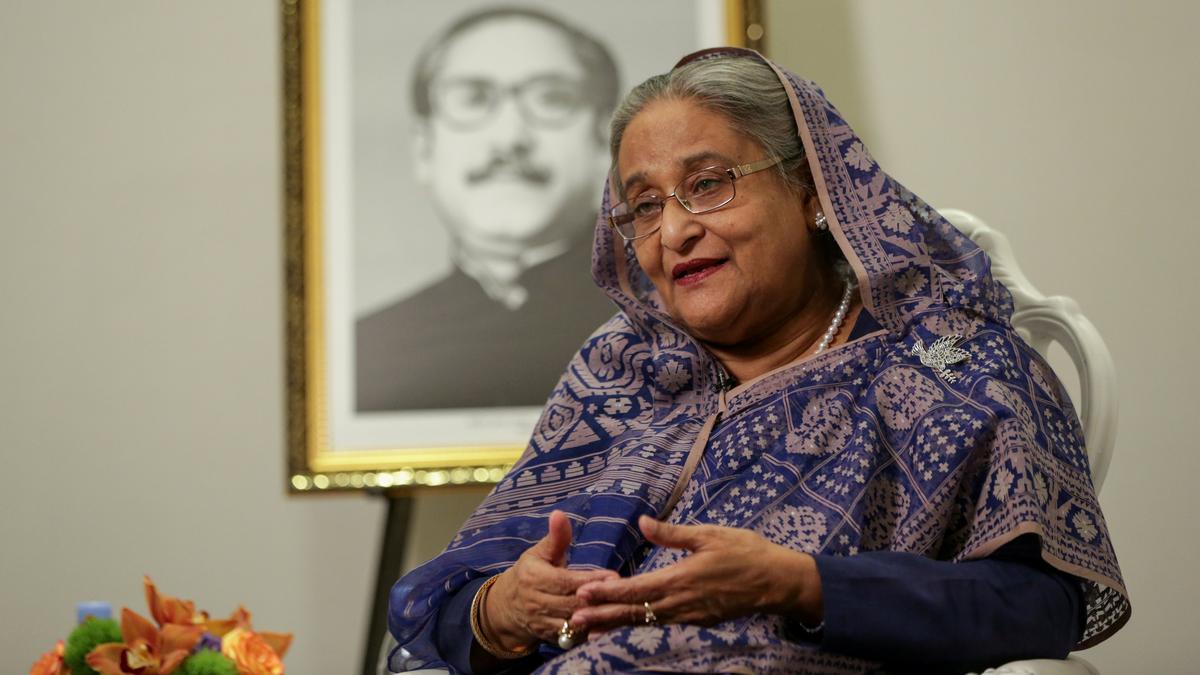
Months after ousted Bangladesh Prime Minister Sheikh Hasina fled to New Delhi seeking exile during anti-government protests in August 2024, Bangladesh, on December 23, 2024, formally asked India to extradite her for “judicial process”. Dhaka sent a note verbale to India’s External Affairs Ministry on the same day, with the Press Secretary to Bangladesh’s Chief Adviser saying, “We want our relations with India to be based on fairness, equality and dignity”, ahead of India’s Foreign Secretary’s visit to Bangladesh with the hope of rekindling constructive relations between the two countries.
Ms. Hasina was declared an absconder for not surrendering after leaving Dhaka on August 5, 2024. A first information report was filed on August 13, 2024 against her and other former associates. She has been charged with conspiracy to eliminate the students involved in protests, and the mistreatment and the killing of hundreds of the protesters, which are labelled as genocide and crimes against humanity. The state machinery is working to collect credible and probative facts for the prosecution to make a strong and winnable case against her. The Dhaka-based International Crimes Tribunal on October 17 issued arrest warrants for Ms. Hasina and 45 others including former Cabinet ministers, advisers and military and civil officials. On November 18, the Tribunal gave the investigation authority a month’s time, with the date of December 17, 2024 for them to wrap up the investigation. A charge sheet will be filed soon.
Trial in absentia
In common law jurisdictions, a trial cannot commence in absentia of an accused. To commence this trial, Ms. Hasina must be present before the court and participate either physically or virtually.
As an alternative to this, in some jurisdictions, a lawyer can be presumed to have constructive presence, but it is still contentious in common law jurisdictions. However, Section 339 B of the Code of Criminal Procedure 1898 of Bangladesh says that an accused person can be tried in their absence. Regarding a hearing in absence of an accused, the International Criminal Court (ICC) also has a recent precedent, when on October 29, 2024, its Pre-Trial Chamber III issued a decision to hold a confirmation of charges hearing for suspect Joseph Kony in his absence. Kony, suspected of 36 counts of war crimes and crimes against humanity in northern Uganda, was absconding for 19 years.
As a matter of fact, Bangladesh appears to be an apt place for trial, as alleged acts have been committed there along with the presence of evidence and victims. While Bangladesh has asked India to extradite Ms. Hasina via a diplomatic channel, the Indian government has not yet commented on this. Although there is an obligation on the state under customary international law under the aut dedere aut judicare principle to “either extradite or prosecute” any accused facing a grave international crime such as genocide, war crimes, crimes against humanity, enforced disappearance or torture, India is not obliged to extradite Ms. Hasina to Bangladesh.
India’s potential defences
India has neither aided, abetted, solicited nor is complicit in the alleged crimes of Ms. Hasina. In 2013, India concluded a bilateral extradition treaty with Bangladesh. It has the Indian Extradition Act 1962, which authoritatively provides a framework for the extradition of nationals and non-nationals. In this case, Bangladesh is the requesting state and India is the requested state. The requested state can take two defences, which bar the claim of Bangladesh to get an extradition. First, India can argue that Ms. Hasina has committed political offences, which are a legitimate ground to reject such a proposal. However, this argument does not look plausible. At least, prima facie there will be no takers to say that the acts of Ms. Hasina appear to be a political offence. Long before her ouster there were reports by Amnesty International, Human Rights Watch and many other organisations that her regime was involved in state-sponsored violence against the civilian population such as torture, enforced disappearance, persecution and other inhuman acts of high gravity. Therefore, at least, whether she has committed such crimes or not can only be decided by a fair trial.

Second, common law follows the rule of non-inquiry. It means that, traditionally, extradition is the executive’s discretion, and the person concerned cannot seek intervention of the municipal court. However, this practice does not have much support now. Nevertheless, Ms. Hasina, though not an Indian citizen, is still protected by Articles 20 and 21 of the Indian Constitution. In National Human Rights Commission vs State Of Arunachal Pradesh & Anr. (1996), the Supreme Court of India ruled that even a non-citizen is entitled to get protection of Article 21 as it uses the term ‘person’. Based on the current situation and the past record of Bangladesh on torture and prison conditions, the Court would have reasonable basis to protect Ms. Hasina and bar the Indian government from extraditing her to Bangladesh.
There is, however, a way ahead. The Indian government can allow an in-house arrest of Ms. Hasina in India in the same condition she is staying in and ensure that she participates in her trial through video conferencing with a lawyer of her choice physically present before a Bangladesh court. After this, India can assure Bangladesh that it will fully cooperate in the investigation and evidence gathering.
Bangladesh authorities must have access to Ms. Hasina with prior notice. In case the judgment is against her, then too, based on the sentencing agreement, she can undergo her sentencing in India. This measure shows bona fide intent on behalf of India and demonstrates compliance with Article 2(4) of the UN Charter, while safeguarding the risk to and the concerns of the accused.
Ms. Hasina is no longer in power and considering her old age and infirmity, any extraneous treatment is not justifiable for her well-being. She has the right to human rights. This can be achieved through reason and a far-sighted approach. Polemics and emotional arguments can have long-time and serious consequences for India-Bangladesh ties. Bangladesh must understand that Ms. Hasina’s trial is important and that she must not be available to face the brunt of vengeance. At the same time, India needs to make room for Bangladesh state agencies to operate and conduct her trial successfully. If this works out, it will show to the international community, a collaborative approach to fair trial as well.
ICC’s jurisdiction, alternative solution
Bangladesh is the 111th state party to the Rome Statute of the ICC. This could be a matter before the ICC, based on Articles 5, 11 and 12 of the Rome Statute, and for fulfilling the ICC’s criteria of jurisdictions, i.e., material, personal, territorial, and temporal, as follows: being a ‘crimes against humanity’, it passes the threshold of gravity (material); it is committed by a citizen of a state party (personal); committed in the territory of Bangladesh (territorial); and occurred after 2002 (temporal). The ICC is a court of last resort, and it must supplement, rather than supplant, national jurisdiction. Its jurisdiction is based on the principle of complementarity, as per Article 17. As Bangladesh has started this trial at the domestic level, the ICC has no reason to intervene.
However, Article 53 of the Rome Statute, when read with Article 17, shows that if an accused’s rights are in danger, and if proceedings are not conducted independently and impartially, and are conducted in a manner which, in the circumstances, is inconsistent with an intent to bring the person concerned to justice, then there is reasonable ground to believe that the interests of the accused are in grave danger. Ms. Hasina will not be able to get her rights of impartial and independent judicial authority under Article 14 of the International Covenant on Civil and Political Rights (ICCPR) read with Article 21(3) of the Rome Statute. In that case, the Office of the Prosecutor of the ICC (OTP), under Article 15, can start a preliminary examination. Therefore, as an alternative to the first suggestion, it can be possible that under Article 14 of the Rome Statute, Bangladesh can refer this matter to the ICC, or under Article 15 there can be a proprio motu preliminary examination by the OTP. Ms. Hasina can surrender to the ICC with an assurance that she must not be extradited to Bangladesh.
Aklavya Anand is an Assistant Professor at the Faculty of Law, University of Delhi. Shailesh Kumar is a Lecturer in Law at the Department of Law and Criminology, Royal Holloway, University of London, and a Commonwealth Scholar
Published – December 31, 2024 12:16 am IST

