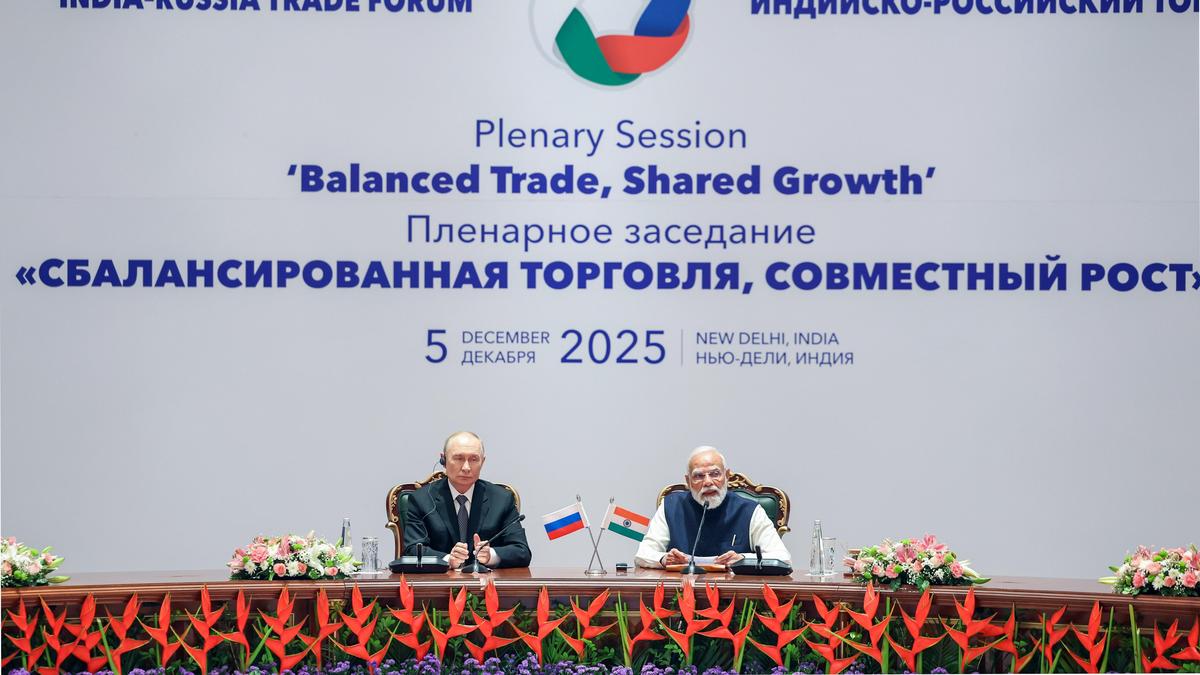
The 23rd India-Russia Summit, which was held in New Delhi last week, once again brought to the fore the treacherous geopolitical terrain that defines today’s world. The Ukraine war has pitted India’s most important partners against each other. Navigating this quagmire is no easy task, but India has led the way for the world.
The signal sent, the timing
The red carpet treatment given to Russian President Vladimir Putin on his first visit to India since the Ukraine war began, and his decision to bring a large high-powered Russian delegation, were significant. The delegation included Kirill Dmitriev, the face of peace efforts (who has been functioning along with special U.S. envoy Steve Witkoff, and the U.S. President Donald Trump’s son-in-law Jared Kushner). In diplomacy, optics matter. For India, it was meant to remove any ambiguity about the Russia relationship, thereby signalling confidence in dealing with the world. For Russia, it signalled the importance of India in its foreign policy priorities.
On matters of war and peace, timing is no less important. The India-Russia summit took place at a time when Russia’s stranglehold on the battlefield is very tight, Ukraine is staring at military defeat and the U.S. has, for all practical purposes, turned its back on Ukraine. Since the only peace effort in town is the one being driven by Mr. Trump, Mr. Modi’s unambiguous support to the peace efforts on Ukraine in general should rightly be read as being a full and strong endorsement of the Trump initiative, and should be welcomed by the U.S.
Editorial | Balancing, not swinging: on India-Russia ties, Indian diplomacy
India and the U.S. are on the same page here. If there is anyone who has a stake in the success of Mr. Trump’s efforts, it is India. The outlier at this point is Europe and India’s challenge will be to preserve the major gains with Europe.
The pillars of ties
On the bilateral front, the Summit’s adoption of a Programme for the Development of Strategic Areas of India-Russia Economic Cooperation till 2030 (Programme 2030) and the enabling decisions to strengthen arrangements for bilateral settlements and trade in national currencies are steps in the right direction. This together with removal of non-tariff barriers, diversification of the trade basket and investments in non-energy sectors can enable the achievement of the $100 billion trade target by 2030. Areas such as fertilizers, railways, pharmaceuticals, mineral resources and critical raw materials are essential for India’s growth needs, for which Russia’s huge untapped potential is an invaluable fit.
On the energy front, India is the second largest importer of fossil fuel globally. Assured and affordable availability of energy is quite simply a national security imperative. Russia’s resources dwarf the rest of the world. China understood this early on, and has worked, with single-minded purpose, to capture a large chunk of them. Today, companies in the United States are waiting in the wings to do so for energy and all critical minerals. If India does not play its cards right, it risks being pushed out from what is its natural preserve, and at great cost to its economic security. Therefore, the focus on energy cooperation is likely to be a foundational pillar of the relationship going forward.
Three new areas that are maturing well are maritime connectivity involving the Chennai-Vladivostok Maritime Corridor, the Northern Sea Route and, relatedly, the shipbuilding sector; second, cooperation in the Arctic, especially the Russian offer to train Indian seafarers; and third, and most importantly, the export of Indian skilled workers to Russia. The last agreement has come about after years of negotiation. The structural demographic crisis in Russia, including in its Far East, hastened by war losses, curtailment of workers from Central Asia and unease over a growing Chinese presence have contributed to making this agreement a reality. The agreement to ease tourist visas is another quick yielding and long overdue initiative.
Science and technology, and space, nuclear and defence cooperation are all areas of long-standing cooperation built over generations. Russia has been a generous partner in all these areas, with much less strings attached than the West. The Indo-Russian BrahMos has emerged as one of the mainstays of India’s missile force, while the S400 air defence system proved its indispensability during Operation Sindoor (May 2025). Due to persistent Indian efforts, levels of localisation, technology transfer and joint production have increased significantly. India still needs support to maintain its Russian origin military inventory even as it shifts to indigenisation. Future defence cooperation is likely to be concentrated on niche technologies and systems.
In perspective
The real story of the summit is the re-engineering of the relationship, the determination to move ahead despite many hurdles, and the eye being kept on the geopolitical shifts underway between the U.S. and China which draw India and Russia closer. As far as Europe is concerned, the road to peace does not lie through New Delhi. It lies in dialogue between Europe and Russia. India’s point is that history contains enough examples to emulate and mistakes to avoid. India believes it is, and can be a valuable partner and friend to both.
Pankaj Saran is Convenor, NatStrat, a former Deputy National Security Adviser and a former Ambassador to Russia
Published – December 09, 2025 12:08 am IST