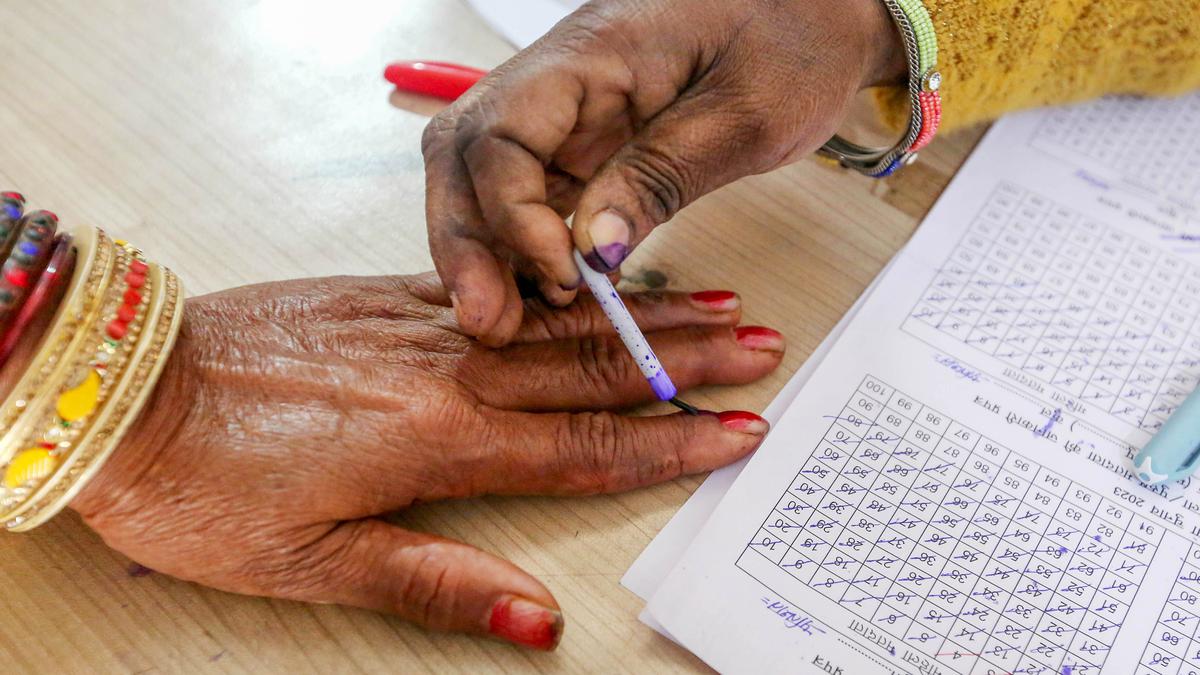
Image for representation only
| Photo Credit: ANI
Perched on her traditional charpai bed, Naeem Kausir says she would like to vote in Pakistan’s upcoming election — if only the men in her family would let her.
Like all the women in her town, the 60-year-old former headmistress and her seven daughters are forbidden from voting by their male elders.
“Whether by her husband, father, son or brother, a woman is forced. She lacks the autonomy to make decisions independently,” said Ms. Kausir. “These men lack the courage to grant women their rights,” the widow said.
Although voting is a constitutional right for all adults in Pakistan, some rural areas in the socially conservative country are still ruled by a patriarchal system of male village elders who wield significant influence in their communities.
‘Myriad reasons’
In the village of Dhurnal in Punjab men profess myriad reasons for the ban of more than 50 years.
“Several years ago, during a period of low literacy rates, a council chairman decreed that if men went out to vote, and women followed suit, who would manage the household and childcare responsibilities?” said Malik Muhammad, a member of the village council. “This disruption, just for one vote, was deemed unnecessary,” he concluded.
Muhammad Aslam, a shopkeeper, claims it is to protect women from “local hostilities” about politics, including a distant occasion that few seem to remember in the village when an argument broke out at a polling station.
Others said it was simply down to “tradition”.
The Election Commission of Pakistan (ECP) has stressed that it has the authority to declare the process null and void in any constituency where women are barred from participating. In reality, progress has been slow.
In the mountainous region of Kohistan in Khyber Pakhtunkhwa province, religious clerics last month decreed it un-Islamic for women to take part in electoral campaigns.
Fatima Tu Zara Butt, a legal expert and a women’s rights activist, said women are allowed to vote in Islam, but that religion is often exploited or misunderstood in Pakistan.
Pakistan famously elected the world’s first Muslim woman leader in 1988 — Benazir Bhutto, who introduced policies that boosted education and access to money for women, and fought against religious extremism after military dictator Zia ul-Haq had introduced a new era of Islamisation that rolled back women’s rights.
However, more than 30 years later, only 355 women are competing for national assembly seats in Thursday’s election, compared to 6,094 men, the ECP has said.
Pakistan reserves 60 of the 342 National Assembly seats for women and 10 for religious minorities in the Muslim-majority country, but political parties rarely allow women to contest outside of this quota.
Robina Kausir, a healthcare worker, said a growing number of women in Dhurnal want to exercise their right to vote but they fear backlash from the community if they do — particularly the looming threat of divorce, a matter of great shame in Pakistani culture.
Matter of fear
“These men instil fear in their women – many threaten their wives,” she said.
Ms. Robina, backed by her husband, is one of the few prepared to take the risk.