Several statues have, everywhere, been the sources of discontent. The world had witnessed that immediately after the dissolution of the Union of Soviet Socialist Republics (USSR) In 1991. Statues of heroes of the old regime were toppled in parts of the constituent-states of the erstwhile USSR. Likewise, those of former President Saddam Hussein were brought down in Iraq after the conquest by the U.S. and allied forces of the west Asian country in 2003 or those of Bangladesh’s first President Sheikh Mujibur Rahman or Syria’s former President Hafez al-Assad in 2024.
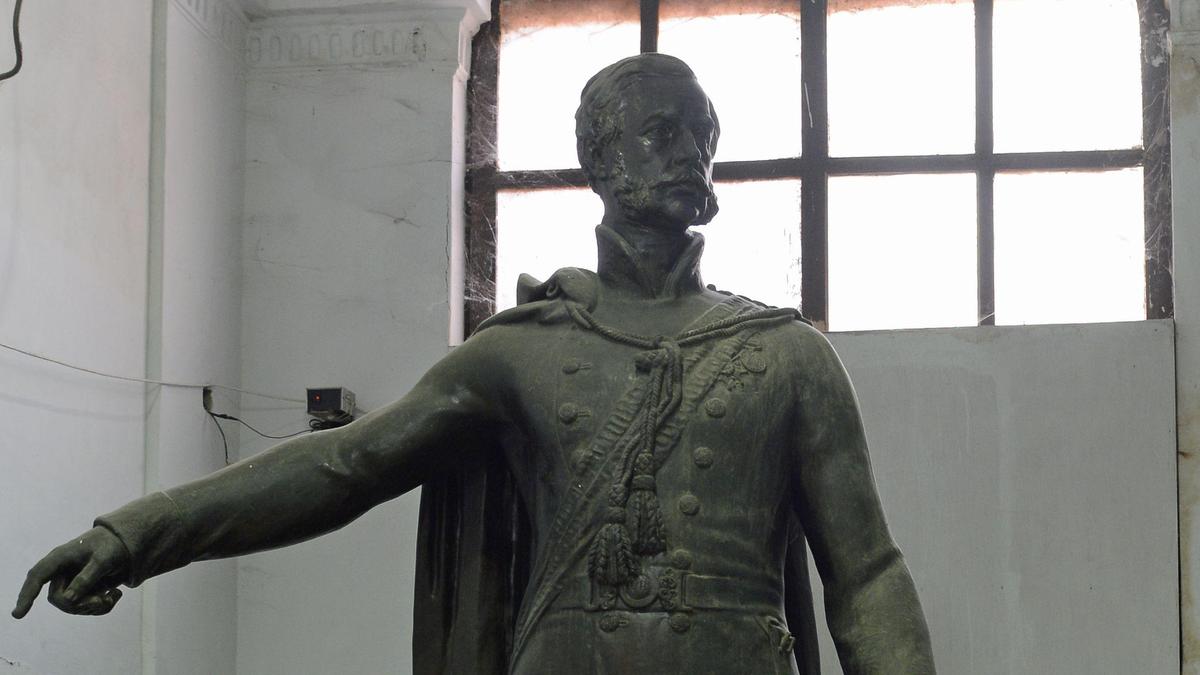
In India, around the time of Independence, a trend caught on among people who had advocated the removal of statues or memorials viewed by them as despicable remnants of the British past. However, what is not discussed much is that Madras (Chennai) witnessed, even about 100 years ago — that too, when the British Raj was thriving — an intense agitation to remove the statue of a British military officer, James George Smith Neil.
Located at what is now called the Spencer’s junction – the intersection of Mount Road (now Anna Salai) and Binny Road, the statue had served as an important landmark of Madras for over 75 years in the later part of the 19th Century CE and the early part of the 20th Century CE.
Who was James George Smith Neil?
During the Great Revolt of 1857, Neil, who was attached to the Madras Fusiliers, played a role in putting down the rebels brutally but died in service. However, for Indians, he was the “Butcher of Allahabad [now known as Praygraj].” As a mark of his memory, a bronze statue, made in Scotland, was installed in August 1861, the cost of which (₹18,953) was borne mostly by the British.
For 55-odd years, Madras city did not protest “Neil’s presence.” But, by the later part of 1920s, patriotic fervour was on a revival, after a spell of inertia. Yet, the nationalists were divided into two camps: the Congress, spearheaded by Mahatma Gandhi, and Swarajists had been adopting contradictory lines of thinking with the former boycotting legislature and the latter remaining members. Younger generations of people in India, like their counterparts in many other countries, were increasingly coming under the influence of Karl Marx. The demand for complete freedom from British rule was growing louder.
As its response to the formation of an all-white commission, led by John Simon, to propose constitutional changes in India and the constant refrain of the then Secretary of State for India Lord Birkenhead on Indians’ inability to formulate a concrete constitutional scheme, the Congress, at the Chennai session in December 1927, decided to draft a ‘Swaraj’ Constitution. The outcome of this move was the Nehru Report that was essentially authored by Motilal Nehru, after holding a series of meetings with other parties.
The beginning of opposition
It was against this backdrop that the agitation against the Neil statue commenced in August 1927. On the morning of August 10, 1927, two youths from Madurai — Mohammed Saliah and Subbarayulu Naidu — clad in khadi and wearing Gandhi caps, came across, at the Spencer junction, Neil’s statue that had a hanging sword. Both were members of the Tamil Nadu Volunteer Corps. As they were “reminded” of the action of Neil [in 1857], stated a report of The Hindu next day, the two, armed with an axe, a chisel and a ladder, were “determined to cut off the sword and deface the statue.”
A few days later, in Madurai, the Corps held a meeting under the chairmanship of Srinivasavarada Iyengar and “a large gathering” had assembled, this newspaper reported on August 16, 1927. Iyengar sought support and sympathy of people to the “movement of Satyagraha,” which the volunteers hoped to start shortly. Gradually, the issue started acquiring steam.
At the Madras Corporation Council’s meeting on August 17, M. Singaravelu Chettiar, who belonged to the fishing community, wanted to raise the matter but he was disallowed. Chettiar came to be famously known as “first Communist in south India” for having chaired the first conference of Communists in Kanpur in 1925. When two members of the Satyagraha committee, Angachi Ammal and Lokaiah Naidu, were arrested for their agitation, it was Chettiar who, on his own, appeared on behalf of them in a court and defended them, according to a biography authored by K. Murugesan and C. S. Subramanyam on Chettiar.
Gandhi’s opinion
Meanwhile, 20 representatives of the Satyagraha panel met twice with Mahatma Gandhi, who was in Chennai in September 1927, and sought his support. On September 10, The Hindu published an exhaustive report with the observation, “with the approval of Mahatma Gandhi.” The members had a free-flowing discussion and Gandhi conveyed to them bluntly not to expect public associations including the Congress, to guide them. He explained to them why the organisation would not be able to support them.
Calling the agitation “sectional,” which, he clarified, that he did not mean communal, Gandhi, however, said “If the Congress is called up to help such movements, it will cut a sorry figure. The Congress has a status and a reputation to lose. Therefore, it is much better for you, young men, not to expect the Congress or other public bodies to immediately shoulder your movement.” At the same time, he told the youth that he would support them “so long as I find you on the straight road.”

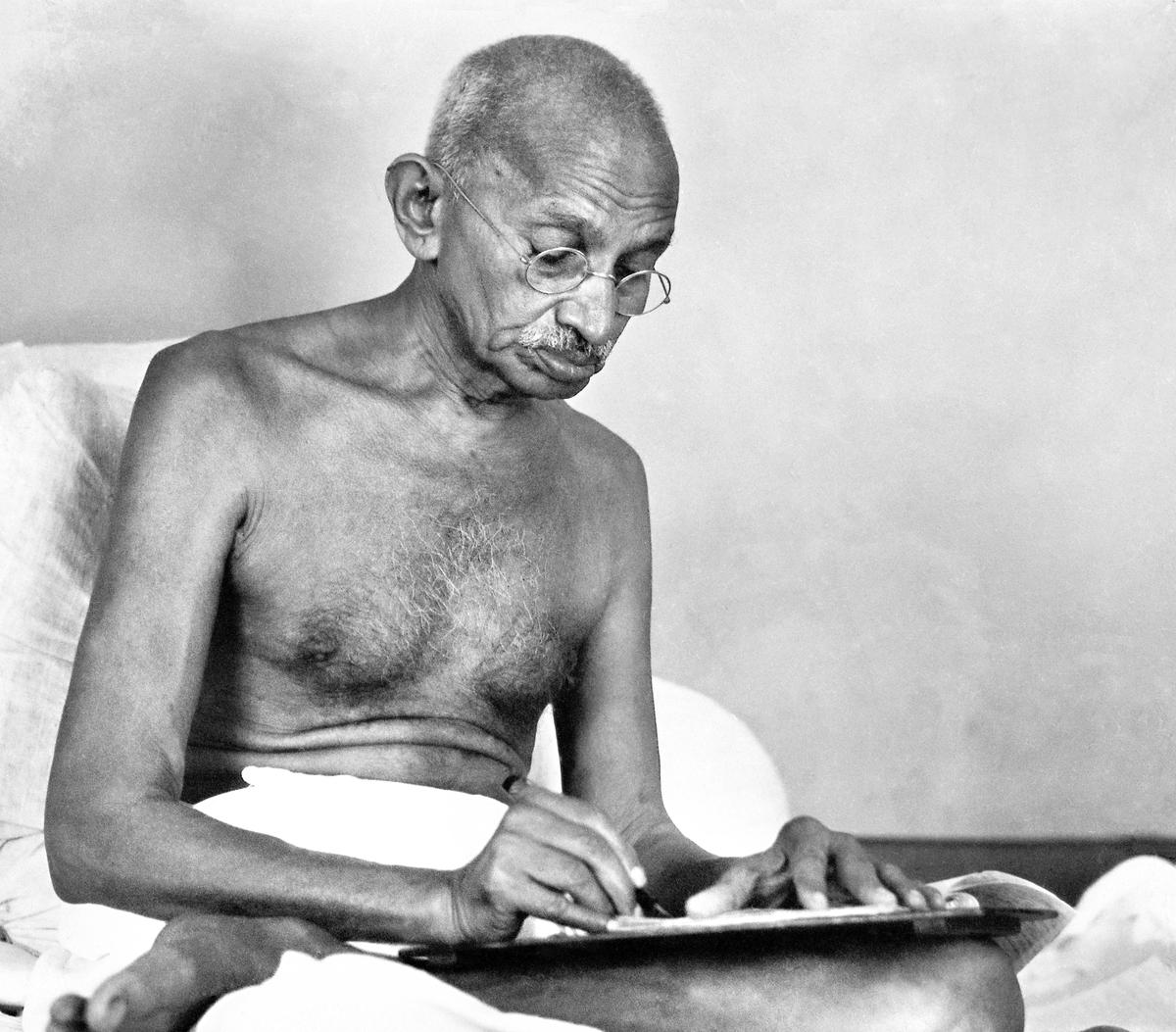
Mahatma Gandhi. File
| Photo Credit:
Getty Images
In the fourth week of the month, Chettiar had again raised the issue of the statue removal at the Madras Corporation Council’s meeting and wanted the local body to adopt a resolution, which was “merely a request to the government to remove the statue from the place,” said The Hindu on September 24, 1927.
Chettiar told the Council the issue was “drawing the attention of the whole of India and it was tending to create a great crisis” in the city. This time too, G. Narayanaswami Chetti, who was the president of the Corporation [which was how the post of Mayor was called then], did not permit the motion to be brought in. One of the points raised in the public discourse was that the statue was a “stumbling block” to traffic.
In November that year, when the Legislative Council saw a motion on the same matter getting defeated, Gandhi observed that “the innocent resolution asking for the removal of the offending statue was lost by an overwhelming majority.” Pointing out that almost all the Indian members, “except the stalwarts,” went against the resolution, he stated that “this vote and the debate are a fresh demonstration of the fact that Swaraj is delayed not so much by the obstinacy of the English rulers as by our own refusal to recognise and work for our status,” said The Hindu on November 7, 1927.
Police protection
As the years went by, the statue issue did not disappear. Whenever protests were organised publicly against the statue, the authorities had posted police to guard it. The Madras Corporation, in May 1937, conveyed to the British government about the shifting of the statue from Mount Road. This was revealed by Mayor K. Sriramulu Naidu at a meeting of the Council on July 6, 1937 in response to a query by veteran Congress leader and a Councillor, S. Satyamurti.
The removal
On July 14, the Congress regime, headed by C. Rajagopalachari (Rajaji or CR), assumed charge. Four months later came the official announcement that “in deference to public sentiment as expressed from time to time,” the removal of Neil’s statue had been ordered from the present site and the statue would be preserved at the Government Museum [in Egmore], reported The Hindu on November 15, 1937.

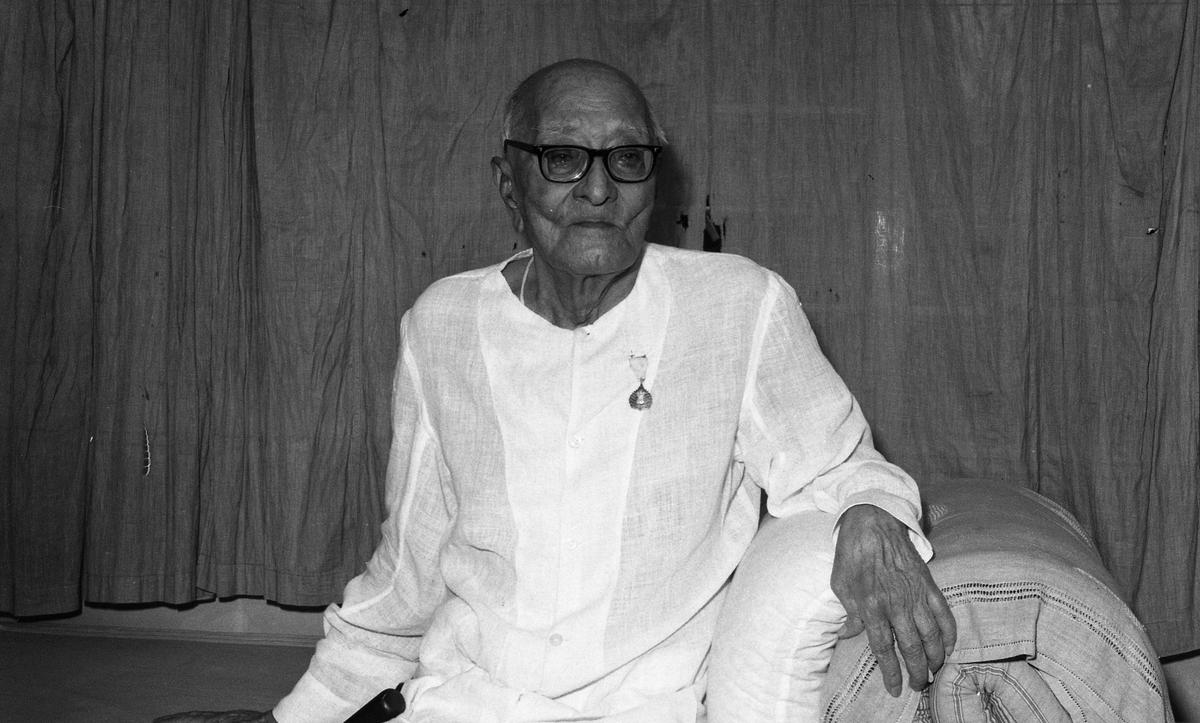
C. Rajagopalachari. File
| Photo Credit:
The Hindu Archives
On the night of November 21, the statue removal was effected by a number of workmen under the supervision of an officer of the Public Works Department. The entire operation took nearly five hours to complete. The statue was placed on a four-wheeled cart and taken to the Museum, which was reached by 3 a.m,” stated this newspaper on November 22, 1937.
Matter reaches British Parliament
The statue removal came up for discussion even in the British Parliament and there were suggestions from citizens of the western country that the statue be sent to London. Reacting to the development, Rajaji, during his visit to Visakhapatnam on December 3, explained to journalists why his government had wanted to retain the statue, not necessarily for public display.
He explained that there was “no contradiction” in the attitude of his government when they did not want it as “a continuing course of irritation but claim to hold it and intend to preserve it with care.” He added that “the statue which belonged to us should be preserved at Madras. We had become, even more than ever before, responsible for its keeping and cannot agree to the statue being sent away anywhere because it would then become a permanent focus of misrepresentation of our attitude in the matter.”
Where is the statue now?
Ten days later, the government had announced that the statue would be kept in the verandah adjoining the Arms gallery of the Museum. A report, published by this newspaper on November 24 in 1940, stated the statue “stands in the archaeological section of the Museum, between the Connemara Library and the Museum Theatre.”
The statue, which had once aroused strong public feelings, has been remaining a “constant occupant” of a small space in the Museum for nearly 90 years.