

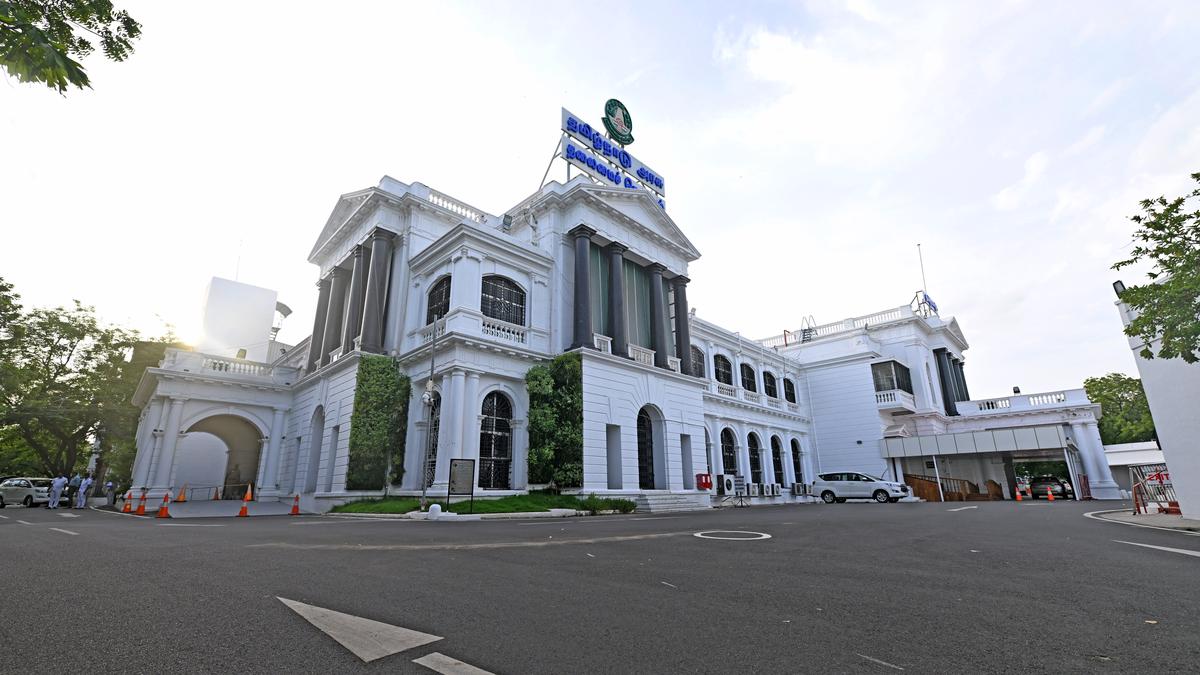
Fort St. George, Chennai
| Photo Credit: The Hindu
The Government of Tamil Nadu recently hosted the Sixteenth Finance Commission, which was chaired by Arvind Panagariya. With its distinguished experts from various fields, the Commission is uniquely positioned to address the critical fiscal challenges facing India and rectifying the skewness in the relationship between the States and the Union.
Opportunities from global changes
The decisions taken by this Finance Commission will not only shape the fiscal fate of the nation for the next five years but will also influence India’s economic trajectory in the decades to come. The Sixteenth Finance Commission’s work coincides with significant shifts in global economic trends. Concepts such as “friendshoring” and “reshoring” are reshaping international trade and investment patterns. These trends present a unique opportunity for India and Tamil Nadu. To seize these opportunities, the critical challenge for the Finance Commission lies in striking a balance between equitable redistribution and incentivising growth in high-performing States such as Tamil Nadu.
Since 1951, when the first Finance Commission was formed, each Finance Commission has adapted its own approach towards the fiscal challenges of its time. Every Commission has sought to achieve an equitable redistribution of resources by increasing the share of States under vertical devolution and channelling funds to less-developed States through horizontal devolution.
But there have been clear gaps between their declared objectives and outcomes; therein lies our case for a new and fair system of distribution of resources. For instance, while the Fifteenth Finance Commission awarded the vertical share of the divisible pool to the States as 41%, the effective devolution to States in the first four years of the award period amounted to only 33.16% of the Union’s gross tax revenue. The unprecedented levying of cess and surcharges by the Union is the fundamental reason for this effective decline in devolution.
Hike States’ share, incentivise performers
The States, which are near to people, bear substantial developmental expenditures, and, hence, their share should be further increased substantially. The financial strain on the States has been particularly severe due to increases in counterpart funding for centrally sponsored schemes on the one side and inadequate devolution on the other side. Hence, a fair and equitable share for States would be 50% devolution of the gross central taxes, allowing States greater fiscal autonomy in funding and implementing locally relevant schemes.
On horizontal devolution, it is evident that the redistribution policy followed for the first four and a half decades in our country has yielded limited results in driving real growth. Hence, the fundamental question would be this: should the focus be on a smaller national pie with a larger share for less-developed States or a larger national pie with equitable distribution that provides greater absolute resources for all? The answer is difficult, yet a more balanced approach would ensure a larger national economic pie, allowing for reasonable shares for less-developed States and adequate resources for progressive States to continue their upward trajectory. This would clearly necessitate a progressive resource allocation methodology for the performing States so as to allow them to fulfil their potential to be India’s growth engines.
Unique challenges in progressive States
Amidst this, it is also important to note that progressive States such as Tamil Nadu also face unique challenges in demography and urbanisation. With a median age higher than the national average, the State’s capacity to generate consumption-based tax revenue is declining, even as the costs of supporting an aging population are rising. It is imperative to ensure that such States do not fall into the “middle-income trap”, where growth stagnates and they “grow old before becoming rich”. Next, the challenges due to urbanisation in fast-growing States merit adequate addressal. A State like Tamil Nadu is witnessing the fastest rate of urbanisation in the country, due to which it will have a 57.30% urban population in 2031, against the expected national average of 37.90%. The resources for fulfilling the infrastructure needs of urbanisation should be earmarked to ensure the long-term sustainability of our growth.
We should keep in mind that the mandate of the Commission goes beyond fiscal arithmetic. It is about envisioning a future where every State contributes to and benefits from the nation’s progress. Whether it is fostering manufacturing, addressing urbanisation challenges, or ensuring climate resilience, the Commission’s decisions will impact millions of lives and determine the trajectory of the country’s destiny, to take its place among the world’s leading economies.
M.K. Stalin is the President of the Dravida Munnetra Kazhagam (DMK) and the Chief Minister of Tamil Nadu
Published – December 06, 2024 12:16 am IST

