

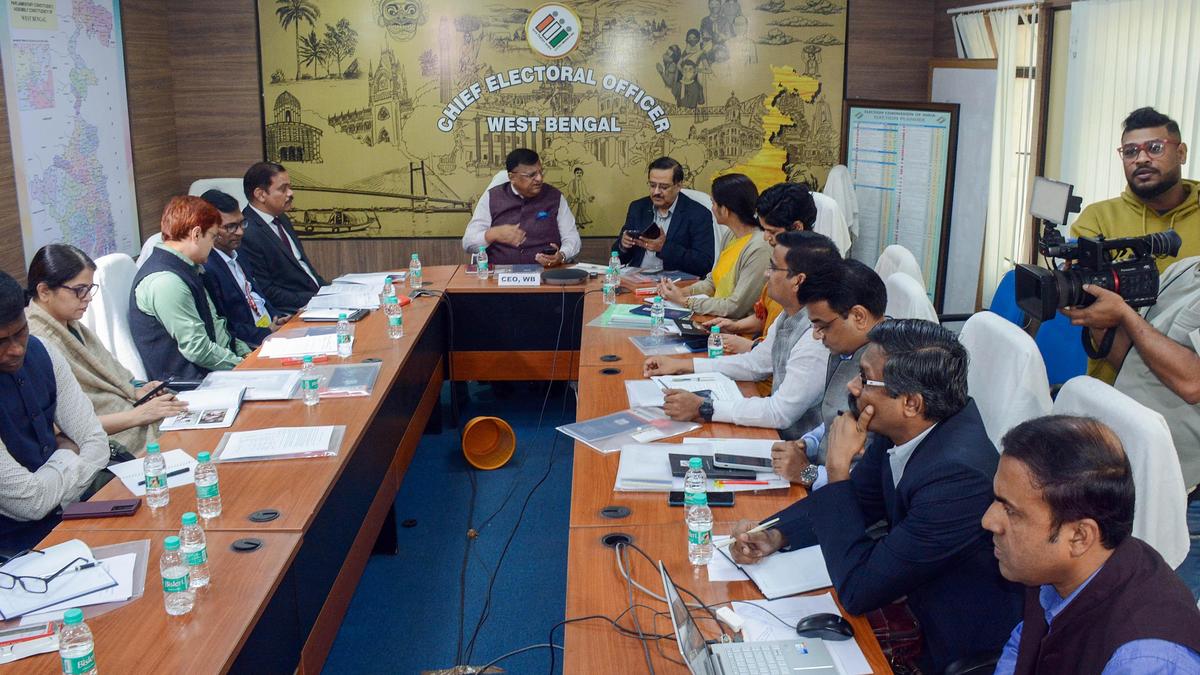
West Bengal Chief Electoral Officer Manoj Agarwal, Special Roll Observer Subrata Gupta, and others hold a meeting on Special Intensive Revision at the CEO office in Kolkata on December 10, 2025.
| Photo Credit: ANI
The second phase of the Special Intensive Revision (SIR) exercise conducted by the Election Commission of India (ECI) is ongoing in 12 States and Union Territories. The exercise will cover nearly 51 crore voters.
Section 19 of the Representation of the People Act, 1950, says that any person who is “ordinarily resident in a constituency” can be enrolled in the electoral rolls. In 1999, the Gauhati High Court provided an expansive interpretation of “ordinarily [a] resident” as anybody who is ““a habitual resident of that place” and that “he must have the intention to dwell permanently”. It added that an ordinary resident would be such that any “reasonable man will accept him as the resident of that state.” And so, exercising constitutional morality, the ECI and the judiciary have operated on the premise of presumed citizenship. Any resident adult was by default considered to be a valid voter.
The current SIR makes a U-turn from such a default conceptualisation of citizenship. Regardless of having voted in earlier elections, every elector now has to match their names and documents with the electoral rolls of 2002-2005. Such an inversion of responsibility by shifting the onus of compliance from the state to the people risks disenfranchising many; women, migrants, and the homeless are likely to be most hit.
Technocratic playbook
Such an architecture appears to have strong resemblances with the technocratic play book of the Union government in welfare delivery that has led to large-scale exclusions. The formula is straightforward: shift the responsibility of inclusion from the state to the people, give strict targets to officials with haphazard protocols, discipline officials to achieve 100% coverage in a short time, give an ultimatum to people to comply or strip away their rights, and then show efficiency gains claiming de-duplication by deleting people. This is how it has played out in MGNREGA and many other welfare programmes.
Every rural household is by default entitled to MGNREGA work. Prior to 2022, MGNREGA workers were paid using an account-based system in which errors, if any, could be rectified locally by the computer operator at the block office. In 2022, the Union government mandated the use of the Aadhaar-based payment system (ABPS) in MGNREGA which meant that workers had to link their MGNREGA job cards with their Aadhaar. Without this, their right to work would cease. Procedures on dealing with mismatches across workers’ two documents were unclear. Some officials got overburdened with the quantum of work while some others transferred the responsibility of fixing document errors to workers. While many workers were unaware of how to do this, several others were not in their village to complete this within the stipulated period. To hastily achieve 100% Aadhaar linking targets set by the Union government, many officials then began deleting workers from the MGNREGA database. In an ongoing research paper, based on a random sample of 2.98 lakh of worker deletions between 2022 and 2024, we find that since ABPS became mandatory, an estimated two-thirds of all those deleted in India were deleted on grounds of being “unwilling to work”. This is a legal violation, as per the Act.
The logic in SIR goes beyond this. The 2002-2005 rolls are not machine readable and even a minor mismatch between present details and the earlier electoral rolls can lead to notices and potential deletion. In 2021, the Union government introduced the National Mobile Monitoring System (NMMS) app to digitally record attendance of workers. On the one hand, this denied attendance to many workers and on the other, it aided in newer forms of corruption. The Ministry of Rural Development has itself flagged that the NMMS is being “misused or manipulated” in several instances. Workers protested to have the app scrapped; the government instead introduced an additional digital layer of pushing workers to do an e-KYC. With stringent targets and timelines, frontline officials had limited scope to address migration-related absences and recurring app or documentation glitches. Consequently, nearly 27 lakh deletions in just one month became the administrative route to close pending records.
Constitutional morality
What is eerily similar in the technocratic adventures in MGNREGA and the SIR is the structural codification of exclusions. Even well-meaning officials are pressured to focus on dashboards and targets. Unable to cope with pressures, some have reportedly taken their own lives. And, among others, since field officials are judged based on targets such as completion rates, exclusions become a quick way to show progress. By the time the harmful consequences are known, it becomes a fait accompli. For example, it took more than a year for the Union government to issue a standard operating procedure on worker deletions, much after the rights of millions got deleted. Also, grievance channels are inaccessible for vulnerable groups, because they require procedural agency that is rarely available.
Dr. B.R. Ambedkar stressed on the need for constitutional morality. An interpretation of this is that institutions must embody fraternity, which implies that inclusion must be the norm and exclusion the exception. But by inverting the citizen-state relationship and putting the onus of onerous documentation on people, the ECI is compromising on constitutional morality. In turn, the polity risks the annihilation of their rights. It is still not late. As suggested by experts, social audits can be an alternative to the SIR.
Chakradhar Buddha, works with LibTech India, a centre within CORD; Rajendran Narayanan teaches in Azim Premji University, Bangalore and is affiliated with LibTech India. Views are personal
Published – December 11, 2025 01:58 am IST

