

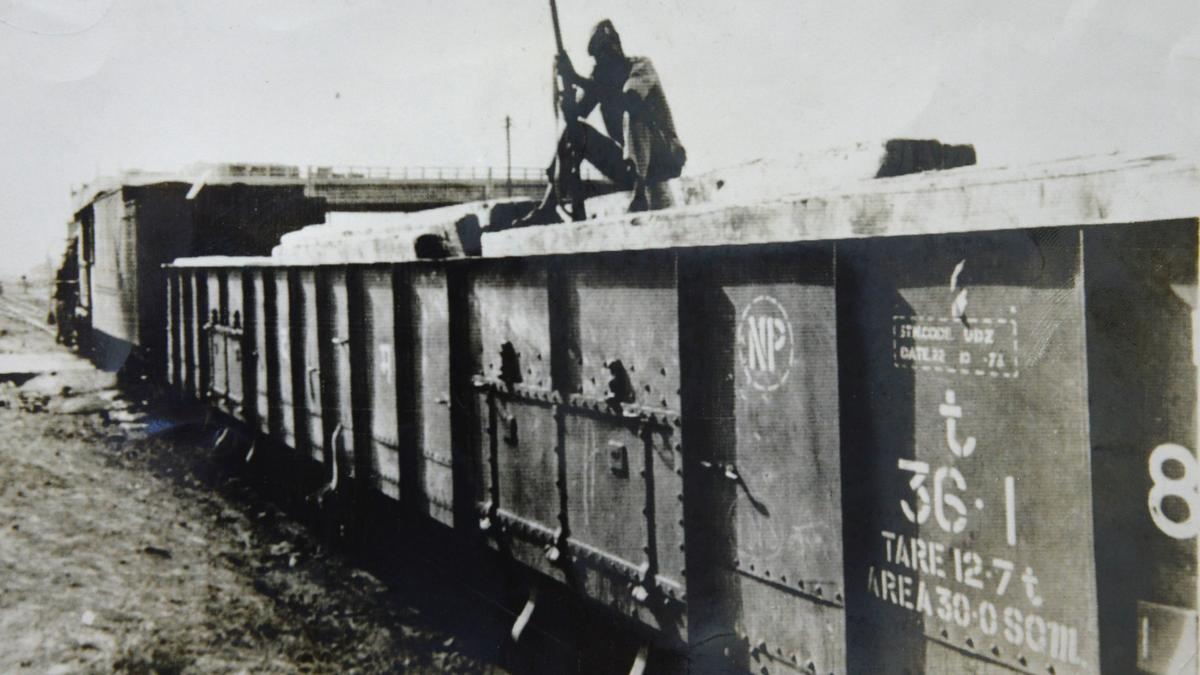
The third day of the national railway strike in 1974
| Photo Credit: THE HINDU ARCHIVES
The year 2024 marks the 50th anniversary of the railway workers’ general strike, a monumental event in the history of organised labour in India. This general strike, a remarkable display of working-class unity, was unparalleled in its geographical spread and public involvement. Faced with gruelling work conditions, diminishing wages and bonuses, and soaring prices of essential goods and oil, exacerbated by a meagre wage hike proposed by the Third Pay Commission, the railway workers decided to go on a general strike on May 8. The strike, however, began unexpectedly when more than a million railway workers deserted their posts across India following the arrest of George Fernandes, president of the All India Railwaymen’s Federation, at Lucknow on May 1. The station masters of Victoria Terminus sealed its gates in the early hours of May 2, thereby challenging the ruling government and asserting their authority over a symbolic and physical unifier of the nation.
Bringing life to a standstill
Despite the initial lack of coordination, the strike swiftly brought normal life to a standstill in all the major cities. It halted the railway system, disrupting train movement across the country. There was not a single major railway centre that was not shut down or severely affected. The strike was all-encompassing in the metropolitan centres, and along with the long-distance passenger trains, the suburban services were also immobilised. In Bombay, a general strike was called in solidarity, bringing the city to a grinding halt. All the major railway towns with a substantial population of railway workers, such as Jamalpur, Perambur, Mughalsarai, and Kharagpur, emerged as the strongholds of the strike. Despite the Railway Board and the government’s assertions, the railway system was thrown into disarray for over three weeks. One of the striking features of the general strike was the pivotal role played by the railway workers’ families, especially women. In Delhi, they went around railway residential colonies, painting the faces of strikebreakers with vermilion and forcing them to put on bangles. They demonstrated outside local police stations and gheraoed them against the arrest of railway workers and blocked tracks to prevent train services.
The railway workers’ tenacity to continue with the strike was met by unprecedented violence by the incumbent government. Besides declaring the strike illegal under the Defence of India rules, the government mobilised police and paramilitary forces to maintain train services, arrest union leaders, and intimidate workers. At most stations, the security forces outnumbered passengers and striking workers. As many as 50,000 railway workers were arrested during the strike; 10,000 were put behind bars within the first 24 hours. More than 30,000 families were evicted from the railway colonies. Railway colonies of Mughalsarai, Jamalpur, Jhansi and other important towns emerged as the centre of this brutal repression. Police and paramilitary forces frequently raided and ransacked homes, threatened eviction, and harassed workers and their families to coerce them to resume work. These military-style operations, which confronted the workers and their families as enemies rather than protesting citizens, marked a new authoritarian turn by the government, which culminated in the Emergency of 1975. Although the strike mobilised the workers, under the weight of unparalleled state repression and financial hardship, the strikers had to capitulate, and the general strike was formally called off on May 27.
A dress rehearsal
In retrospect, the response to the strike has often been seen as a dress rehearsal for the Emergency declared the following year. While the political implications of the strike must be acknowledged, considering it merely as a political campaign used by the opposition to discredit the government would be a gross simplification of the workers’ motivation and collective will to carry out the campaign. The strike grew out of the railway workers’ bid to address their two-decade-long grievances, which were neglected by the government and the industrial relation machinery of grievance redressal through collective actions. The general strike was a unique event, not just because it challenged the government’s ability to govern; its significance further lay in the rank-and-file militancy it inspired and the wider solidarity it weaved among the railway workers, who were divided into innumerable categories and fragmented labour regimes. The impetus for the general strike came from these independent unions, not recognised ones. One of the lasting legacies of the strike was the workers’ assertiveness in exercising power in their own organisations for the redressal of their grievances, thus turning the union into a site of struggle as much as an instrument of struggle.
While the strike was withdrawn unconditionally, it would be a mistake to call it a complete defeat. Once the Janata government came to power, a substantial number of casual and regular employees dismissed during the strike were reinstated. Railway workers ensured that the government accepted their demand for a bonus. Today, railway workers face similar precarity due to the pension scheme’s scrapping, Railways’ privatisation, increasing work casualisation, and the adverse recommendation of the Seventh Pay Commission. Various trade unions and federations of Indian Railways have again come together to resist these assaults. In the context of these renewed attacks on labour, the strike of 1974 remains relevant as a struggle.
Robert Rahman Raman is a labour historian with a PhD from CeMIS, University of Goettingen. Views expressed are personal.

