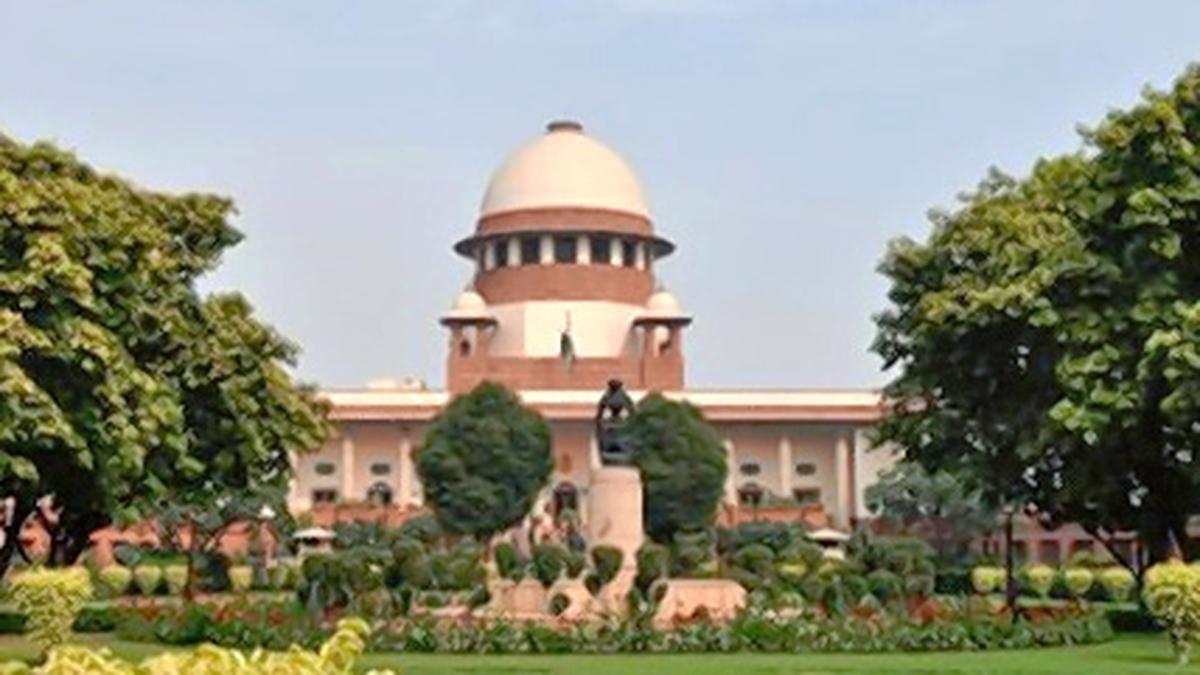
A view of the Supreme Court of India in New Delhi.
| Photo Credit: Sushil Kumar Verma
The observations in public fora and within the legal fraternity about the propriety of Prime Minister Narendra Modi’s videographed visit to the residence of Chief Justice of India D.Y. Chandrachud to participate in Ganapati puja are grounded in a 16-point document on judicial values adopted in a Full Court Meeting of the Supreme Court on May 7, 1997.
The document called the ‘Restatement of Values of Judicial Life’ was an illustrative, and not exhaustive, guide of what was expected of Supreme Court and High Court judges.
“The behaviour and conduct of members of the higher judiciary must reaffirm the people’s faith in the impartiality of the judiciary. Accordingly, any act of a judge of the Supreme Court or a High Court, whether in official or personal capacity, which erodes the credibility of this perception has to be avoided,” the very first tenet of the document had advised.
It recommended a judge to practice “a degree of aloofness consistent with the dignity of his office”.
“Every judge must at all times be conscious that he is under the public gaze and there should be no act or omission by him which is unbecoming of the high office he occupies and the public esteem in which that office is held,” the document cautioned.
The document was based on the principle that people should be assured that justice is done and seen to be done.
The Campaign for Judicial Accountability and Reforms, of which noted advocate Prashant Bhushan is an office-bearer, said the established practices of judicial conduct place an emphasis on maintaining public confidence through probity in the interaction between high constitutional functionaries.
“As then CJI M.N. Venkatachaliah put it to then Prime Minister Narasimha Rao, the relationship between the judiciary and executive has to be correct, not cordial, and cordiality between court and government has no place in our constitutional scheme of checks and balances. The judiciary, which holds the responsibility of safeguarding the Constitution and ensuring justice without fear or favour, must be seen as entirely independent from the Executive branch,” the statement said.
‘Man of great integrity’
Senior advocate Kapil Sibal, who is also the Supreme Court Bar Association president, said the Chief Justice of India was a man of great integrity.
“The issue is not the individual; the issue is what such a video clip has on the minds of the people… If there is gossip around it, it is not fair on the institution. You should not lend yourself to a situation, to be in a situation where people can gossip about the institution and start speculating. My religion and my way of expressing in the context of my beliefs is a private matter, not a public matter,” Mr. Sibal told the media.
Senior advocate Indira Jaising, in a post on social media platform ‘X’, said “Chief Justice of India has compromised the separation of powers between the Executive and Judiciary. Lost all confidence in the independence of the CJI. The SCBA must condemn this publicly displayed compromise of independence of the CJI from the Executive”.
Senior advocate Manan Kumar Mishra, Bar Council of India chairperson, however downplayed the furore while speaking to the news agency, ANI. He said this was merely a social, religious function and would not affect any Supreme Court judgments. The Prime Minister had just gone to the Chief Justice’s residence, offered prayer and returned. “If there had to be some different kind of meeting, it would have been done confidentially. They would have talked on FaceTime or WhatsApp,” Mr. Mishra explained.
Published – September 12, 2024 09:22 pm IST