Steffan MessengerWales environment correspondent

Wales’ controversial post-Brexit subsidy scheme for farmers has come in, almost a decade after the vote to leave the EU.
It will provide payments with a greener focus and see farms agree to a checklist of requirements.
Farms have to actively manage at least 10% of their land as habitat to join, and while some have land that qualifies, many dairy farmers say they don’t.
Farming union NFU Cymru warned the protest-hit scheme still needed work, but after an “enormous rollercoaster” ride it was now “acceptable to the industry”.




Rural affairs secretary Huw Irranca-Davies called it “a landmark moment for Wales” and said an early test would be how many farmers sign up.
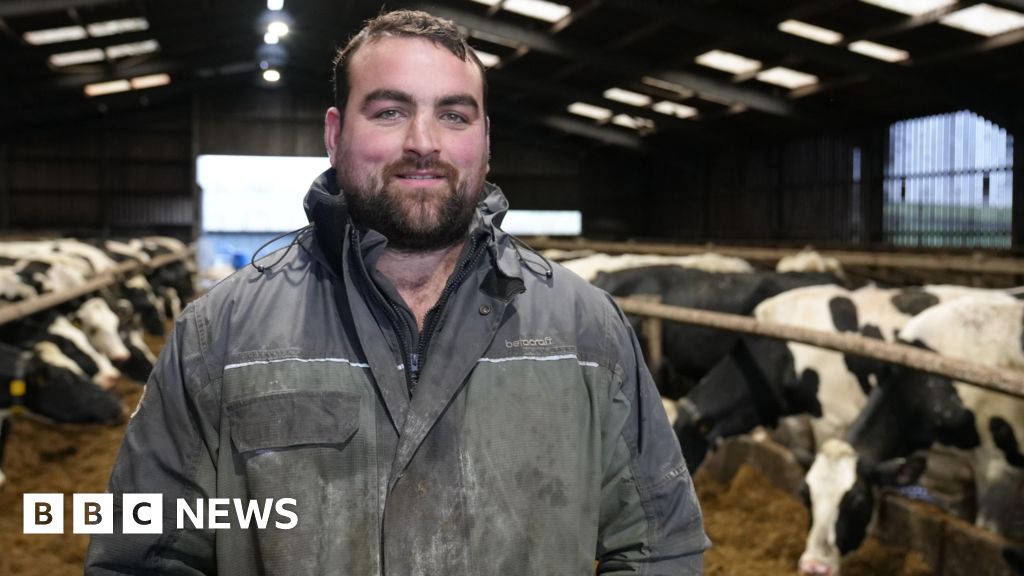
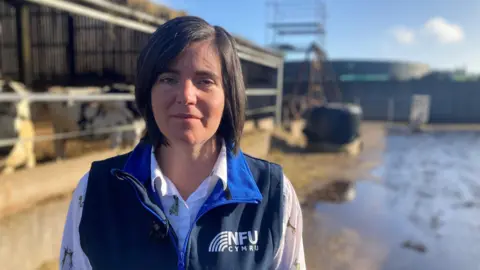
New Year 2026 is “really significant” for Welsh agriculture, said Abi Reader, NFU Cymru’s deputy president, who owns a dairy farm in Wenvoe, Vale of Glamorgan.
“This is a once in a generation change to farm support payments and there’s a lot of expectation riding on this,” she said.
For decades farms had received more than £300m a year in EU subsidies, shared out largely based on how much land they had.
Getting a replacement plan in place after Brexit – known as the Sustainable Farming Scheme (SFS) – had been “an absolutely enormous rollercoaster”, Ms Reader said.
Unions had branded earlier versions of the government’s plans as “unworkable” and they contributed to a wave of protests in 2024, including the largest ever seen outside the Senedd.
After further negotiations, final details were unveiled this summer.
Farms joining the SFS will have to commit to 12 so-called universal actions in exchange for their entry-level payment.
These range from maintaining hedgerows and reducing pesticide use to attending online courses on sustainable farming practices.
Additional funding would be available for more ambitious environmental work and farms working together.
“I think we’re largely pleased with the framework now, but there are still a number of tweaks [to be made] and we still need a budget that will reflect inflation and really deliver for farms and for the countryside,” Ms Reader said.
Farmers now have to prepare to apply for the new scheme by 15 May.
Alternatively they could stick to their old subsidies as they are phased out, but see a 40% cut to their payments this year.
Dairy farmer Gethin Hughes, of Ffostrasol in Ceredigion said he had decided to join the SFS.
The payments would help provide “a little bit of security” in the face of volatile milk prices, he explained.
Though the scheme was now “much better” than it had been, it continued to divide opinion, he said.
Farms have to actively manage at least 10% of their land as habitat to join and Mr Hughes said he was fortunate to have some land available that would qualify.
But “a lot of my friends who are dairy farmers are saying they can’t join as they don’t have the habitat land”, he said.
“They’ll have to cut back on cows and there’s no point them carrying on farming then.”
Environmentalists say habitat land can still be grazed and used productively, and having more of it helps make farms more resilient to extreme weather.
They worry the SFS may ultimately end up not being ambitious enough.
The entry-level payment would only help farmers “maintain” the habitats and wildlife they already have, according to Arfon Williams, of RSPB Cymru.
The big environmental benefits would come from additional funding pots – known as the scheme’s optional and collaborative layers, he argued.
“We need to develop those upper layers of the scheme as quickly as possible,” he said, pointing to the Welsh government’s target to stop the loss of biodiversity by 2030.
“Farmers have a huge role in restoring nature but only if they’ve got the tools and the support to do the job,” he said.
Deputy First Minister Huw Irranca-Davies said “bringing the SFS into a reality” was “a significant achievement”.
On being handed the rural affairs brief in March 2024 in the wake of major protests, he announced a further delay to the scheme’s introduction and set up roundtable groups with farmers and environmentalists to work through the areas of disagreement.
“We’ve got something that we’ve co-designed together, and it’s also a dynamic scheme that we can adjust as time goes forward,” he said.
“It doesn’t mean everyone’s 100% happy – they’re not – we were never going achieve that.
“But I think we’ve got something we can be really proud of here and I just want to encourage everybody as we step into the new year to go and have a good look at this now.”
The government had not set “an arbitrary target” for how many farms it wanted to join the SFS in the first year, but those numbers would be one sign of success, he said.

Welsh Conservative shadow cabinet secretary for rural affairs, Samuel Kurtz MS, said the SFS failed to prioritise food production and food security and was “not fit for purpose”.
“Even in its revised form it is projected to result in job losses, reduced livestock numbers and declining farm business incomes across Wales,” he said.
The Tories had pledged to urgently review and replace the SFS with a “food security first” scheme, he said.
Plaid Cymru’s spokesperson on rural affairs Llyr Gruffydd MS said while the SFS was now “much better” than the original proposal “there’s still much work to do”.
“We have already called for a more gradual transition to the new scheme, giving the sector more time to adapt,” he said, adding that a Plaid Cymru government would also “provide multi-year funding certainty for agriculture rather than the current twelve-month commitment from Labour”.
A Reform UK Wales spokesperson said the SFS “doesn’t have the confidence of farmers and is set to deal a hammer blow to the rural economy”.
“The SFS needs to be changed to put food production and farmers at its centre, not green targets,” they said.
Welsh Liberal Democrats leader Jane Dodds MS said the SFS gave “some much needed short-term guarantees” to farmers “under sustained pressure from all corners”.
But it was “not the scheme that the Welsh Lib Dems would have designed” and farmers needed “long-term solutions”.
The Green Party’s leader in Wales, Anthony Slaughter, said the government “needs to do much more to properly support farmers to make the changes our country and planet needs”.
“The government and the public are asking for a lot so it can’t be done on the cheap. The scale of the transition means the scale of funding has to match – I’m not sure we’ve seen that commitment yet.”