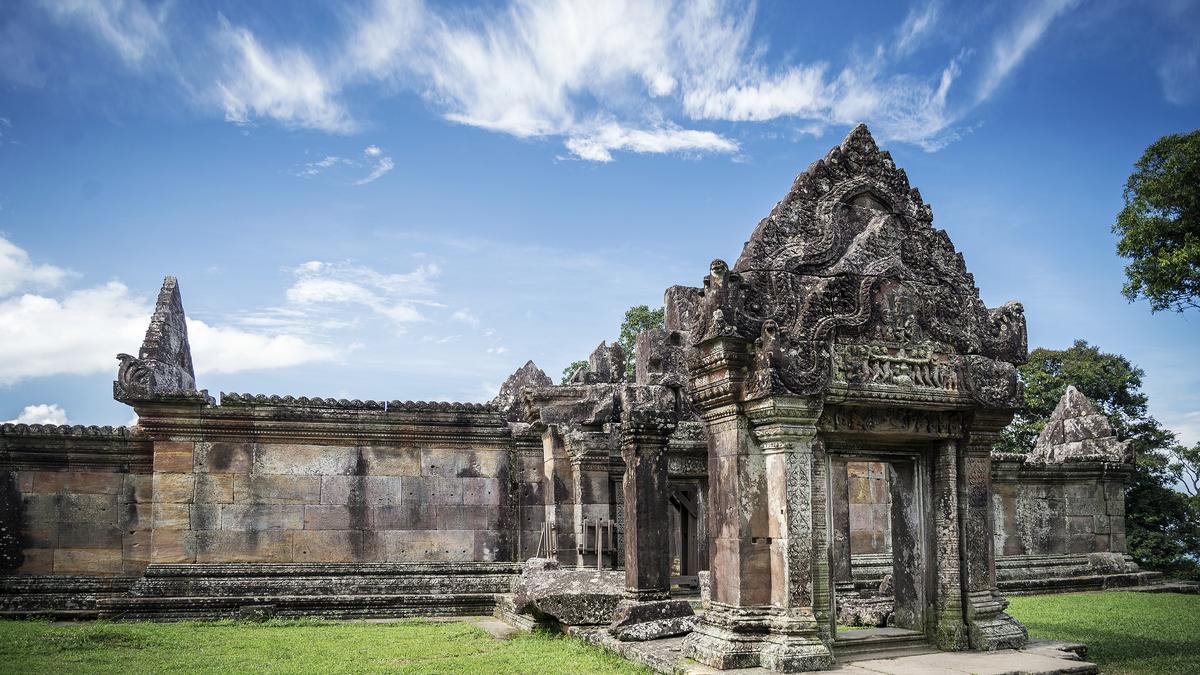
Preah Vihear ancient Khmer temple ruins in Cambodia.
| Photo Credit: Getty Images/iStockphoto
Perched atop a steep cliff in the Dangrek mountain range, Preah Vihear straddles the natural frontier between Cambodia and Thailand. The forested hills stretch from the Mekong River, Southeast Asia’s longest, flowing from the Tibetan Plateau to the South China Sea, to the highlands of San Kamphaeng, Thailand.
Built between the 9th and 12th centuries by Khmer kings like Yasovarman I and Suryavarman I and II, the temple honours Shiva as a sacred mountain abode. Originally known as Sri Sikharisvara, meaning ‘Glorious Lord of the Mountain’, the temple is located in Cambodia’s Preah Vihear province, about 140 km northeast of Angkor Wat, the 12 century monument also built under Suryavarman I and II. Rising more than 700 metres above the plains, it commands sweeping views of the surrounding landscape. While access today is primarily from Cambodia, the temple’s position has long made it a point of contention. It lies at the heart of the Thai-Cambodia tensions, which flared again last week with cross-border air strikes and artillery shelling, before U.S. President Donald Trump announced a ceasefire on December 12.
Unlike the conventional east-facing rectangular plan of most Khmer temples, Preah Vihear follows a linear north–south axis. According to UNESCO, the complex comprises a series of sanctuaries connected by pavements and staircases stretching over 800 metres. Five ornate gopuras (gateways), carved with Hindu mythology and Khmer symbols, are built on the rugged cliff face. Though partly in ruins, the temple’s elevated settings offer panoramic vistas, while its stone galleries and sanctuaries blend Hindu and Buddhist elements.
UNESCO recognises Preah Vihear as an outstanding masterpiece of Khmer architecture. For Cambodia, the temple is both a sacred pilgrimage site and a powerful symbol of national identity and sovereignty.
The dispute between Thailand and Cambodia has its roots in colonial-era borders. The Franco-Siamese treaties of 1904 and 1907 defined the frontier along the watershed line of the Dangrek Mountains.
When French surveyors created maps, they placed Preah Vihear on the Cambodian side despite the temple sitting atop a cliff more easily accessible from Thailand. After Cambodia got independence from France in 1953, its rulers renewed claims over Preah Vihear, but Thailand had deployed troops in the region.
ICJ ruling
Cambodia took the dispute to the Hague-based International Court of Justice (ICJ), which in 1962 ruled that the temple lay in territory under Cambodian sovereignty. The Court noted that the Franco-Siamese Treaty of 1904 provided that the frontier was to follow the watershed line, and that a map based on the work of a Mixed Delimitation Commission showed the Temple on the Cambodian side of the boundary. Thailand claimed that the map had no binding legal status and had never been formally accepted by Bangkok. The ICJ rejected this contention and upheld Cambodia’s claim. It ordered Thailand “to withdraw any military or police force stationed there and to restore to Cambodia any objects removed from the ruins since 1954.” While the temple was awarded to Cambodia, the sovereignty around the surrounding land remained undefined, leaving room for divergent interpretations and fuelling periodic flare-ups. UNESCO’s decision to list the temple as a World Heritage Site in 2008 underscored its historical significance, but also sharpened sensitivities, leading to cross-border fighting.
In April 2011, Cambodia asked the ICJ to interpret the 1962 Judgment, arguing that while Thailand recognised Cambodia’s sovereignty over the temple itself, it did not recognise the sovereignty of Cambodia over the surrounding area. In its ruling on November 11, 2013, the Court declared unanimously that the 1962 Judgment decided that Cambodia possessed “sovereignty over the whole territory of the promontory of Preah Vihear”, and ordered Thailand to withdraw its forces from that territory. The court also affirmed that the temple was a site of religious and cultural significance for “the peoples of the region”, and asked both Thailand and Cambodia to cooperate for its protection.
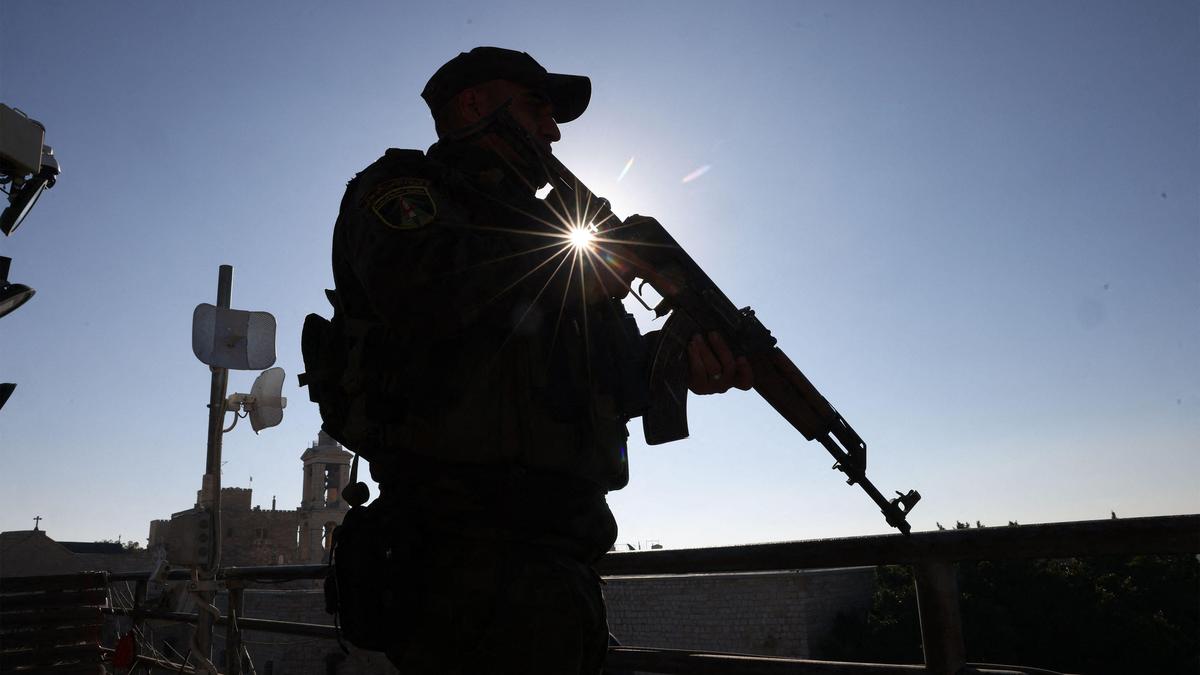
Despite the ruling, tensions continued to simmer, punctuated by periodic skirmishes along the undemarcated border. These flared into open conflict in July 2025, when cross-border fighting killed dozens and displaced more than 300,000 people. The five-day clashes were halted through diplomatic intervention by Malaysia and the U.S. But in November, Thailand announced it would suspend implementation of the ceasefire after a landmine blast injured several soldiers. The decision led to renewed fighting on December 7, with Cambodia accusing Thailand of launching air strikes.
On December 12, U.S. President Donald Trump claimed that he had talked to the leaders of both countries and secured another ceasefire. Yet, tensions continued to linger in the forested, hilly, and sparsely populated borderlands, an area dotted with ancient monuments and sacred cultural carvings.
Published – December 14, 2025 01:36 am IST