At 12.40 a.m. on December 26, near K.R. Market in the heart of the city, a small crowd began gathering around a goods vehicle. Four men were distributing blankets. The temperature was 16 degrees Celsius.
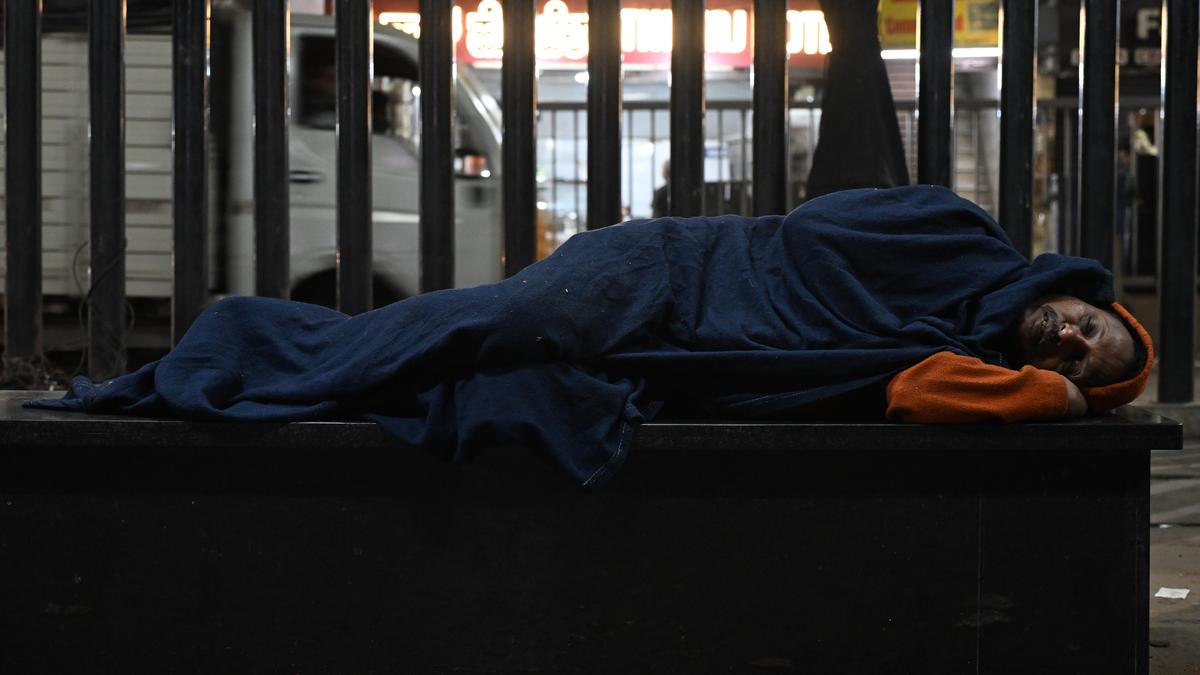
Beneath the Mysuru Road flyover, several people had taken shelter, wrapping themselves in blankets or gunny bags to protect themselves from the biting cold. A beat police officer stationed there said two homeless people had died under the flyover within just four days.
The Bengaluru City Police data revealed that the city witnessed the deaths of more than 15 homeless people over the last 40 days, who were sleeping on the streets, all registered as Unnatural Death Reports (UDR). Police stations such as Malleshwaram and City Market, areas with major transport hubs, hospitals, and markets, have recorded four deaths each.
Although the State has housing schemes, there is nothing exclusively for homeless people who lack or have lost documents such as Aadhaar cards.
| Photo Credit:
ALLEN EGENUSE J
While there is no confirmed direct connection, Bengaluru police say such deaths generally increase during winter, and this year has seen more, possibly due to the drop in temperature. Notably, December recorded temperatures as low as 13 degrees Celsius in Bengaluru, according to the India Meteorological Department.
C. Vamsi Krishna, Joint Commissioner of Police (West), told The Hindu that such deaths occur during winter as well as extreme summer conditions, according to the number of UDRs registered. “Deaths might not be directly connected to the weather, but it may exacerbate existing health conditions, leading to fatalities. These homeless people mostly lack access to warm clothes and other safety gear,” he said.
Arvind Kasthuri, Professor in the Department of Community Health at St. John’s Medical College, explained that the drop in temperature in Bengaluru is unlikely to cause hypothermia leading to deaths, but it can aggravate underlying health conditions and result in serious situations.
“In Bengaluru, falling temperatures, combined with usual factors such as poor air quality and the consumption of low-quality food and water, can prove fatal for people with health issues,” he added.
However, many NGOs have stepped in this winter, distributing blankets, food packets, and other healthcare essentials, along with individual donors. In areas such as Yeshwantpur and Vidyaranyapura in north Bengaluru, a few police officers and civil defence personnel have also contributed by providing winter essentials and food to the homeless.

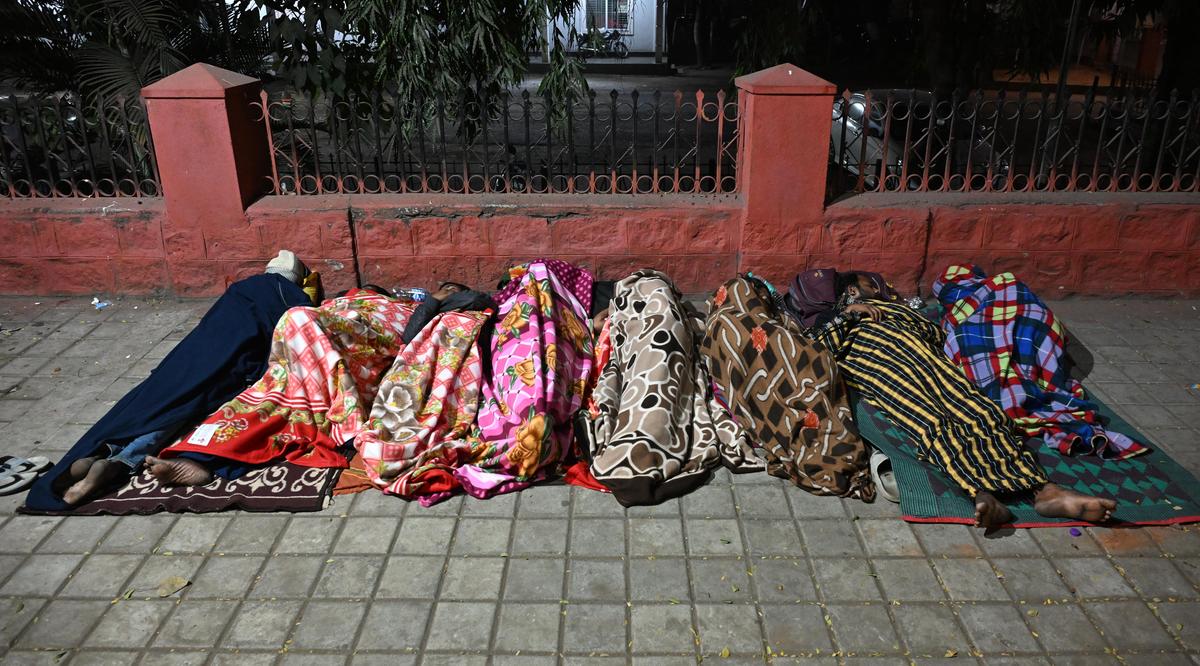
Many NGOs have stepped in this winter, distributing blankets, food packets, and other healthcare essentials, along with individual donors
| Photo Credit:
ALLEN EGENUSE J
Under the Deendayal Antyodaya Yojana–National Urban Livelihoods Mission (DAY-NULM), a central scheme, civic bodies are required to create infrastructure and enrol homeless people. However, the erstwhile Bruhat Bengaluru Mahanagra Palike (BBMP) and the newly formed corporations have done little.
Although shelter homes conduct bi-weekly surveys of homeless people to increase enrolment, NGOs running these homes say there is little support from civic bodies, pointing to scarce fund allocation. On the other hand, many homeless people are reluctant to join shelter homes, which social activist R. Kaleemullah attributes to underlying “fear” and a feeling of being in an “open jail”. He also pointed to the existence of “social divisions” within shelter homes.
Although the State has housing schemes, there is nothing exclusively for homeless people who lack or have lost documents such as Aadhaar cards, leaving gaps in the central scheme.
Battling weather, stink, stray dogs
When The Hindu travelled across the city to review the conditions faced by homeless people and how they are coping with plummeting temperatures, most had sought shelter under flyovers, near religious institutions, transport hubs, hospitals, and, dangerously, under old trees.
Near K.R. Market, hundreds have taken refuge under the flyover. However, the place itself is uninhabitable. Many sleep in corners of bus stops that stink, often surrounded by leftover food.
“They don’t move from here, and many have been living here for years because they work at the market in the mornings and sleep under flyovers at night. Many people give them daily essentials, some just to make videos of themselves giving, but it still helps the poor,” said Mohammad Shafeeq, an autorickshaw driver.

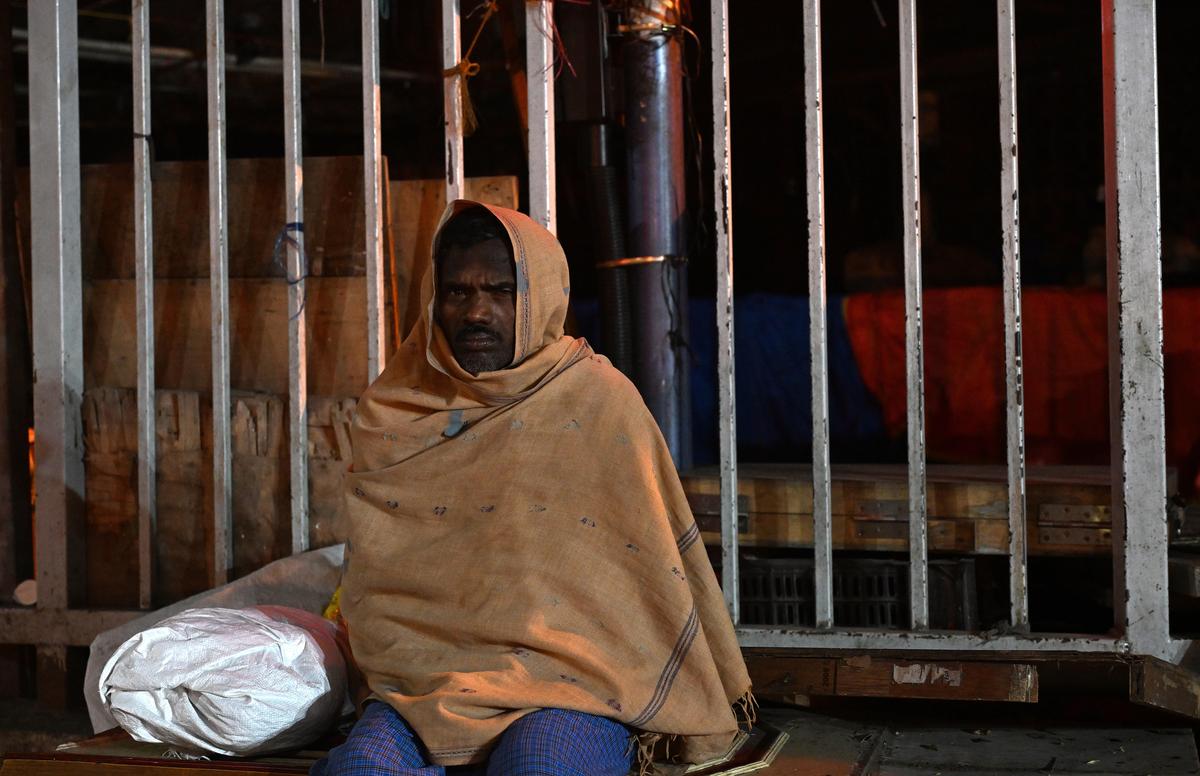
Homeless people, constantly exposed to harsh weather, also face mental health challenges.
| Photo Credit:
ALLEN EGENUSE J
A police beat officer added that fights sometimes break out under the influence of alcohol. Many quarrel over “their place to sleep” and even over blankets.
Meanwhile, a group arrived in a goods autorickshaw to distribute blankets, prompting several men and women to rush towards it. Mohammad Irfan, a mechanic and president of the Al Qaswa Feed and Care Foundation, said they distribute basic accessories to help people cope with the cold across central and south Bengaluru. “We don’t raise funds. We pool a portion of our salaries and buy these essentials for the homeless,” he said.
Bala said he earns ₹100 to ₹200 a day by helping traders carry vegetable bags at the market, which he spends on food. “On lucky days, some traders pay ₹50 instead of ₹20. I save that for liquor. I sleep here itself. I don’t go anywhere,” said Bala, who is originally from Mandya.
As the night progressed, near Vani Vilas Hospital, a few more people had taken shelter near a bus stop, sleeping on the ground. A man from West Bengal, who refused to reveal his name, said, “The bench becomes colder at night, so we sleep on the footpath.” When asked why he did not join a shelter home, he replied, “People ask us to move there, but I don’t want to go because I am free here. Those who went there told me inmates fight unnecessarily.”
Mohan (name changed), manager of a shelter home run by an NGO that operates four other such centres across the city, said people who have separated from families or run away from home usually join shelters on their own. “Very rarely do we see homeless people involved in rag-picking or begging joining shelter homes,” he added.
Human rights activist T. Narasimhamurthy said he had encountered homeless women who feared being pushed into the flesh trade. “They are often traumatised and groped on the streets, yet feel safer in open spaces than in shelter homes,” he said.
Around Adugodi, NIMHANS, Koramangala, Madiwala, and HSR Layout, homeless individuals were mostly found sleeping alone rather than in groups. For those sleeping alone, stray dogs pose a major threat.
NGOs running shelter homes said that while ground realities remain unchanged, the BBMP and new corporations have limited themselves to inspections and reprimanding managers.
Only 48 shelters instead of 120
Under the NULM policy, civic bodies are responsible for ensuring basic infrastructure such as water supply, sanitation, safety, and security for the homeless. This reporter visited four shelter homes, most of which lacked basic facilities such as adequate lighting, proper beds, water, and sanitation.
The policy mandates that each shelter cater to 50 or more people, barring exceptional situations, yet barely any shelter has more than 40 beds. As per policy requirements, Bengaluru should have at least 120 shelters. Currently, there are only 48 shelters: North City Corporation (12), South City Corporation (7), Central City Corporation (16), East City Corporation (6), and West City Corporation (7).
The scheme mandates four types of shelters — for men, women, families, and special shelters for the mentally challenged, physically challenged, and recovering patients. Bengaluru has no special shelters.
The policy also mandates systematic third-party surveys to assess shelter needs at appropriate locations. Although surveys are conducted, there has been no expansion of shelter homes since 2023, nor any strategic planning. For instance, shelters in Yeshwantpur are always full and need more shelter homes, yet there are only two in the area. In contrast, Mahadevapura and nearby localities have over six shelters, with occupancy rarely exceeding 50%.
A GBA official told The Hindu that the Health Department has agreed to provide space in some hospitals to set up shelters, and a few new homes have been commissioned and are expected to become operational soon. “A foundation called Aaladamara has expressed interest in setting up a special shelter home, and the file has been moved,” the official added.
The scheme’s mandate goes beyond building shelters, as it requires ensuring that no one is deprived of a safe and secure roof. Agencies running shelters are responsible for identifying homeless persons and persuading them to move into shelters. Despite this, a 2023–24 third-party survey identified 1,329 homeless people. Agencies say they conduct biweekly surveys, but many homeless people resist relocation and sometimes even become violent during persuasion attempts.
Narasimhamurthy said the civic body must explore alternative solutions in such cases. “They barely consult activists or social workers to brainstorm ideas or implement schemes effectively. There is general negligence,” he said.
Challenges in running shelter homes
“In many centres, beds haven’t been replaced for three to four years. Pest control is needed to eliminate bedbugs, but we haven’t received funds even for small works, surveys, or logistics for health camps,” a shelter home manager said on condition of anonymity.
He further said that funds, including salaries for staff, have not been sanctioned to several shelter homes for the past two years. There are also issues with local residents opposing shelter homes.
A GBA welfare wing official admitted that funds had not been released for some shelters. “These shelters needed fresh work orders after contracts ended, but they continued operating without them, so bills were not cleared,” he said. When asked about the lack of follow-up, the official acknowledged delays from former zonal offices as well.
Vulnerability, mental health, and solutions
Akshay Hakay Machhindra, DCP, Central Division, said homeless people are highly vulnerable to crimes such as theft and robbery and sometimes even become accused unintentionally.
Homeless people, constantly exposed to harsh weather, also face mental health challenges. “Extreme weather discomfort can increase psychological distress, especially in people with pre-existing anxiety, depression, or trauma-related disorders. Those with poor coping mechanisms are particularly affected,” said Suresh Bada Math, Professor of Psychiatry at NIMHANS.
While these concerns are serious, solutions lie in civic bodies taking greater interest in and empowering their welfare wings. Narasimhamurthy stressed that Human Rights Commissions exist to address such issues and should take note of poor scheme implementation and ensure accountability.


“Women are often traumatised and groped on the streets, yet feel safer in open spaces than in shelter homes”T. NarasimhamurthyHuman rights activist
“Very rarely do we see homeless people involved in rag-picking or begging joining shelter homes”Mohan (name changed), manager of a shelter home