

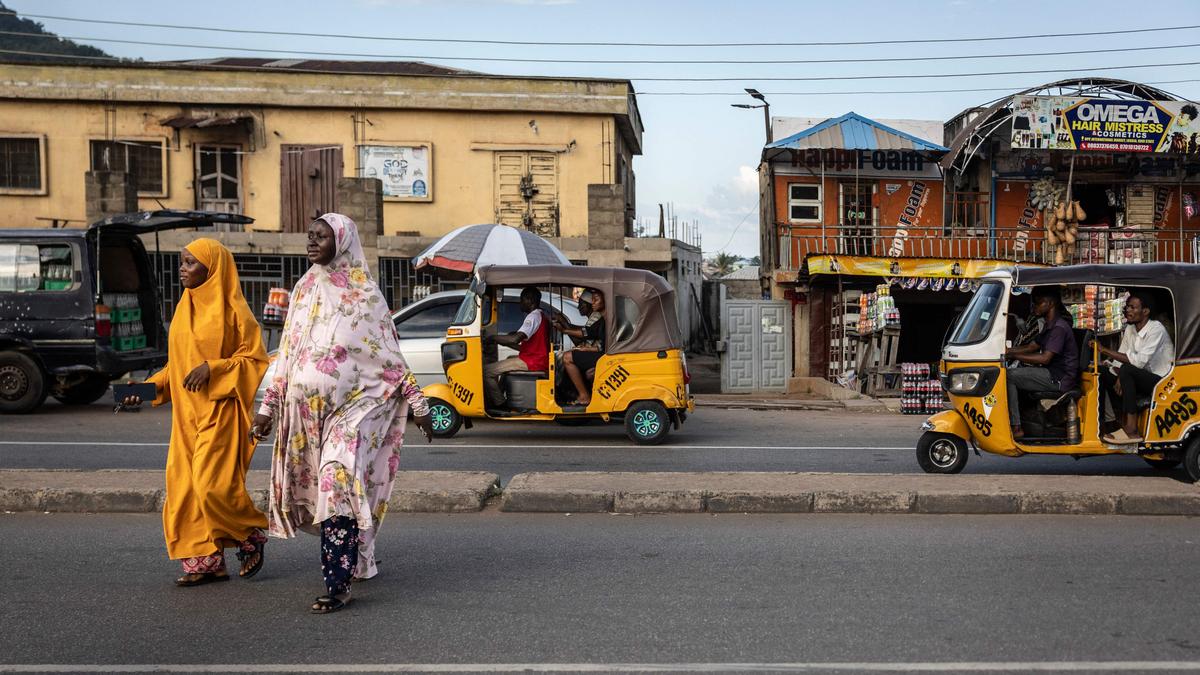
‘With foresight and a judicious mix of ambition and sensitivity, India and Nigeria can forge a win-win synergy’
| Photo Credit: AFP
On November 16-17, 2024, Prime Minister Narendra Modi visits Nigeria, Africa’s most populous country and second largest economy. Though on his first visit to that country, he may still find it familiar: from Airtel to Bajaj, Bollywood to Cipla and TVS to Tata, India is ubiquitous in Nigeria. Thanks to a shared Commonwealth legacy and similar challenges, the two multi-ethnic, large developing democracies face identical issues: improved governance, socio-economic development, terrorism and corruption. At the same time, they have complementarity in such strategic areas as hydrocarbons, defence, institution building, health care and education. Leveraging this milieu of similarity and complementarity can catapult the Abuja Summit from “successful” to “historic”.
Substantive assets on the ground are available for this endeavour. There are more than 150 Indian companies with footprints in Nigeria with investments estimated at $27 billion. With bilateral trade at $7.9 billion, India is Nigeria’s second largest trading partner. Nearly 50,000 Indians in Nigeria, the largest Oyibo (non-African) group in the country are well regarded for their low profile, professionalism and integrity. Nigerians flock to India for trade, medical treatment and education.
India’s hard and soft power in Nigeria might look impressive, but it has lost ground over the past decade. The bilateral trade is half its peak a decade ago when India was Nigeria’s largest trading partner. Despite being the top buyer of Nigerian crude, India has no upstream assets there. There are multiple reasons behind this stagnancy. To begin with, a more effective and comprehensive framework is indispensable for bilateral renewal and upgrading through frequent contacts. The Prime Minister’s visit takes place after 17 years and the last meeting of the bilateral joint commission, this year, was after 13 years. Nigeria is too big and important a partner for India to channel its development assistance multilaterally through the African Union. India also needs to better leverage the local Indian diaspora, Nigeria’s second-largest employer. The two vibrant private sectors should be better empowered through a platform, preferably with financial and underpinning. With foresight and a judicious mix of ambition and sensitivity, India and Nigeria can forge a win-win synergy.
Nigeria, which is currently facing several economic and security headwinds, is looking for friends such as India for help. Since coming to power in 2023, President Bola Tinubu has acted with political courage. Unlike most of his predecessors who merely kicked the can of worms down the road, he has confronted long-standing national challenges. The measures taken include withdrawing petroleum subsidies costing $10 billion annually, freeing the national currency, the Naira, of controls (leading to a steep depreciation and 32% annual inflation), and dismissing several functionaries including the Central Bank Governor, Head of Secret Service and military brass. These have upended the economy and caused public disaffection. In a recent speech, President Tinubu defended these stiff measures as necessary for national rejuvenation and assured the public that the worst was over.
Where India could help
Despite the current eco-political conundrum, Nigeria retains its long-term attractiveness for India as a major hydrocarbon supplier, a large market with physical and social infrastructure deficit, and growth potential. While its occasionally stained reputation calls for due diligence and caution, macro-economic management is quite competent and the sovereign commitments are upheld.
The Nigerian leadership has high expectations from the Modi visit. Among its top concerns is upgrading its defence and security services to meet the terrorism and economic anarchy-related challenges such as Boko Haram, oil bunkering, Gulf of Guinea piracy, and a turbulent neighbourhood. Having overcome similar challenges at home, India is well experienced and equipped to help Nigeria through a comprehensive package of defence supplies, training, and remote sensing. This can, in turn, boost India’s defence exports and revive bilateral defence ties epitomised by seven Nigerian Presidents since independence in 1960 being trained in India as defence officers.
An equally urgent Nigerian requirement would be to seek India’s help for economic stabilisation as it faces a critical foreign exchange shortage. India could best do so through some strategic initiatives such as partnerships for upstream hydrocarbons and infrastructure, a bilateral comprehensive economic partnership agreement and large financial facilitation through lines of credit and barter arrangements. India can provide the Nigerian requirements of petroleum products, foodstuffs (rice, wheat, milk powder), consumer goods, pharmaceuticals, compressed natural gas conversion kits, textiles and garments, agricultural inputs, and power equipment. The possibility of rupee-based trade can also be put on the table. Other complementarities to be leveraged would include importing palm oil, hides and skins, ginger, and Gum Arabic. Such moves would arrest the 29.7% year-on-year decline in India’s exports in 2023-24 to $3.6 billion. Moreover, it would help locate other drivers for bilateral trade as India now buys less Nigerian crude. Though less tangible, India’s services exports in areas such as Information Technology (IT) and IT-enabled services, banking, financial services and insurance, health care, skilling and education also deserve support.
Half a millennium of shared history
A less-known but interesting historical snippet is about the first direct bilateral contact. A hazy legend traces it to the arrival around 1500 AD of Baba Ghor, a gem merchant from Kano (now in northern Nigeria) who settled down in Ratanpur in Gujarat. He is still revered as a saint and for devising a method to polish agate stones. We need a similar impetus today to make the natural bilateral ties more lustrous.
Mahesh Sachdev is the former Indian High Commissioner to Nigeria and the author of the book, Nigeria: A Business Manual
Published – November 15, 2024 12:08 am IST

