

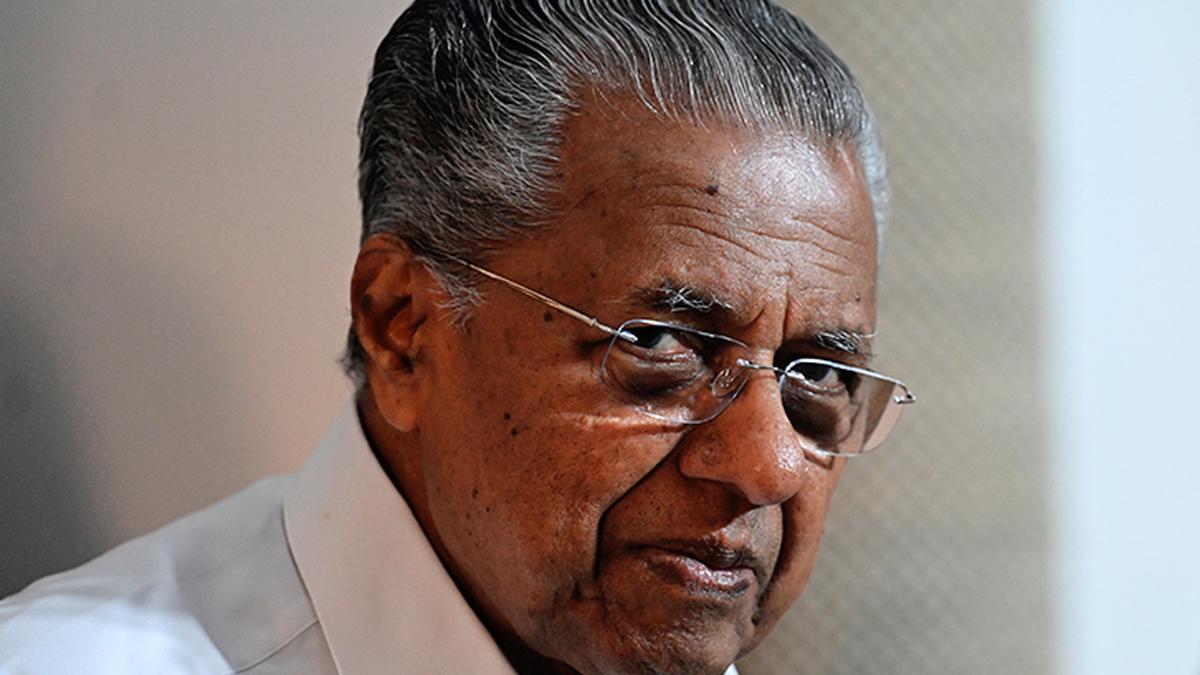
Kerala Chief Minister Pinarayi Vijayan (file)
| Photo Credit: THULASI KAKKAT
Kerala Chief Minister Pinarayi Vijayan has said Sivagiri Mutt broadcast a powerful socially reformist message by suggesting that devotees abandon the regressive practice of entering temples after removing their shirts.
Inaugurating the 92nd Sivagiri Pilgrimage at Varkala on Tuesday (December 31, 2024), Mr. Vijayan said Sivagiri Mutt president Swamy Sachithananda stated that the practice was anachronistic and not in tune with modern progressive values. “His words echoed the reformist thought, life and message of Sree Narayana Guru”, he added.

Mr. Vijayan said temples associated with Sree Narayana Guru’s movement had abandoned the questionable custom.
He hoped other temples would follow suit. “There is no need to force anybody. Nevertheless, progressive change is inevitable. Sivagiri has historically led reformist social movements,” he added.
Mr. Vijayan slammed attempts to cast Sree Narayana Guru as a proponent of Sanatana Dharma. He said Sanatana Dharma and Varnashrama Dharma were not dissimilar.
Mr. Vijayan said Sanatana Dharma imposed a rigid set of so-called divinely ordained duties and practices on followers. It hewed to the principles of Varnashrama Dharma, an inflexible set of obligations and responsibilities based on the follower’s caste-based social station.
Mr. Vijayan said Sree Narayana Guru challenged the Sanatana and Varnashrama Dharma concept that individuals born into a particular caste or social class could only pursue the traditional occupation practised by their ancestors.
Mr. Vijayan said the social order defined by the two ancient creeds denied those at the lower strata of the caste-based society the opportunity for upward social mobility and self-advancement.
Mr. Vijayan said Sanatana Dharma preached universal welfare, with the cynical rider that “only the well-being of cows and brahmins would ensure the world’s happiness”.
‘Against humanist message’
Mr. Vijayan said the attempt to portray Sree Narayana Guru as a champion of Sanatana Dharma ran counter to the renaissance leader’s humanist message. Mr. Vijayan said Sree Narayana Guru challenged the tenets of Sanatana Dharma.
Mr. Vijayan said Sanatana Dharma “celebrated monocracy, feted the oppressive dominance of the Brahminical pecking order and advanced the social and economic hierarchy based on a rigid caste-based public order.”
“The 18th-century king of the erstwhile princely State of Travancore Marthanda Varma ruled in the name of Sanatana Dharma”, he said.
Mr. Vijayan said the Hindu epic the Mahabharata was ambiguous about the principle of universal justice as advanced by Sanatana Dharma. At the epic’s end, “righteous Yudhishtira and morally wrong Duryodhana” gain a place in heaven, he pointed out.
“The Mahabaratha was the product of an age when society transitioned from tribal to caste-based polity. Sree Narayana Guru harshly questioned the text’s ambivalence about the concept of justice”, Mr. Vijayan said.
He said some entities were misleading the public by claiming that restitution of Sanatana Dharma was a panacea for socio-economic inequalities.
Mr. Vijayan said Sanatana Dharma had the patronage of the ruling elite and political cover of the powers that be as it did in the past. “It manifested in the continuing oppression of Dalits, backward classes and minorities in rural areas of north India. The tormentors act with impunity and escape the law due to the political and administrative backing”, Mr. Vijayan said.
Published – December 31, 2024 02:26 pm IST

