

Before October 7, 2023, West Asia looked like a different region, at least from a geopolitical perspective. The Palestine question had been pushed to the margins of the region. Palestinians themselves were divided with the Islamist Hamas controlling Gaza and the Fatah running the Palestine Authority in the West Bank. Iran, despite its economic woes, remained a powerful actor through its so-called axis of resistance. The Arab countries, mostly the wealthy Persian Gulf monarchies, saw Iran as a security threat, and chose to deepen security cooperation with Israel.
The United States, seeking to slowly disentangle itself from West Asia, was trying to knit together two of its key regional pillars — the Arab world and Israel — into a joint front against Iran. The foundation of this vision was laid in the Abraham Accords of 2020, brokered by the first Trump administration, through which four Arab countries signed a normalisation agreement with Israel. By 2023, Saudi Arabia was in an advanced stage of normalising ties with Israel.
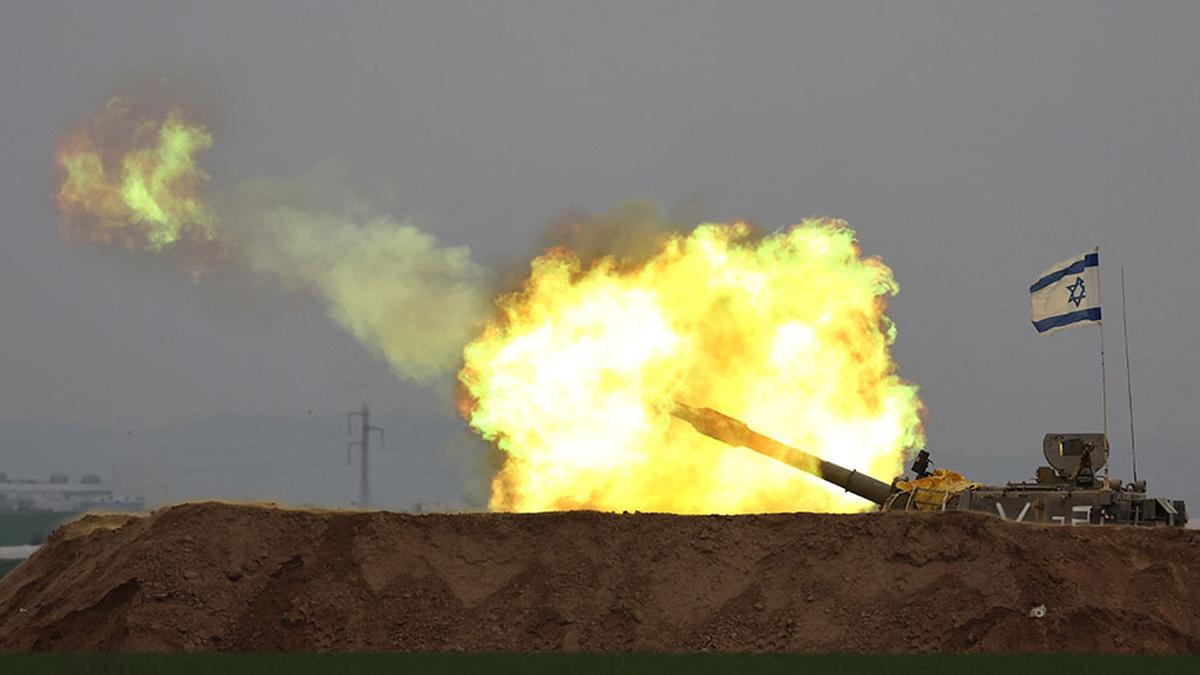
Washington’s broader plan was to integrate Israel deeper into the regional economy as well as the global order with two major initiatives, both involving India — the I2U2 grouping (India, Israel, the U.S. and the United Arab Emirates), and the India-Middle East-Europe Economic Corridor (IMEEC). It was a grand vision to reshape the region under the American leadership with Israel at the heart of what was being hailed as “the new Middle East”. Then came the October 7, 2023 attack by Hamas on Israel, in which about 1,200 people were killed. The attack shattered the sense of security that Israel had seemed to enjoy despite its continued atrocities against Palestinians. Hamas’s murderous assault was widely condemned, but the violence also served as a reminder that unless the Palestine question was addressed, peace and stability would remain elusive in West Asia. Israel also realised that the attack sabotaged its efforts to reshape the region in its favour diplomatically. The Israeli response was swift and overwhelming — an all-out war, first focused on Gaza and then spilling into the wider region.
Two years, over 65,000 deaths: The data story of Gaza’s war
Objectives of the war
Israel declared two primary objectives — the destruction of Hamas and the release of the 251 hostages taken on October 7. But the way it fought the war suggests that it has deeper ambitions. For Israel, Hamas was only the tip of the iceberg. Its real conventional enemy was Iran, which backed Hamas, Hezbollah, Islamic Jihad and other militant groups. After October 7, Israel saw an opening to wage a two-front war — the first was to crush Palestinian resistance once and for all, and the second was to dismantle Iran’s axis and weaken its regional influence. Israel’s Prime Minister Benjamin Netanyahu wanted the following: to build a unipolar West Asia, with Israel, backed by the U.S., being the central security player; Iran rolled back; Arab countries subdued, and the resurgent Palestine question pushed to the margins.
To be sure, Israel has made some advances in this direction. Hamas’s militant and administrative infrastructure have been severely damaged, and Israeli forces control much of Gaza. Even if they withdraw under U.S. President Donald Trump’s 20-point ‘peace’ plan to the initial withdrawal lines, Israeli troops will still retain parts of Rafah in the south, much of Khan Yunus and a buffer zone in the north. Hezbollah, the feared Shia militant group in Lebanon, has been humbled by Israel’s repeated strikes.
In Syria, the collapse of the Bashar al-Assad regime, and the rise of Abu Mohammed al-Golani (Ahmed al Sharaa), a former al-Qaeda jihadist, marked a tactical victory for Israel. Mr. Assad had been a critical link between Iran and Hezbollah and his fall not only weakened Hezbollah further but also allowed Israel to grab more Syrian territory. Emboldened by these developments, Israel carried out air strikes on Iran in June to destroy its nuclear programme and degrade its military capabilities.
Israel’s strategic missteps
While Israel’s tactical gains project the image of a country determined to reshape West Asia through force, none of these advances has translated into long-term security. If the destruction of Hamas was one of the principal objectives of the war, two years on, Hamas has not been defeated, let alone destroyed. Israel may have decapitated the Hamas leadership and killed thousands of its fighters, but Hamas is not al-Qaeda or the Islamic State — transnational jihadist organisations detached from local populations and which have flourished through nihilistic violence.
Hamas is deeply rooted in Palestinian nationalism. Faced with military setbacks, Hamas has reinvented itself as an insurgency, its original avatar. This makes it extremely difficult for Israel to crush Hamas — ask the Americans about their 20 years in Afghanistan. If Israel sought to push the Palestine question back to the margins, its genocidal war in Gaza has had the opposite effect. Today, even Israel’s closest partners have started formally recognising Palestinian statehood, while global public opinion is steadily turning against the Zionist state.
Regionally, Israel’s strikes have incapacitated Iran’s non-state allies and weakened its influence, but Hezbollah remains a formidable political and social force in Lebanon. And Iran did not merely survive Israel’s 12 days of bombing (June 13-25, 2025). It hit back with long-range missiles. If Israel’s desperation to weaken Iran took it to the 12-day war, its desperation to defeat Hamas took it to bomb Qatar in September, which turned out to be a grave mistake. Israel targeted a gathering of Hamas’s political leadership in Doha, but failed to kill any of the group’s top leaders. Since October 7, Israel has bombed at least five countries besides Palestinian territories. It has targeted Syria, Lebanon, Yemen, Iran and Qatar. Qatar is a close American ally and its targeting shook the foundations of the U.S. security guarantees in the Arab world.
Israel’s expansionism has pushed Arab countries to reassess their political and security calculus. If in September 2023, Saudi Arabia wanted to join the Abraham Accords and normalise ties with Israel, today an agreement with Tel Aviv is seen as a liability in the kingdom rather than as a strategic asset. Without a Saudi normalisation deal, the IMEEC is unlikely to take off. The I2U2 remains paralysed with the UAE making it clear that any Israeli attempt to annex the West Bank — a key demand of Israel’s powerful far right — would cross a red line.
The Gulf monarchies have moved ahead diversifying or doubling down on their security partnerships — Saudi Arabia has signed a mutual defence agreement with nuclear-armed Pakistan, and Qatar has got a North Atlantic Treaty Organization (NATO)-style security assurance from Mr. Trump. His executive order states that future attacks against Qatar would be seen as a “threat to the peace and security of the U.S.”
No end plan
Despite its tactical military gains, Israel finds itself trapped in a strategic labyrinth. Like Mr. Trump put it, “Bibi [Netanyahu] took it very far in Gaza.” Israel still does not have an end plan. It cannot ignore the Palestine issue any more and continue the occupation without consequences. Isolated internationally, it is clinging to U.S. support for political, economic and military cover. Hamas remains an unresolved problem even after Israel’s killing of at least 67,000 Palestinians in Gaza. The Iranian regime still stands with its nuclear programme. And the grand diplomatic vision of reshaping West Asia, with Israel at its centre, lies in ruins, as Arab states increasingly view Israel as a threat rather than a security provider. The return of Palestine to West Asia’s geopolitical core would mean that Israel would have to make concessions to go back to the pre-October 7 diplomatic order. But Israel’s leaders hate making concessions on Palestine. Mr. Netanyahu’s only solution to these strategic challenges was to continue the war endlessly. But even that path is being shut after Mr. Trump publicly demanded Israel “to stop bombing Gaza immediately”.
Mr. Netanyahu wanted to reshape West Asia. The region is being remade, but not according to his design.
Published – October 08, 2025 12:16 am IST

