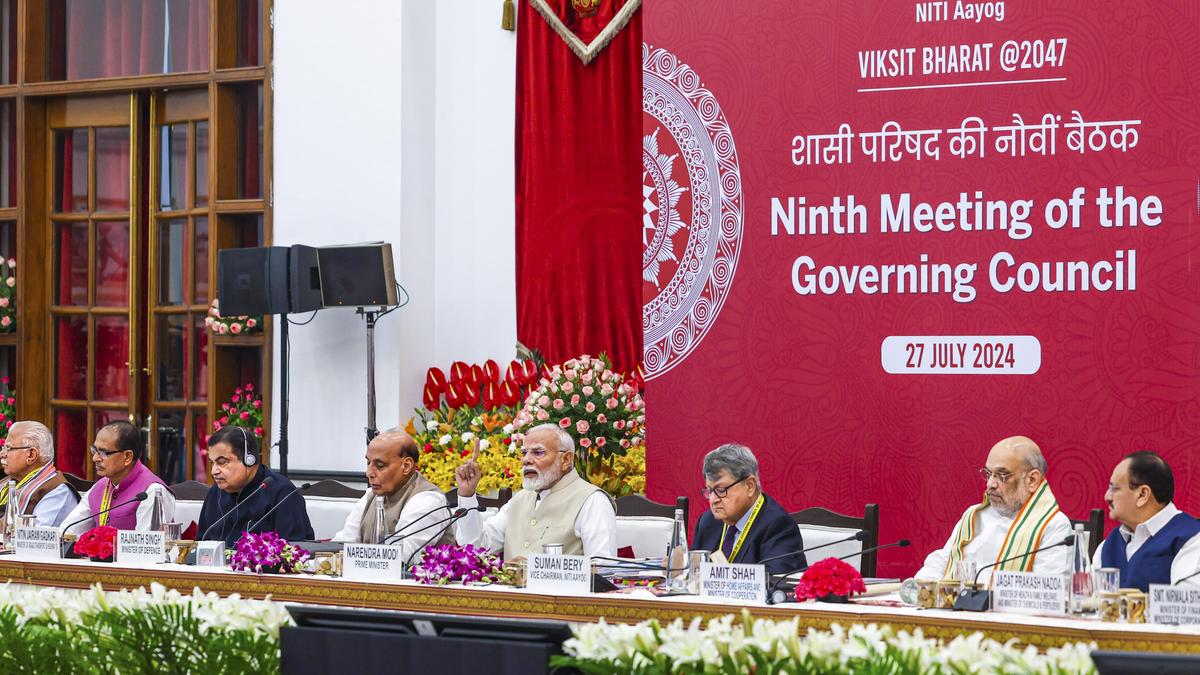
Following the Union Budget, Opposition Chief Ministers have boycotted and walked out of the NITI Aayog meeting chaired by the Prime Minister alleging that the Centre is discriminating against non-NDA States. Is the Centre being iniquitous in State transfers? Pinaki Chakraborty and R. Ramakumar discuss the question in a conversation moderated by Jasmin Nihalani. Edited excerpts:
Do you think the opposition’s concerns about bias in resource allocation are valid?


R. Ramakumar: There are different types of transfers from the Centre to States: devolution of taxes, loans, finance commission grants and, non-finance commission grants, which are essentially discretionary grants. This is where the real problem lies. In discretionary grants, there are no criteria to decide on how much each State should get. Consequently, an element of arbitrariness creeps in, which is not healthy for the spirit of cooperative fiscal federalism.
If you look at the last 10 years, there were many announcements of packages made for selected States, coinciding with political developments, but no rationale was provided for these decisions and how the concerned amounts were arrived at. We see a continuation of this phenomenon in this Budget.

Critics say that the NITI Aayog which replaced the Planning Commission has been reduced to creating indices and ranking States, fostering competitive federalism. Do you think it should be given more powers?
R. Ramakumar: Earlier States had complaints about transfers determined by the Planning Commission as it was not a constitutional body. Yet it played an important role in using public investment to address regional inequalities and as an institutional interlocutor between the Centre and the States. So even if the States had complaints about transfers, there was at least a forum that they could engage with. This is no more the case with the NITI Aayog.
The National Development Council has also been disbanded. The NITI Aayog has no powers. It is a skeleton with no financial prowess; it is just a think tank with no powers of enforcement. Its powers have been transferred to the Ministry of Finance, which makes all the decision on transfers outside the Finance Commission (FC) recommendations.
What we need is a new, credible body, which should not be seen as politically influenced, and as one where States can sit with the Centre and discuss matters professionally and transparently. Above all, all transfers outside the FC recommendations must be free from discretion and also be rule-based transfers.
On the distribution of Union tax resources among States, one side says that the States that contribute more should have a higher share while others say that distribution should be done to provide comparable levels of services across the country. What should the 16th FC do to allay the concerns of the States that perform better?
But if due to an increase in per capita income ranking, certain States witness a continuous decline in transfers and that creates challenges for their fiscal stability, then it needs to be addressed through a mechanism of grants.
Also, all State-specific needs may not be possible to address through a devolution formula as it is to address fiscal inequality. Per capita income always would get a very high weightage. And States with high incomes are not going to benefit because of that. So, if we have a State-specific need, I think the ideal way would be to provide grants. States should make a case for needs and challenges they have and how much money is required to address those challenges, with the FC.
R. Ramakumar: I agree that one devolution formula cannot be to the satisfaction of all the States. So, you need to use grants judiciously to ensure that post devolution differences across States are hammered out. The devolution share itself must also rise in the divisible pool to 50%.
The share of cesses and surcharges levied have significantly increased in the gross tax revenues. Should the revenue from them be shared with States or should the Centre reduce its reliance on them?
R. Ramakumar: When the share of devolution from the net proceeds was raised from 32% to 42%, the Centre tried to compensate for the fall of its share in two ways. One, by raising cesses and surcharges, which are kept outside the net proceeds. Two, by changing the spending ratio in CSS schemes by thrusting 40% of the burden on the States.
If you add the total amount of cesses and surcharges collected by this government between 2015-16, and 2024-25, it cumulatively amounts to about ₹36 lakh crore. Not a paisa from this amount has been shared with the States in an untied format.
Cesses and surcharges are not unconstitutional, but they should be charged only for limited periods for specific purposes. However, many of them have continued over many years. Some were ended but rechristened under a different name from the next year. The other problem is that many cesses and surcharges were collected but only partly used for the purposes of their collection. So cesses must be limited in number and collected for a specific period. What the FC can do is increase the State’s share in devolution from 41% to 50% because the Centre keeps all cesses and surcharges in full and does not devolve at all from its bounty of non-tax revenues like the dividends received from the RBI.
Kerala’s FM argued that the revenue deficit grants for the State have decreased, the borrowing limit has been whittled down and State has lost revenues due to the fall in its share in the divisible pool.
R. Ramakumar: Kerala faces a hard Budget constraint not because the State is fiscally irresponsible but because it has historically chosen to make critical investments in its social sector. This is why a State like Kerala would continue to need a revenue deficit grant. Many other States appear to be fiscally prudent and not needing a revenue deficit grant because they invest relatively less on the social sector. But such prudence is achieved at a social cost. On the other hand, Kerala has historically suffered in the devolution process. It must be compensated for its losses through grants. Revenue deficit grants is one type, and I hope the 16th FC continues it.
Pinaki Chakraborty is visiting distinguished professor, National Institute of Public Finance and Policy, New Delhi; R. Ramakumar is Professor, School of Development Studies, Tata Institute of Social Sciences, Mumbai