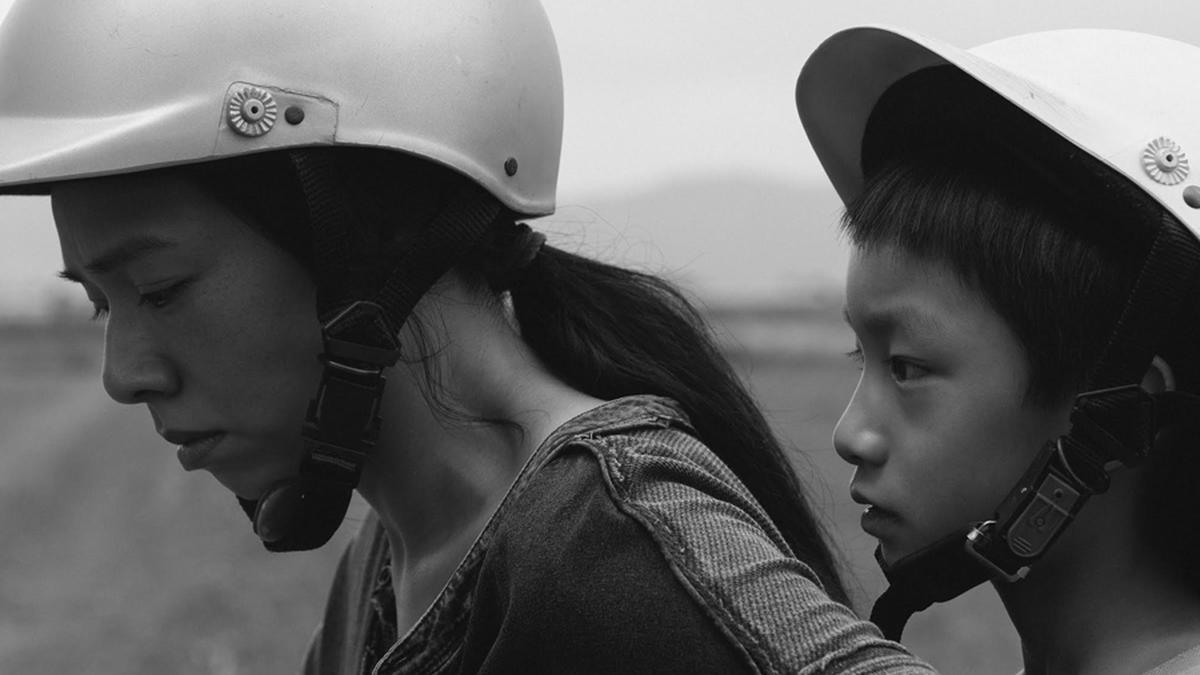
A still from Yen and Ai-Lee
Yen and Ai-Lee, directed by Tom Shu-yu Lin, begins with the protagonist, Yen, played by Kimi Hsia, covered in blood, pedalling her bike towards the audience with a horrified look on her face. She surrenders at the police station, and it is later revealed that she has murdered her father.
The black-and-white drama was screened in the International Competition category at the 30th International Film Festival of Kerala (IFFK). The film had premiered at the Busan International Film Festival in South Korea in 2024.


Eight years later, Yen is free and reunites with her mother, played by Kuei-Mei Yang. While the mother is happy to see her daughter, tension exists between the two. Yen is distressed to see her mother dating an abusive man and is reminded of her father. Yen is unsuccessful in securing a job, owing to her track record. Tension rises between Yen and her mother as Yen’s half-brother Wei is abandoned by his mother.
Parallel story
Parallelly, in the city, Ai-Lee joins an acting class with the objective of becoming more comfortable in her own skin, with the help of Linda, who used to be a professional mourner. The film reveals how the lives of Yen and Ai-Lee or Ally are intertwined.
Yen and Ai-Lee explores people’s tendency to pursue abusive relationships and stay in them, despite it hurting them and affecting their personal relationships. In the film, the mother exhibits a pattern of staying in abusive relationships, and this ultimately strains her bond with her daughter.
The film explores the complicated relationship between a mother and her daughter, driven by an emotion to protect each other, yet putting themselves in harm’s way. Yen and her mother both carry fragments of the dead father and husband, as presented in the subtleties, such as the flavour of the hot sauce, which Yen’s father liked.

Despite discussing serious themes, subtlety remains the film’s strong suit. The complex emotions experienced by the protagonist, as a result of her tumultuous past, are presented with restraint by Kimi.
While Yen’s character represents instability and uncertainty, Ai-Lee stands for stability and strength. Very little is revealed about her past, indicating how her identity is not a hindrance to her, unlike Yen. Ai-Lee is presented as a blank slate as she joins the acting class.
The cinematography by Kartik Vijay has created some picturesque frames. The film also seamlessly transitions between steady wide-angle shots and close-ups, maintaining a certain rhythm. The absence of colour does not imply the absence of character; instead, it amplifies the sorrowful tone, which is ubiquitous for most parts of the movie.
The ending of the movie hinges on acceptance, identifying one’s harmful patterns, and breaking the vicious cycle. Yen and Ai-Lee, with its slow pace and intertwined individual narratives, foreshadows how healing is a messy and time-consuming ordeal, grounded in letting go of the past.
Published – December 18, 2025 05:06 pm IST