

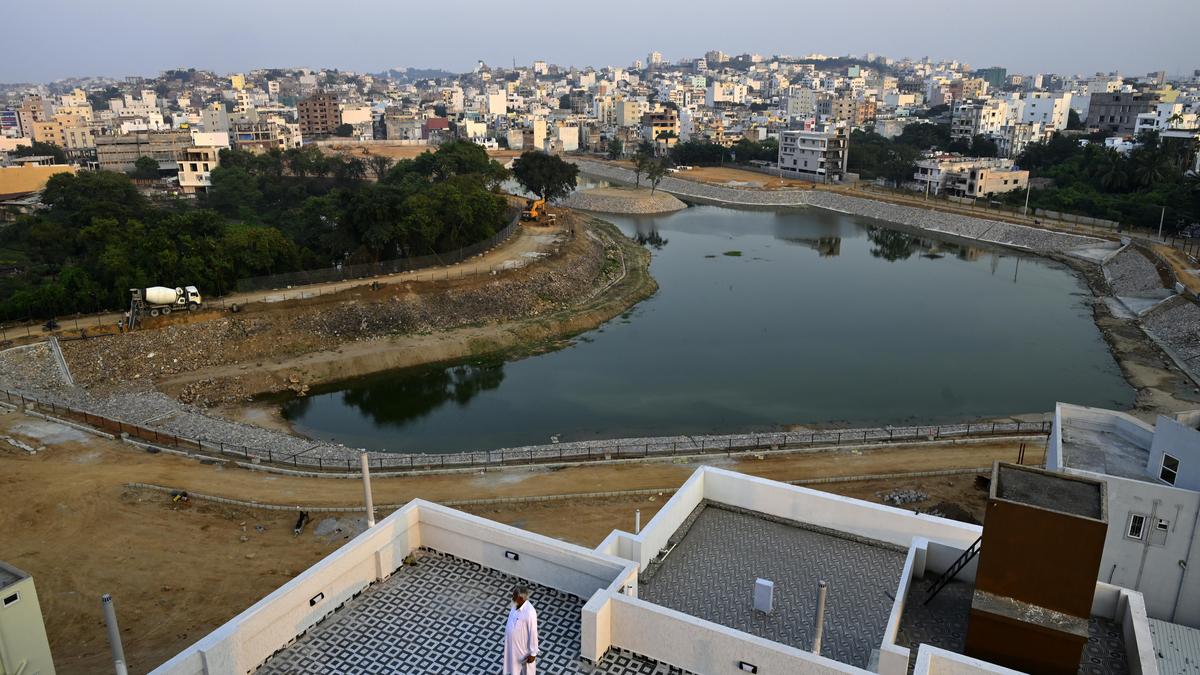
The crescent-shaped tank that lies diagonally across the National Police Academy at Shivarampally in Hyderabad presents a picture of serenity now. Its waters, once troubled and uncertain, lie still. A child could wade through its shallow ripples without so much as wetting the calves. Here and there, boulders rise through the surface, blades of grass sway gently, lending the lake a quiet, pastoral charm. Snuggled into its curve is another crescent on the other side — a bowli or spring — filled with water seeping from the mother lake.
Surrounded by the chaotic sprawl of the city’s unchecked expansion, this tranquil pair of ponds had, until a year ago, endured the full fury of encroachments threatening to erase them.
The water body, Bam Rukn-ud-Dowlah, carries a history dating back to 1770, when Nawab Musa Khan Rukn-ud-Dowlah, then Prime Minister of Hyderabad, constructed it during the reign of Nizam Ali Khan (Asaf Jah II). ‘Bam’ in Persian means reservoir, and the tank’s purpose was to provide drinking water. Its sweetness was so renowned that the king reserved it for royal use.
A 1922 document, ‘Chronology of the Qutb Shahi Dynasty’, states: “Whenever the Kings of Hyderabad went out of Dominions, this water [from Bam Rukn-ud-Dowlah] was despatched every day to the Royal camp as far as Delhi and Simla”. To preserve its purity, bathing and washing were strictly prohibited in its vicinity.
Centuries later, that legacy lies tainted. A small stream of open sewage now flows from nearby colonies into a pipeline laid right through the reservoir’s full tank level, ironically, to prevent sewage flow into the lake. Many surrounding buildings, a few of them multi-storey, that discharge sewage, lack the required permissions for construction.
Nearly two years ago, the lake bed was being readied for yet another round of illegal construction. Over half the lake was filled with soil and debris, and divided into plots for sale. The encroacher, citing a High Court ruling, claimed ownership of six acres in Survey Number 42 — part of which falls into the lake — without specifying boundaries.
While activists fretted and fumed, officials concerned chose to look away as truckloads of soil buried the water body, aided by local politicians.
Concrete structures soon sprang up with such alacrity that many thought it was the end of the lake — until August 29, 2024.
Hardly a month into its formation, the Hyderabad Disaster Response & Asset Protection Agency (HYDRAA), under the stewardship of its Commissioner A.V.Ranganath, rolled its machinery into the lake bed and pulled down the multi-storey structures, amid raucous protests by political leaders including legislator Mohammed Mubeen, MLC Mirza Rahmat Baig and their henchmen.
So far, HYDRAA forces have entered 39 lake beds, cleared 233 acres in the full tank level, and earned both praise and criticism for its uncompromising approach. People as well as Opposition parties have labelled it a ‘demolition squad’.
Turning doubt into action
Skepticism grew when HYDRAA Commissioner A.V. Ranganath announced that the agency would go beyond demolition and take up the development of six lakes it had cleared, transforming them into urban retreats. Citizens and activists doubted the promise, viewing HYDRAA as a force of destruction rather than renewal. And their doubts were not unfounded.
Since the formation of the Lake Protection Committee in 2010 under the Hyderabad Metropolitan Development Authority (HMDA), lake rejuvenation efforts have largely failed. At the beginning of 2024, close to 3,000 water bodies were still awaiting final notification of their boundaries. A project in 2018 under Urban Mission Kakatiya to restore 20 lakes proved to be a dud.
Another initiative led by then Municipal Administration and Urban Development Minister K.T. Rama Rao, involving private realty firms in lake development under corporate social responsibility, also failed amid resistance from owners of patta lands within lake limits.
In another corner of the city, Nalla Cheruvu in Kukatpally was among the 20 lakes taken up for beautification in 2018. Except a walking track lined with greenery, little was done to improve its hydrology.
Of the six lakes taken up for development, Bathukamma Kunta in Amberpet, Hyderabad, has already been restored and relaunched.
| Photo Credit:
ARRANGEMENT
In September last year, barely two months after its formation, HYDRAA razed 16 temporary structures and walls from within the lake, reclaiming 12 acres of encroached land.
Today, the site is abuzz with restoration activity. The walking track built seven years ago stands barricaded, while the green spaces within it are now used by HYDRAA workers resting between shifts. Four to five excavators run across the foreshore, shaping a new bund to demarcate the sedimentation tank. Bund revetment works using boulders and concrete are under way, while a natural island in the lake has been reshaped and fortified. A raft of little cormorants stays close to the bund, and a lone black drongo occasionally swoops over the water.
“We have removed five metres of silt from the tank and transported it to the dump yard. After clearing the debris laden with sewage which had accumulated in the tank for decades, we created a sewage diversion channel circumventing the lake,” says Younus Pervez, director of Vimos Technocrats Private Limited, an empanelled consultant for HYDRAA in carrying out lake restoration works.
A HYDRAA worker recalls carting away nearly 9,000 truckloads of silt, at the rate of 300 trucks a day. Some of the dredged material has been used to build an inner walking track and fortify the island where workers are shaping an H-shaped sculpture using boulders, perhaps to denote HYDRAA or Hyderabad.
To restore the lake’s natural inflows, seven to eight inlets are being created, each fitted with silt traps to filter runoff from surrounding localities. The sedimentation tank is designed to capture silt and sewage, allowing only clean water to seep into the tank’s main portion. The outlet, roughly 15 feet wide, is now sealed with sand mounds to facilitate the ongoing works.
“The lake now has only fresh water. We have enhanced the capacity of the lake by five times. After our restoration works, there is evidence of borewells getting recharged in the surrounding areas,” says Pervez, who has been entrusted with all six lake restoration works by HYDRAA.
Leaping weir technology has been used in the inlets of both Bam Rukn-ud-Dowlah and Nalla Cheruvu to divert ‘dry weather flows’— essentially sewage — during non-monsoon periods. The system works by leveraging the difference in hydraulic behaviour between sewage trickles and stormwater flows.
“At Bam Rukn, the lake contours were totally destroyed. We created inlets and are in the process of laying catchment drains. Our aim is to channel floodwater from Aramghar junction into the lake, along with inflows from Shastripuram, Raghavendra Colony and Rasheed Colony,” Pervez explains.
Revival through science and strategy
Ranganath points out that the agency’s approach differs fundamentally from past restoration efforts. De-silting, which is vital for groundwater recharge, was not done earlier, he notes. “In Thammidikunta lake, we cleared a lot of biomedical waste, and in Nalla Cheruvu of Uppal, we removed industrial waste. If silt isn’t removed, it hardens and blocks water percolation.”
HYDRAA’s model focuses on restoring lakes in their entirety, by re-integrating them into the city’s flood control mechanisms and reviving their groundwater recharge capabilities. The lake is extended to its entire area, rather than being confined to the extent of government land alone, Ranganath says.
To bring on board private patta landholders, who have historically been a major obstacle, HYDRAA is promising Transferable Development Rights (TDR).
Sedimentation tanks are a new feature in most lakes, except at Bathukamma Kunta and Bam Rukn-ud-Dowlah. Nalla Cheruvu in Uppal, for instance, has a three-tier sedimentation system to filter pollutants before the water enters the main tank.
Still, the restoration story has its downside. Of the original 17.5 acres of Bam Rukn-ud-Dowlah, HYDRAA has so far managed to recover only about 11 to 13 acres. The rest remains occupied by residential buildings, apartment complexes and a mosque, apart from a large sewerage line laid by the Hyderabad Metropolitan Water Supply and Sewerage Board that still cuts through the lake area.
HYDRAA’s latest additions include a walking track laid inside the FTL area and a few isolated pockets earmarked for amenities such as parks and recreation zones. The lake’s capacity is said to have increased from 8 million litres to 108 million litres post restoration. However, in its original expanse, the tank could hold much more.
At Nalla Cheruvu in Kukatpally, historical satellite images show that the previous walking track encroached into the lake’s FTL, and the latest one has further reduced its perimeter. The bund separating the sedimentation tank and the island fortification also limit natural water spread. Environmentalists warn that during heavy rain, sedimentation tanks may prove ineffective as overflowing water could still carry silt and sewage right into the lake.
Ranganath defends the walking tracks, terming them ‘peripheral bunds’ designed to contain flooding in surrounding colonies during heavy rain.
Call for transparency, accountability
But not everyone is convinced. Lake activist and Congress leader Lubna Sarwath calls HYDRAA’s lake development efforts ‘dirtification’, not ‘beautification’. She alleges selective demolitions that spare religious structures, accuses the agency of filling lake areas under the guise of creating walking tracks and opposes the construction of gazebos and other recreation facilities in the FTL and buffer zones.
“Who gave HYDRAA the authority to ‘beautify’ the lakes? Their role is merely to protect them from encroachment, after which they should hand them over to the Irrigation department,” Sarwath says, and questions the opacity with which the agency is operating.
“HYDRAA has no presence on the Telangana government’s online portal as an agency representing the State government. It is functioning like a private army,” she alleges, adding that her applications under the Right to Information Act, 2005, have been rejected by HYDRAA chief Ranganath.
In one such RTI query, Sarwath had sought information related to Bam Rukn-ud-Dowlah, including the detailed project report, action plans for restoration, details of the agency carrying out the works, copy of the tender document finalising the agency and names of the departments involved. Other queries sought information on HYDRAA’s online presence, its organisational details and the broader scope of its lake restoration activities.
Ranganath, however, insists that the process is transparent. Tenders have been floated on the government’s e-procurement platform and agencies have been selected through due process, he clarifies. The ₹56-58 crore project, he says, is funded by the HMDA, with detailed project reports prepared in consultation with departments, including Irrigation.
Of the six lakes taken up for development, Bathukamma Kunta in Amberpet has already been restored and relaunched. Work is progressing at Thammidikunta in Madhapur, Nalla Cheruvu in Uppal, Bam Rukn-ud-Dowlah and Nalla Cheruvu in Kukatpally, while the project at Sunnam Cheruvu in Guttala Begumpet has been delayed following objections raised by Sarwath over the absence of a final notification.
Ranganath remains optimistic that three lakes — Thammidikunta, Nalla Cheruvu (Kukatpally) and Bam Rukn-ud-Dowlah — will be opened next month post restoration, followed by Sunnam Cheruvu in January.

