

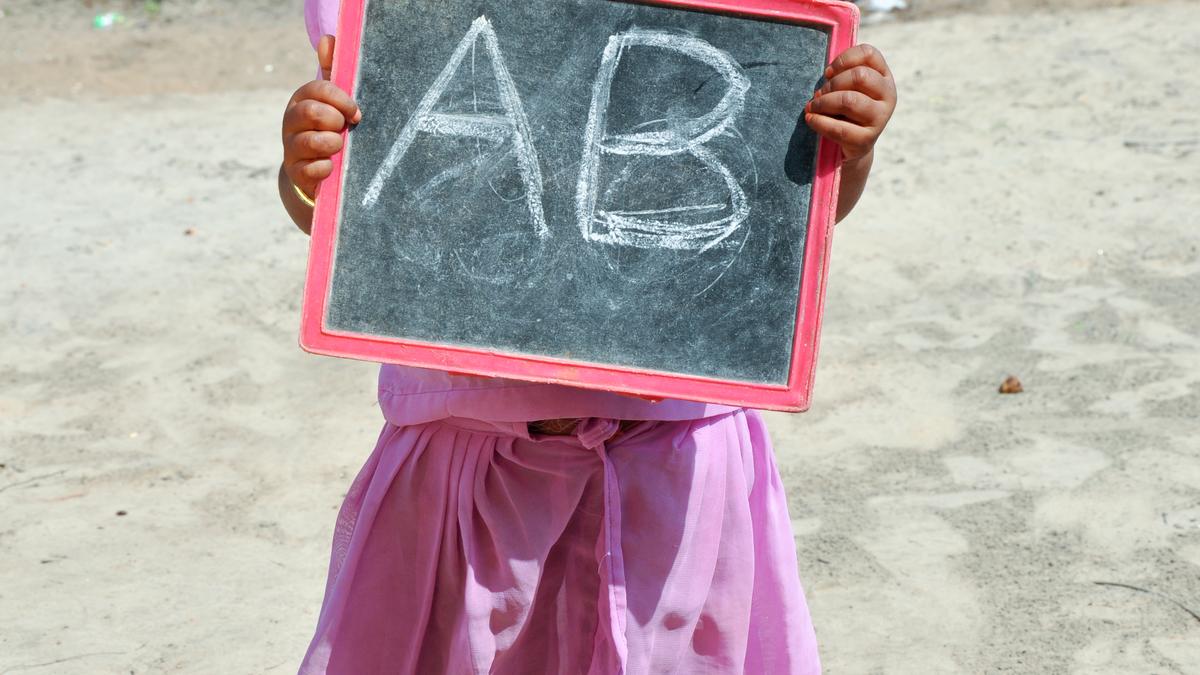
Are we orienting our students towards accepting different standards of living that an unequal society imposes on them? Does pre-primary schooling teach children from rural and deprived classes to set their aspirations according to their present conditions?
A household is forced to make the first school choice of their children. Discrimination starts at this level and sets a potentially inequitable trajectory for the entire life of the child. The 2025 Comprehensive Modular Survey: Education (NSS 80th Round) by the National Statistical Office (MoSPI) reveals deep-rooted disparities driven by type of schools, geography and household income.
At 10.4%, pre-primary has the lowest enrollment compared to other levels. Students in primary education constitute 41.6%. Pre-primary is not a substantial proportion when compared to the total enrolled students in school education.
The UNESCO, the UNICEF, and the National Education Policy 2020 all agree that pre-primary orients children to the schooling process, improves school readiness, and thereby reduces chances of dropout. Yet, pre-primary remains the lowest proportion of the student population of the school system.
Is there any gender discrimination at this level? Data from the Comprehensive Modular Survey says there is not much difference in terms of gender distribution with pre-primary students comprising 10.3% of all enrolled males and 10.6% of all enrolled females.
A deeper look, however, exposes the emergence of rural vs urban as a new discriminator for these young learners. Nearly two-thirds (65.6%) of pre-primary children in rural areas are enrolled in government institutions. Conversely, 62.9% students enrolled in urban sectors have enrolled in private unaided schools.
The reasons could be willingness to spend more money, size of family (with grandparents to look after children at home), occupied parents, and, of course, most importantly a trust deficit among urban households about the quality of pre-primary education offered by government schools.
The surging enrollment in private schools in urban sectors indicates de-facto privatization of foundational education in urban India. This rising privatisation in pre-primary education raises questions of equitable access to education at the early stages of learning.
Parents in urban sectors would be willing to spend more money for buying better quality pre-primary education for their children. But the financial burden of pre-primary education on parents from the rural and urban sectors lays the foundations for two different expenditure patterns. Urban parents take up more financial responsibility, compared to their rural counterpart.
The difference in the expenditure gap between rural and urban households is substantial. In rural sector, the average expenditure for educating a pre-primary student is ₹6,059. The average expenditure per student in urban areas is ₹18,943.
Urban families spend over three times more than their rural counterparts. One could attribute this to higher costs in urban areas. That is justifiable too, because there is difference in the expenditure for pre-primary education in government schools in rural and urban sectors.
For pre-primary education in rural government schools, a household has to spend ₹557 in an year while it is ₹1,094 in urban areas. The difference is almost double.
The difference in the expenditure between rural government school and private un-aided school is enormous though. For a rural family, the choice of a private unaided school comes at an average cost of ₹17,986. This means a rural family has to spend more than 32 times the expenditure required for a government institution. Comparing ₹557 and ₹17,986 shows that the natural choice of a rural household is a government school.
In addition the survey has reported that urban parents spend ₹783 per student for private coaching and tuition at pre-primary level. Is this expenditure gap, among sectors, justifiable in terms of quality of education?
The expenditure gaps between government schools in rural and urban schools, between government schools in rural and urban, between government schools in rural and private schools in urban are alarming. But more serious is the systematic consent-making regarding this structural inequity as neutral and natural, through this differential pricing of pre-primary education.
Sabotaging the idea of equity
How does a nation attain its dream of equity in education when there is a deep divide between households falling into various sectors? The survey indicates that the idea of equity in education is sabotaged at the very foundational level of pre-primary stage.
Households that can afford to buy more expensive education at pre-primary level upends any attempt to create a level playing field when children begin their education. Parents who understand this huge expenditure gap between rural/urban sectors and government/private sectors orient themselves towards a thinking that the variable pricing in education as natural. It sets them up to accepting structural inequalities that will plague their children’s education in future.
Students are systemically accustomed to educational “goods and services” that fit their standards in government schools and accept, in future, the differences between theirs and their private school counterparts as genuine and natural. This also orients them to accepting any such unequal treatments in their future, not just in school days, but in adult life as well, as natural and non-political.
Hence, the deep sectoral divide exposed by the “Comprehensive Modular Survey: Education” (NSS 80th Round)” is a serious indicator of perpetuating inequality with the consent of the socially and economically disadvantaged.
Pre-primary is foundational. But, foundation for what? Normalising inequity or better education? The pre-primary schooling system needs to be redesigned from being institutions that manufacture consent to ones that present a level playing field to all children. This will create the foundation of equity in the education system.
(The author is Professor, School of Education, Central University of Kerala)
Published – October 16, 2025 07:04 pm IST

