It’s a little before 8 p.m. on a nippy Tuesday night, a deafening sound of silence enveloped Cuttack’s Barabati Stadium. Having done the hard yards, Tilak Varma has just been dismissed to an excellent catch at fine-leg by Marco Jansen. It’s the strapping left-arm quick’s third catch of the evening, Lungi Ngidi’s third wicket of the contest.
At 78 for four midway through the 12th over, India’s innings is going nowhere. The run rate is in the 6s, courtesy South Africa’s discipline and a tacky surface where stroke-making is fraught with danger. India’s top-four has all fallen attempting big shots, its efforts negated by both bounce and the ball sitting in the pitch. There is a sense of apprehension, if not anxiety, among the 45,000 predominantly pro-India audience in the first of five Twenty20 Internationals.
The silence lasts only till a lithe, athletic figure strides out, all intent and purpose. Hardik Pandya is playing his first international game in two and a half months but from the time he takes guard, one feels he has never been away.
Such is the strength India can summon in white-ball cricket that Hardik wasn’t missed in the time he was away from the game, recovering from a quadricep injury that kept him out of the T20 Asia Cup final against Pakistan and beyond. Make that ‘wasn’t almost missed.’ How can one not miss an all-rounder of his calibre, a rare commodity in Indian cricket who bowls in the 140s and who can bat in different gears, depending on the situation? How can one not miss one of the great influencers of the modern limited-overs game, a powerhouse with the bat but also capable of making inroads with the ball, banking on the immense belief that he can use his short ball as a veritable weapon?
How can one not miss a T20I batter who fuses an average in the late 20s with a strike-rate in the early 140s, who smacks a six every 12 deliveries or so? How can one not miss a bowler who can take the new ball, bowl in the middle overs or deliver at the death, who boasts nearly 100 wickets and is agile, athletic and committed in the field? How can one not miss Hardik Pandya?
Back to the Barabati. As Hardik emerged from the dugout, the crowd found its voice. It will be a stretch to say that it saw the Hardik blitzkrieg coming, but they had faith in the 32-year-old, a faith that eventually proved well justified.
More than them, though, Hardik had faith in himself. Immense self-belief. It’s been his calling card, his greatest ally and sometimes his worst enemy. Hardik is at that stage of his career where he is driven by inner expectations, by his own standards, not so much by what others want of him. Various responsibilities, including the captaincy of the T20I side, have passed him by, but instead of moping and cursing his luck and bemoaning the litany of injuries that have stymied his development as a Test all-rounder, he has chosen to sport a sunny outlook marked by positivity and the desire to deliver for the team.
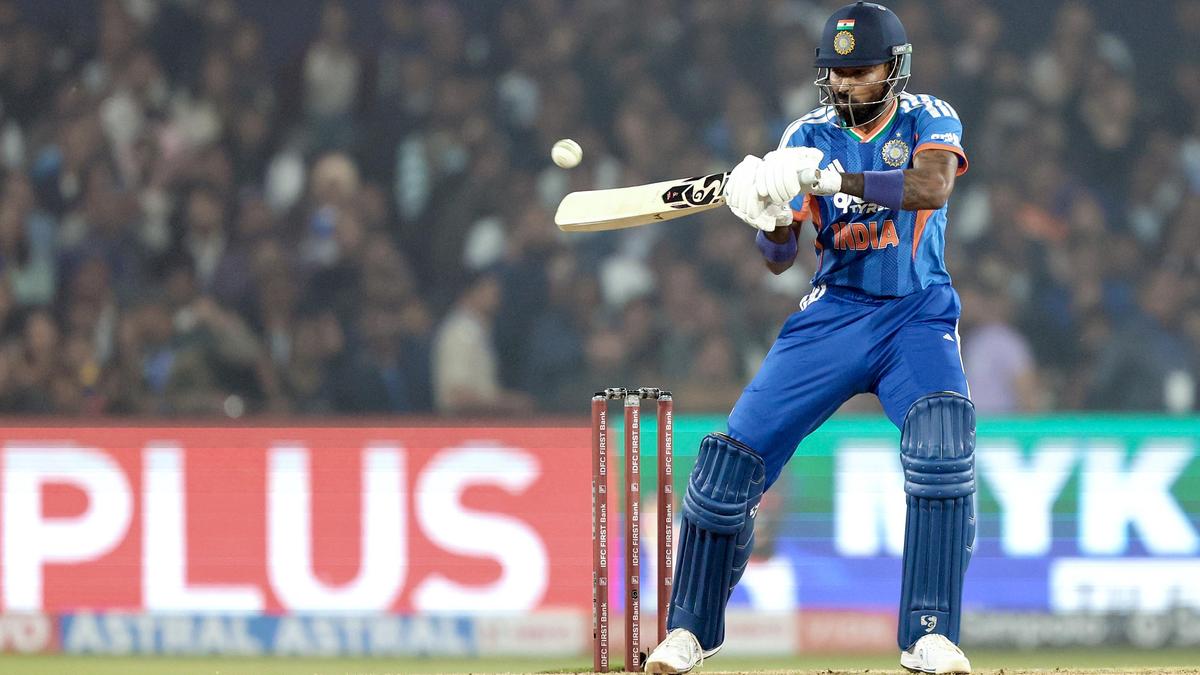
A nonchalant single first ball from Lungi Ngidi got the juices flowing. His second ball, from left-arm spinner Keshav Maharaj, disappeared over wide long-on as he opened his broad shoulders and deposited the ball over the fence. It was a beautifully executed stroke, all timing and grace with power not even an afterthought. Hardik can do that, you know. He has done it a million times previously, across formats. By the end of the first T20I, he boasted 188 sixes in 226 outings for the country, 100 of them in the 20-over version alone.
The next ball disappeared for another six, longer and more dramatic than the previous one. At the time of the bat making contact with the ball, Hardik’s eyes were on Maharaj, not the ball. He had sized up the little white orb in the air, got into perfect position to launch it straighter; the eyes on the bowler sent out a chilling message: ‘I am here, and I mean business.’
For the next 40 minutes or so, Hardik bossed the exchanges. He made batting look ridiculously easy on a demanding pitch. It was as if while the rest were confronted with a minefield, he was taking guard on the most placid of decks, where he could hit through the line with impunity and where the fielders were mere serfs positioned to fetch the ball from the boundary and relay it to the hapless bowler.
Blazing away
By the time the curtain came down on the Indian innings, Hardik had breezed to 59 off 28, six fours and four gigantic sixes. Touch and power competed for effect and efficiency. Tottering and stumbling along until he arrived in a blaze of boundaries, India raced away to 175 for six when they ran out of time.
The electric right-hander contributed 60.82% of the runs accrued when he was at the crease while facing 56% of the deliveries left in the innings. South Africa, all of South Africa, together bested Hardik by 15 runs, but they fell short of India’s total by 101. Just for good measure, Hardik picked up the scalp of the dangerous David Miller with his first ball back. Is there anything this man from Choryasi in Gujarat can’t do?
India tided over Hardik’s latest injury-fuelled absence with minimal damage, though they did surrender the ODI series in Australia 1-2. He would have been handy in Perth and Adelaide, where the first two games were held, because of his propensity to bowl a deceptively heavy ball and because he is an expert at horizontal-bat strokes. But that’s how the cookie crumbles and over the years, India have learnt not to stress too much over Hardik’s unavailability because he has given them adequate practice at playing without him.
A promising Test career was nipped in the bud because his athletic-looking but fragile body couldn’t shoulder the burden of responsibility that comes with the tag of a genuine all-rounder. After token attempts at reviving his five-day fortunes, Hardik heeded the obvious and decided to stay away from the red-ball game. To some, it might appear as if he took the easy way out, opting not to put in the hard labour required to stay relevant in the longest iteration. Hardik will counter that he chose prudence and logic, that no amount of core strengthening could have prevented the ugly shadow of injuries from eclipsing his path.
While there is no denying the value a fully fit Hardik would have given the Test side, there’s no point trying to get on board a ship that has long sailed. He will no longer don the white flannels, a reality he has come to terms with, but he remains crucial to India’s white-ball ecosystem, a landscape where his three-dimensional presence lends the cutting edge that can be the game-changer.
Hardik’s challenge over the next three months will be to steer clear of the spectre of injuries that has been relentlessly chasing him. He needs to be managed carefully, which means perhaps keeping him away from the three ODIs against New Zealand in January and getting him to play only the remaining T20Is of this five-match series against South Africa and five further outings against the Kiwis next month before the T20 World Cup begins in early February.
It was his dismissal of Heinrich Klaasen, with South Africa needing 26 off 24 deliveries, six wickets standing, that turned the final of the last World Cup upside down in Bridgetown last year. A second heartbreak loomed in seven months for Rohit Sharma’s men when Hardik threw them a lifeline through a slower delivery that the marauding Klaasen could only nick through to Rishabh Pant. India were suddenly all over the Proteas like a bad rash, Jasprit Bumrah and Arshdeep Singh expertly closing out all escape routes and Hardik delivering the coup de grace in the final over with the scalps of Miller (to a sensational catch by Suryakumar Yadav running around at long-off) and Kagiso Rabada.
Hardik was Rohit’s deputy at the World Cup and would have realistically expected to don the captain’s imaginary armband when the inspirational skipper retired after hoisting the trophy. But ostensibly because of his numerous dalliances with injuries, Hardik lost out, the crown instead placed on Suryakumar’s head. It must have been a bitter pill to swallow for the man who loves to live life king-size, but he gritted his teeth, kept his mouth firmly shut and decided to let his cricket do the talking.
Nowhere was that more evident than at the 50-over Champions Trophy in Dubai in February-March, when unbeaten India scythed through the draw to add a second ICC title to their cabinet in seven and a half months.
Either side of the haunting meltdown in the final of the 50-over World Cup in November 2023, India won 23 matches in three ICC tournaments, though it is the one that got away that will always rankle. On somewhat dodgy tracks at the Dubai International Cricket Stadium where India lost all five tosses and were forced to chase four times, Hardik came to the party thrice on the bounce.
With a run-a-ball 45 against New Zealand in the league stage, Hardik gave himself and his bowling colleagues enough to defend and took the first wicket in the Kiwi chase to set up a 44-run victory. In the semifinal against Australia, with the match in the balance, he smacked three giant sixes, including two off successive deliveries from leggie Adam Zampa, to settle the issue, and conjured 18 off 18 in the final against the Kiwis. His strike-rate ranged between 100 and 117, not special but just what was needed under the circumstances. It was Hardik at his calculating best, choosing the bowlers to target, the areas to clear.
Hardik’s presence allows the think-tank the luxury of playing an additional specialist resource, depending on what the perceived need is. He is three cricketers rolled in one, and a leader in his own right even if he is not the captain or the vice-captain. His colleagues recognise his value but more importantly, Hardik knows what he must do. For him, that’s what matters the most.