

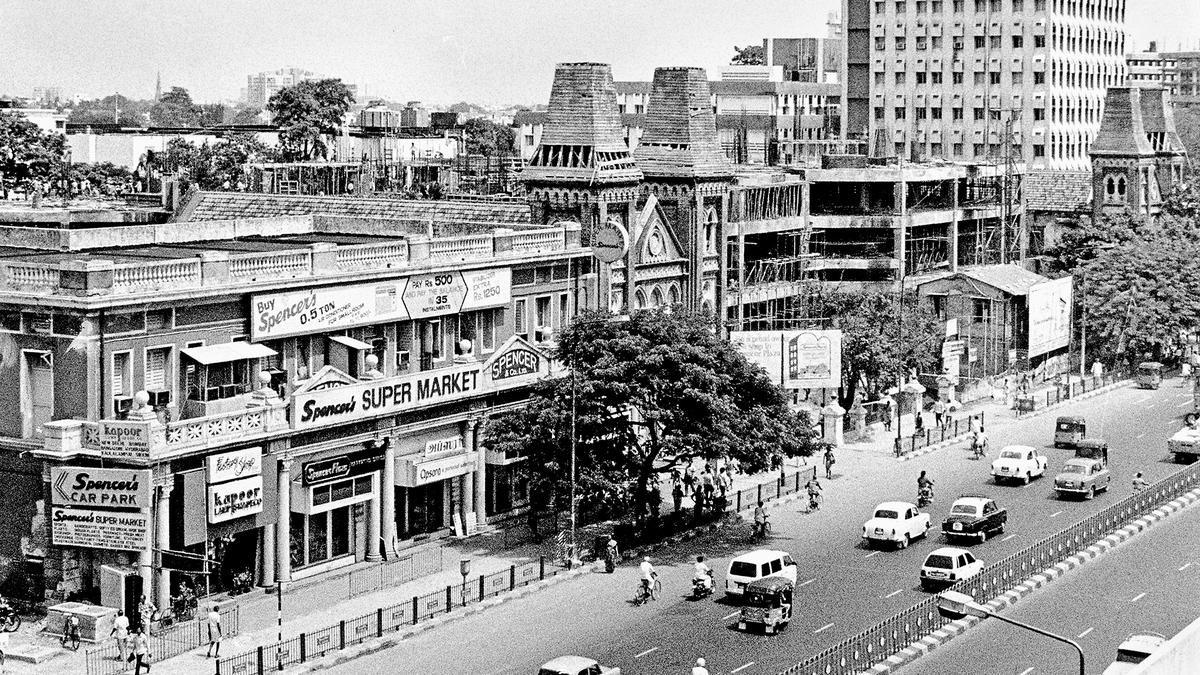
A view of Madras of yore.
| Photo Credit: The Hindu Archives
I remember, as though it happened yesterday, my first train journey to Chennai, then Madras, half a century ago as a pre-teenager. Those days, our little town of Nagercoil did not have a railway station, and we took the train from Nellai Junction. The reserved compartment was less crowded and offered plenty of room for my siblings and me to move around and feel at home. The concept of lying flat overnight on the berth while travelling was simply amusing, as we played around for a long time before eventually falling asleep.
It was only when we alighted at the Mambalam station the next morning that I realised that the train had been carrying a huge crowd to the city overnight. We found ourselves in a different world. Hawkers and hagglers filled Ranganathan Street with noise as humanity flowed like a river. Men in khaki trousers and sleeveless vests ferried people in cycle rickshaws, their bells ringing incessantly. The rooftops of houses invariably sported television antennas, where birds perched in the evening before calling it a day.
I was more familiar with the T. Nagar area where my maternal aunt lived. The area has changed completely in recent times, with the large, shady roadside trees, wide, walker-friendly pavements, and the street vendors selling watermelon and musk melon now gone. In those days, it was common to see milkmen milking buffaloes at street corners and delivering fresh milk to doorsteps. Walls in public places were covered with cinema posters that changed every Friday, giving a fresh new look.
On Sunday evenings, the streets would appear deserted as it was prime time for TV movies. During summer evenings, families would watch TV with their front doors open to let in the breeze, and as you walked down the streets, you could almost follow the entire movie. Similarly, on Fridays, office-goers would hurry home, eager not to miss the Oliyum Ozhiyum programme that aired Tamil movie songs.
In those days, cinema houses, abundant in and around the city, were cherished hubs of entertainment. The magic of the silver screen drew crowds like moths to a flame, with the assurance of entry even when tickets were sold out — thanks to men and women who thrived on selling tickets in the black market. Towering cut-outs of popular stars on Anna Salai heralded the arrival of forthcoming blockbusters, captivating the imagination of passers-by. Alongside these grand displays, the melodic jingles on Vividh Bharati in the evenings added to the excitement, enchanting young and old alike.
The electric trains, with their high-pitched rhythmic whine, served as the city’s cheap local transport, running like blood through veins from early morning until late at night, transporting countless people across the city. The overcrowded, popular green city buses epitomised human collaboration at its best, with the conductor acting as a stationary ticket kiosk, sitting at the back and passing tickets through the human chain.
Today, with its network of roads, overbridges, and sleek underground trains, Chennai has transformed into a modern metropolis. The city moves faster, and convenience is at its core. Yet, amidst all this progress, the soul of Madras feels distant — like a memory fading into the background. The charm of its slower pace, the friendly chaos, and the warmth of familiar faces seem replaced by a more polished rhythm. While the growth is undeniable, a certain warmth and character seem to have been left behind, as though Chennai has lost its Madrasness.
As I walk down this once-familiar road — now paved with concrete and lined with parked cars instead of hawkers’ carts — I can’t help but long for the days gone by. Back then, the streets were alive yet spacious, bustling yet unhurried. The city’s hum was gentler, its pulse slower — a rhythm, a feeling, now lost to time.
jclementselvaraj@gmail.com
Published – September 21, 2025 03:00 am IST

