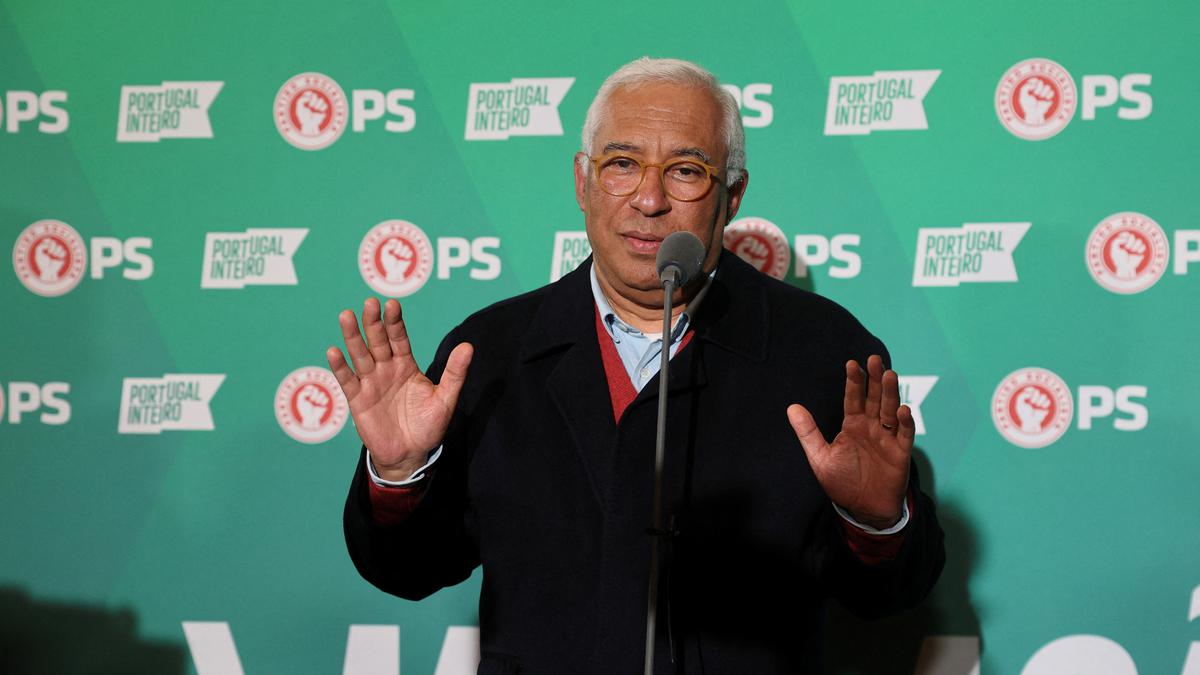
Portugal’s Prime Minister Antonio Costa speaks to members of the press on the day of the general election, in Lisbon, on March 10, 2024.
| Photo Credit: Reuters
With nearly all ballots counted, the ruling Socialist Party (PS) narrowly came second, with 28.7% of the votes, to the centre-right Democratic Alliance (PSD), which garnered 29.6% of vote share, as higher than average polling in a snap Portuguese general election yielded a hung parliament. Historically, the balance of power in the 230-member House has alternated between the PS and the PSD.
However, even if the PS had cobbled together a coalition to remain in office, it would not have retained the Goan-origin Antonio Costa, who has been Prime Minister for eight years – the past three and a half months as caretaker.
The 62-year-old Costa, who undertook a state visit to India in 2017, which included a journey to his ancestral village of Rua Abade Faria, Margao, Goa, resigned as Prime Minister in November after law enforcement authorities arrested his Chief of Staff and personal adviser together with naming two of his Cabinet Ministers as suspects over alleged irregularities in awarding state contracts. Police also raided Mr. Costa’s official residence and he, consequently, became a subject of an official investigation.
For the first time in half a century, the Far Right in Portuguese politics, in the five-year-old incarnation of the Chega (Enough) party, significantly raised its head winning 18.1% of the votes to emerge as the third largest formation. This could compel a PSD government to seek Chega’s support to pass legislation.
The PSD’s prospective Prime Minister, Luis Montenegro, though, insisted he will not turn to Chega for parliamentary business, let alone grant it the status of kingmaker, describing its leader Andre Ventura as ‘often xenophobic, racist, populist and excessively demagogic’.
Mr. Ventura, formerly a trainee Catholic priest, catapulted into public attention as a football commentator on television – football being Portugal’s most popular sport – before venturing into politics.
As PSD activists celebrated with ‘Victory’ signs at their party headquarters, Mr. Ventura remarked: ‘The Portuguese clearly said they want a two-party government: Chega and the Democratic Alliance.’
Mr. Costa’s handling of the COVID pandemic and the economy in what is Western Europe’s poorest nation drew appreciation. Unemployment dipped and Portugal’s GDP growth in 2023 reached 2.3% compared to the EU average of 0.7%.
However, in addition to targeting the perceived corruption, his opponents attacked him on immigration (code for non-white influx) and the stress this has caused to healthcare, housing and public services.
A PSD administration, especially one dependent on a prop-up from Chega in Parliament, is expected to embark on tightening migration from outside the EU, thereby posing barriers to Indian businesses or skilled workers establishing a base in Portugal.
‘Operation Vijay’ or Prime Minister Jawaharlal Nehru’s despatch of the Indian Army to reclaim Goa, Daman and Diu from Portuguese colonisation in 1961, instigated Portugal to angrily move a resolution at the UN Security Council demanding India’s withdrawal. The U.S., the U.K., France and China backed the motion, but the Soviet Union vetoed it in a diplomatic triumph for New Delhi. Indo-Portuguese ties, though, predictably plummeted, as Lisbon took considerable umbrage at being so unceremoniously evicted.
In contrast, Mr. Costa’s strategy was to make Portugal ‘India’s gateway to Europe’, recommending it as a staging post for cooperation in technology, defence and shipping in the EU’s $500 million market.
Mr. Costa joined the youth wing of the Portuguese Socialist Party in 1975 after a bloodless armed forces’ coup against a 48-year Far Right dictatorship in 1974 – known as the Carnation Revolution — paved the way for a transition to democracy in Portugal. His launch-pad for becoming secretary-general of his Socialist Party – a stepping stone to becoming Prime Minister – was the Mayorship of the Portuguese capital between 2007 and 2015. His relatively frugal ways earned him the salutation of ‘Gandhi of Lisbon’.
Though he interacted with the likes of Narendra Modi, Mr. Costa once told media: ‘Against the politics of fear, we need to build hope… that is why Gandhi’s actions and ideas will continue to inspire many around the globe in their non-violent resistance to authoritarian governments …’
Politics in Portugal could now be metamorphosing into a different kind of inspiration and outlook.
Ashis Ray is a London-based journalist.