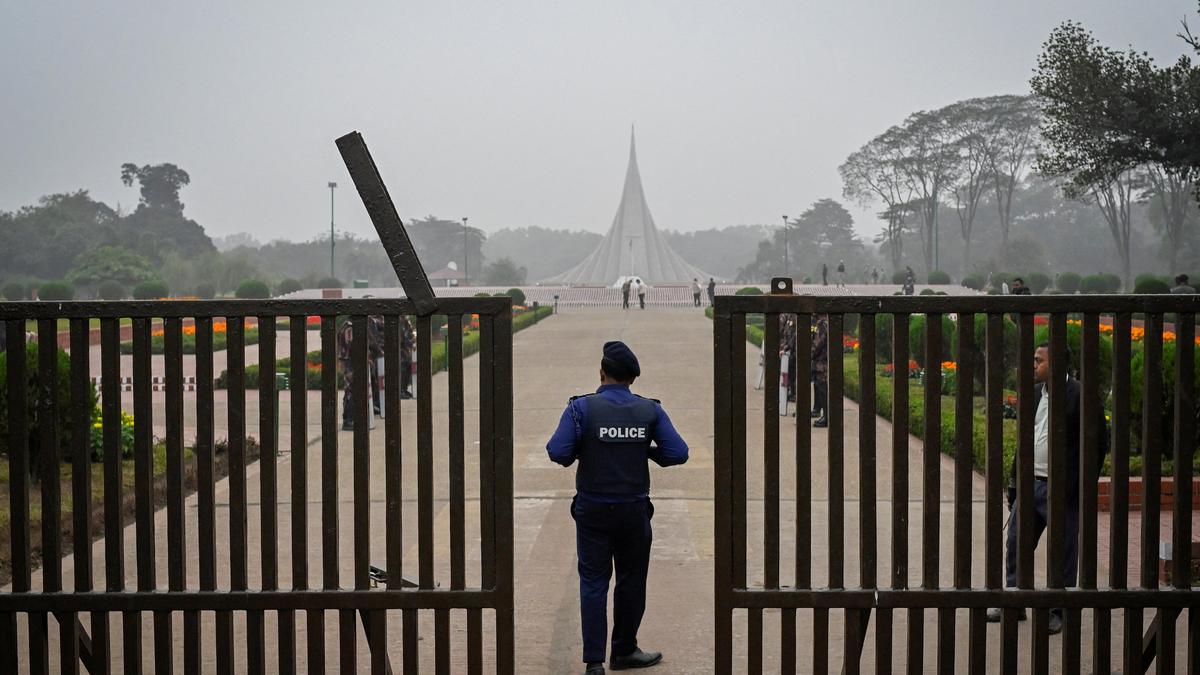
A police officer stands guard at the National Martyrs’ Memorial before the arrival of Bangladesh Nationalist Party (BNP) acting chairman Tarique Rahman in Savar, on the outskirts of Dhaka, Bangladesh, on December 26, 2025.
| Photo Credit: Reuters
A day after the funeral of his mother and BNP Chairperson Khaleda Zia that was attended by way above a million citizens in Dhaka, Bangladesh Nationalist Party’s Tarique Rahman thanked the law enforcement agencies of his country including the police that bore the brunt of public ire over the past sixteen months because of its involvement in the Hasina-era crackdown against protesters.
“My sincere thanks also go to the men and women serving across our security and law-enforcement services: the Home Adviser’s office, the Police, BGB, Ansar & VDP (Village Defence Party), RAB (Rapid Action Battalion) and APBN (Armed Police Battalion). You worked patiently and respectfully, helping millions of people gather and return safely, allowing families to mourn and pay their respects in peace,” said Mr. Rahman
Tarique Rahman’s appreciation for the police for its handling of a large emotionally charged crowd has come after nearly sixteen months when Bangladesh’s police and law enforcement officials have been burdened by the guilt of being complicit in repression under the Sheikh Hasina government during July-August 2024. The tragedy was amplified further by the mob lynchings and attacks that the police was subjected to after Ms. Hasina fled to India. Reputation of the police further suffered when videos were circulated showing the Home Minister Asaduzzaman Khan Kamal receiving feedback from police officials about the attacks on protesters.
In this backdrop, the press wing that works under Chief Adviser Mohammed Yunus said on October 25, 2024 that the total number of policemen who perished in post-Hasina violence was 44. Out of the total 44, at least 13 policemen were killed in the brutal attack at the Enayetpur police station in Sirajganj a day before the Hasina government was toppled. Given the intensity of public antipathy towards the police, there were lingering doubts about the authenticity about the total number of police casualties given by the interim government.
Former Home Minister Khan Kamal who is currently outside Bangladesh received a death sentence on November 17 from the international crimes tribunal (ICT).
After the fall of the government of Sheikh Hasina, who was recognised for her “zero tolerance of terror” policy, the Bangladesh police continued to be handicapped because of the lingering stain of the crackdown and as a result, they often were forced to respond to emergency circumstances without protective gears or defensive weapons. Being unarmed Bangladesh police also avoided arriving on the scene of active violent crimes as seen often in cases of attacks against minority communities on multiple occasions including when victims either perished or had to be rescued by the military. In view of the breakdown in policing, On September 17, 2024, magisterial power across the country was taken over by the Bangladesh Army that started giving protection to the police. Despite that police would often fail in delivering its expected service as seen most recently when mobs burnt down the offices of leading dailies Prothom Alo and Daily Star and wrecked Udichi and Chhayanaut, two iconic cultural institutions of Bangladesh.
In this backdrop, the law and order machinery of Bangladesh had the responsibility of three back to back mega events – the first being the funeral of Sharif Osman Hadi, the second was the return of Mr. Rahman from London and the third was the funeral of Khaleda Zia. Mr. Rahman also thanked the intelligence outfits of Bangladesh and the military wings for standing “with dignity and diligence throughout the day”. “Many of you were on duty for long hours, ensuring order and calm while remaining mindful of the grief that surrounded us, said Mr. Rahman.
Published – January 03, 2026 02:46 am IST