

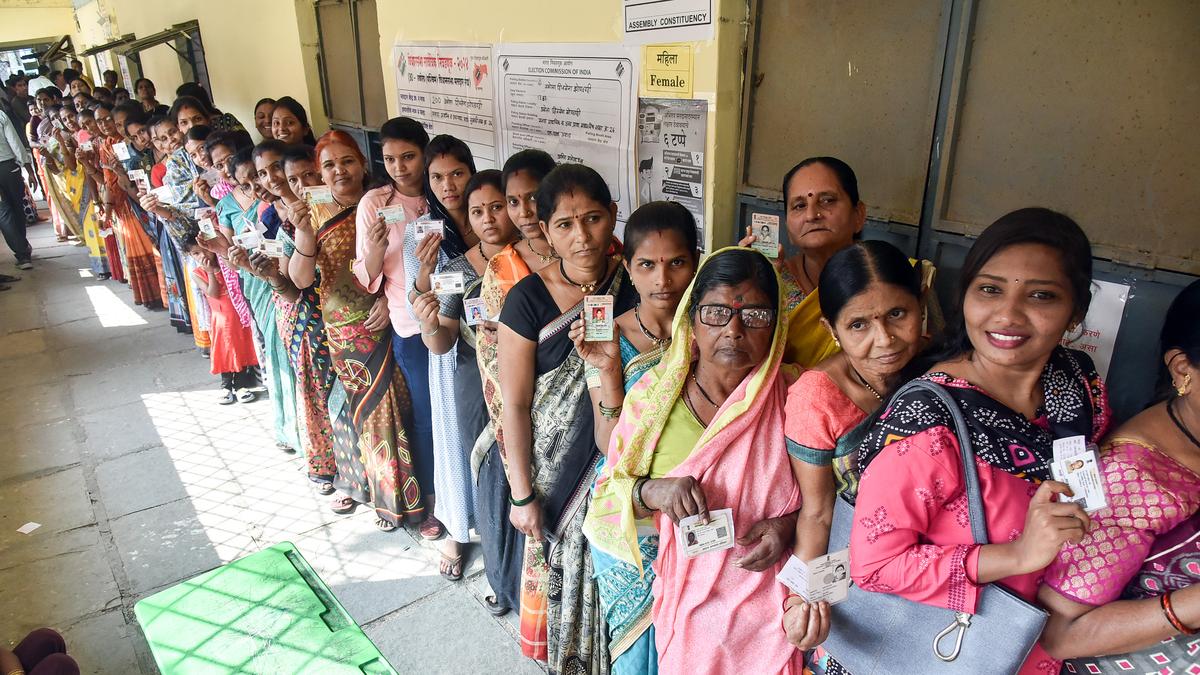
Voters wait in queues at a polling book in Akola, File
| Photo Credit: ANI
In the Maharashtra and Jharkhand Assembly elections, there was a pattern that was followed — having a cash transfer scheme for women that is at the centre of political campaigning. Beginning in August, the National Democratic Alliance government in Maharashtra came up with the ‘Mukhyamantri Majhi Ladki Bahin Yojana’, wherein women who met the criterion would receive ₹1,500 a month in their Aadhaar-linked bank accounts. The Opposition-ruled State of Jharkhand also had the ‘Jharkhand Mukhyamantri Maiya Samman Yojana’, in August, which offered financial assistance of ₹1,000 to eligible women.
Direct cash transfer schemes are no political novelty. According to Axis Bank, 14 States already have such schemes in place, covering almost a fifth of India’s adult female population. So, why is it that across States, cash transfer schemes for women are growing in popularity? Is this policy learning or are State governments experiencing a fear of missing out? Are we getting to a point where there is no alternative vision about welfare? There could be four plausible reasons for political parties across States following this particular genre of welfare.
More women in the public-political space
First, the steady rise in the presence of women in India’s public-political space as a force to be reckoned with is pushing parties to cater to their needs. From a mere 47% turnout of women in 1962, the figure is now 66% in 2024. It is the same trend in State Assembly elections. Along with the increase in turnout, the fact that women are increasingly casting their votes independently reinforces the narrative of a ‘women constituency’. The hurried manner in which Parliament passed the women’s reservation Bill and the renewed focus on ‘Nari Shakti’ are testimony to the rising pressure on political parties to acknowledge the change. In the context of a close election, a swing in votes could mean winning or losing a seat. The cost of disregarding the female voter would mean paying a very high price.
Bypassing the middleman
Second, Direct Benefit Transfer (DBT) is the flavour of the day. Direct cash transfers to bank accounts have their advantages from the point of view of the state. It helps the state bypass existing structures of middlemen who pose a hurdle in making these benefits available. Systemic corruption of this kind is ubiquitous in the Indian setting, and the state lacks the capacity to keep it in check. With the advent of DBT, States can now transfer money directly to the beneficiary’s account and reduce leakage through the system. With parties becoming more individual-centric, DBT helps establish a direct relationship between the individual leader and the citizen. Yamini Aiyar and Neelanjan Sircar call this “techno-patrimonial”, whereby technology aids in advancing personal loyalty to the leader.
The third reason is an extension of the preceding argument. Cash transfers are an easy way to establish the narrative that the government in power is serious about its commitment to the electorate. For instance, improving the functioning of State-run schools or hospitals or building new public infrastructure cannot happen overnight. Such projects require meticulous planning, investment, and a long gestation period before they can bear any fruit.
In addition, given the fact that the poor in India form a significant constituency and that the gains of economic growth are disproportionately divided, populist schemes of this nature are valued by a substantial number of voters. Regular credit to the beneficiary’s account also acts as a constant reminder of the ‘benevolence’ of the leader, further advancing the party’s position.
The core issue
Fourth, this also points to a larger problem dotting the welfare landscape in India. A flattening of welfare, with States across the country coming up with similar kinds of schemes, indicates a deficiency of imagination vis-à-vis welfare in India. One could euphemistically call this “policy learning”, but the fact that even States ruled by Opposition parties are not offering alternatives to this welfare strategy of DBT — sharpened to perfection by the Bharatiya Janata Party at the central level — is worrying.
Though schemes of this kind might look to be a quick and effective solution to the poverty crisis, DBT comes with its own set of problems. Scholars have pointed out that the Indian state, by prioritising ‘efficiency’ using technology, is shielding itself from doing the hard work to improve state capacity. By making cash available in the hands of the poor, the state is nudging its citizens to make use of private alternatives for their basic needs. While the rich in India have already exited this system and are relying on the private for their needs, the poor are also being nudged by the state to fend for themselves. But can the poor in India afford to disengage with the state? Cash transfers, at best, act as bandages, but the state still needs to treat the larger wounds before they become infectious — if they have not already become one.
In the days ahead, yojanas such as ‘Ladki Bahin’ and ‘Maiyan Samman’ will occupy centrestage. So, is this the new rule of the game? Or will there be a break to this pattern? The answers will determine the future welfare landscape.
Abhijith Nair is a research scholar at King’s India Institute, King’s College, London. Shreya K. Sugathan is a research scholar at the Department of Political Science, University of Hyderabad
Published – December 05, 2024 12:08 am IST

