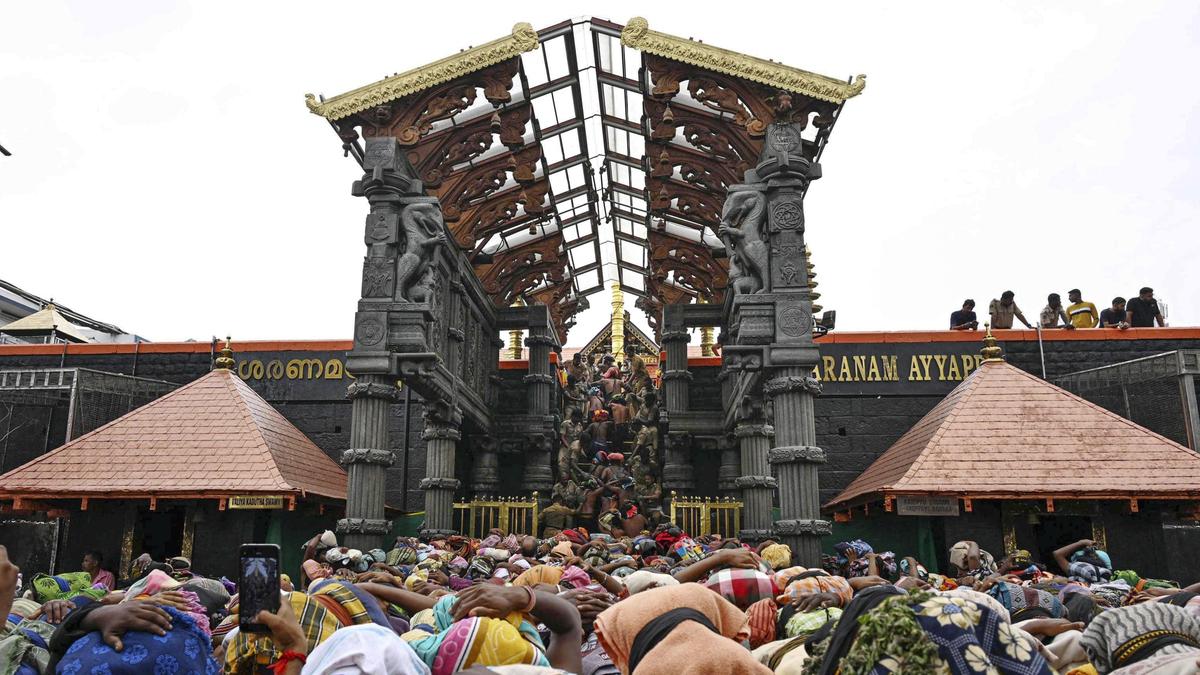
‘A crisis at Sabarimala never remains confined to Sabarimala’
| Photo Credit: PTI
A week after the Sabarimala Ayyappa temple opened for the annual pilgrimage, there is an unusual calm at the hill shrine in Pathanamthitta Nearly six lakh devotees have completed the trek through the Periyar Tiger Reserve.
The tranquil scene of mist, rain-washed forest trails and an unhurried flow of pilgrims is in sharp contrast to the chaos of the first few days of the season. It began even before the temple opened, triggered by a High Court-monitored probe into alleged misappropriation of gold involving Travancore Devaswom Board (TDB) officials. There was a flurry of reviews, security checks and confident claims about the arrangements followed.
As the crowds began to build, every system buckled under the pressure. Cleanliness and hygiene faded away, there were food and water shortages and queues froze. Images of exhausted pilgrims fainting along the trekking route poured in. Many bypassed barricades and used multiple points to make their way to the Sannidhanam. Even distant transit hubs such as Erumely and Pandalam were overwhelmed.
For a shrine known for its precise crowd management, Sabarimala was now close to facing a stampede-like situation. The TDB president, K Jayakumar, a former bureaucrat, who took over the reins of a scandal-hit TDB just days before the season began, called the situation ‘dangerous’ and ‘unacceptable under any circumstances’.
The TDB and the police came up with explanations such as the heavy inflow through forest routes, poor handover by the outgoing administration and a surge in footfalls. Reports of devotees abandoning their journey made it clear that the situation was in danger of getting out of control. Efforts to divert the swelling crowds at the Sannidhanam through alternative gates prevented many from accessing the 18 holy steps, which is a core ritual of the pilgrimage. Extending darshan hours made little difference, as the surge of pilgrims continued at the steps — around 45 pilgrims per minute. The death of a 59-year-old pilgrim from Koyilandy in Kozhikode at Appachimedu, heightened tensions. The absence of central forces only added to the pressure.
There was also the politics. The Congress accused the CPI(M)-led government of gross negligence. The BJP amplified the attack. Right-wing social media lit up with allegations that the State was ‘humiliating’ Ayyappa devotees. And the Karnataka government formally sought Kerala’s cooperation to ensure the safety and smooth movement of pilgrims from the State. The Devaswom Bench of the High Court stepped in once again, demanding urgent corrective action by the authorities.
While reviewing the Sabarimala Special Commissioner’s report, which stated that over two lakh pilgrims had visited the temple in just 48 hours, the High Court noted that women and children could not face danger. Then came the most pointed question: why were preparations for the Mandalam-Makaravilakku season not initiated six months earlier?
The course correction was swift, with a clampdown on the crowd inflow. Though virtual-queue bookings remained unchanged, spot bookings were slashed from 20,000 to 5,000 a day. The effect was immediate. Footfalls from neighbouring States dropped sharply, perhaps affected by reports of the chaos.
But order returned. The forest trails became quieter. Pilgrims walked on with a sense of fulfilment. For a government heading into back-to-back elections, this return to normal was nothing short of political oxygen.
Even under the Model Code of Conduct, Devaswom Minister V.N. Vasavan sought special permission from the High Court to convene a review meeting — an indication of how critical the situation had become. A new consultative committee — the police coordinator, the TDB Executive Officer and the Special Commissioner — is in place. The movement rate up the holy steps has risen to over 70 pilgrims a minute, with plans to push it to 85. A 140-member Rapid Action Force team is to support crowd management. The relief in the corridors of power is unmistakable. If Kerala’s political establishment has learned anything over the years, it is this: a crisis at Sabarimala never remains confined to Sabarimala. It spills into public discourse, onto political platforms and, eventually, to the ballot box. And with election season looming, that is a risk no government can afford to take.
hiran.u@thehindu.co.in
Published – November 24, 2025 12:40 am IST