As 2025 unfolded, India’s business landscape evolved not just by a single defining event, but rather a cascade of developments shaped the business arena. Monetary policy signals, reforms and changes in policy decisions and global corporate entries kept surfacing throughout the year, with each event marking a moment of significance in its own way. Together, these developments capture notable business moments that characterised 2025. Neither exhaustive nor strictly chronological, this list invites us to rewind the tape of ‘2025’.
Trump’s tariff trade war
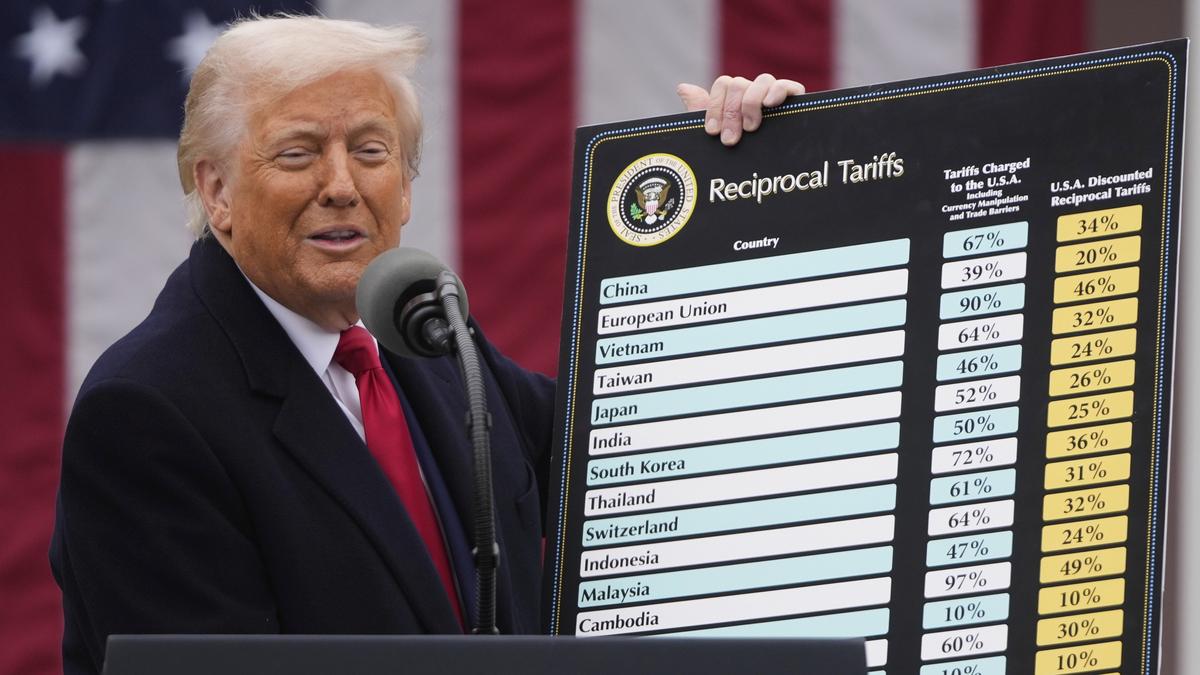
On July 30, 2025, U.S. President Donald Trump announced that imports from India will attract 25% tariffs from August 1, 2025, along with a penalty. President Donald Trump cited India’s purchases of energy and military equipment from Russia as the primary rationale behind the move, linking trade penalties to geopolitical alignments.
Moreover, the U.S. trade policy towards India saw multiple reversals. Later in August 2025, following diplomatic engagement, the tariff was suspended (though temporarily) before being reinstated and expanded to 50% on August 27, 2025 through a subsequent executive order. As of mid-December 2025, there is still no signed trade agreement between India and the U.S. nor any tariff relief.
Notification of Labour Codes
On November 21, 2025, the Union Government formally notified all four Labour Codes, ushering in major reforms in labour laws. The Code on Wages, 2019, Industrial Relations Code, 2020, Code on Social Security, 2020 and the Occupational Safety, Health and Working Conditions (OSHWC) Code, 2020 were passed between 2019 and 2020 but remained unnotified for several years owing to protests from trade unions. They are likely to be fully operational from April 1, 2026.


The notification brought several structural changes such as unification of four labour laws related to bonus and wages; consolidation and modernisation of 13 existing Centra labour laws related to workplace health and safety measures; extension of universal social security coverage to gig workers; consolidation of laws governing trade unions.
100% FDI in insurance
The Lok Sabha, on December 16, 2025, passed a Bill that proposes to increase Foreign Direct Investment (FDI) in the insurance sector from 74% to 100%. Finance Minister Nirmala Sitharaman said that allowing 100% FDI would pave way for further capital infusion, better technology, and that people would have access to better insurance products. It may be noted that the FDI limit for insurance companies was raised from 26% to 49% in 2015 and from 49% to 74% in 2021.
DPDP rules moved from legalisation to compliance
On November 14, 2025, the Union Government notified large parts of the Digital Personal Data Protection (DPDP) Act, 2023, addressing the need for a law to protect people’s data privacy. The centre worked towards operationalising the DPDP Act by through consultations and outlining draft rules governing consent, data fiduciaries, penalties, and compliance timelines. While the Act itself had been passed in 2023, the year 2025 marked the transition from legalisation to compliance as business houses started preparing for actual compliance, through data audits, consent frameworks, and governance structures.

Not just this. Following pushback from disability rights activists, the Ministry of Electronics and Information Technology also revised the DPDP Rules, 2025, removing a provision in the draft that had grouped persons with disabilities with children for the purpose of guardian-based consent.
Activists, who described the earlier provision as the “infantilisation” of persons with disabilities, welcomed the change in the notified rules, though adding that several concerns remain still.
GST reforms
In 2025, the Centre reduced the number of slabs under the Goods and Services Tax (GST) system, retaining the 5% and 18% slabs and doing away with the 12% and 28% ones. Further, it introduced a lower concessional rate below 1% and a high “sin rate” of 40% on just five to seven items each.
Soaps, powder, coffee, diapers, biscuits, ghee, oil to be cheaper as cos extend GST 2.0 benefits
In addition to the slab-rate changes, GST reforms in 2025 also focussed on compliance and system-tightening measures.
New Income-Tax law legalised
In August 2025, the Parliament passed the new Income-Tax Bill, 2025, and subsequently received Presidential assent in the same month, becoming the Income-Tax Act, 2025. The new law replaces the Income-Tax Act of 1961 and is scheduled to come into force from April 1, 2026. The Act was one of the most significant changes made to the country’s direct tax framework in decades. While the legislation did not alter tax rates immediately at that time, Sitharaman said the measure aimed to simplify language, remove redundancies, and modernise tax administration. For business houses, the passage of the Act was a notable milestone, as it set the legal foundation for future tax compliance, assessments, and litigation under a restructured framework.
Income-Tax slab revision
In the Union Budget 2025-26, the Union Government revised the Income-Tax slab structure under the new tax regime, resulting in zero tax on annual incomes up to ₹12 lakh and an effective tax-free limit of up to ₹12.75 lakh for salaried taxpayers after accounting for the Standard Deduction of ₹75,000.
Ms. Sitharaman said the move is intended to provide substantial tax relief to taxpayers and to repose faith in middle-class people. The benefit, Sitharaman said, would boost household consumption and investment.
Record GST collections
In April 2025, GST collections reached a record high of ₹2.37 lakh crore, the largest monthly revenue figure recorded since GST’s rollout in 2017. This represented a 12.6 % year-over-year increase compared with April 2024 figures, reflecting a strong economic activity.
RBI Repo rate reset
After a lull of 57 months since 2020, it’s only in 2025, the Reserve Bank of India’s (RBI) Monetary Policy Committee (MPC), under Governor Sanjay Malhotra, lowered the repo rate four times. The first cut was announced on February 7, 2025, when the MPC unanimously slashed the repo rate by 25 basis points (bps) to 6.25%. This was followed by another unanimous 25 bps cut to 6% on April 9, 2025. Further, on June 6, 2025, the MPC delivered a larger 50 bps reduction to 5.50% with a 5:1 majority vote. After a detailed assessment of the evolving macroeconomic conditions, the MPC voted unanimously to maintain the repo rate unchanged at 5.50% in both its August and October 2025. Finally, on December 5, 2025, the MPC voted unanimously to reduce the policy repo rate by 25 basis points (bps) to 5.25% with immediate effect. So, overall, 2025 is an important year for both banks and borrowers as the RBI’s MPC has cumulatively cut the repo rate by 125 basis points (1.25%) on four occasions, unlike the past five years of post-pandemic times. For Indian business houses, RBI’s rate cut was considered 2025’s key macro developments.
Fastest sectoral activity in more than a decade
In August 2025, India’s manufacturing sector recorded its fastest expansion in more than 17 years, supported by strong demand that lifted new orders and production. That is, the HSBC India Manufacturing Purchasing Managers’ Index (PMI) rose to 59.3 from the July’s mark of 59.1.
India’s services sector too recorded a sharp acceleration in August 2025, with growth hitting a 15-year high, backed by robust demand. To be specific, the HSBC India Services PMI, compiled by S&P Global, climbed to 62.9 in August from 60.5 in July, but fell short of the flash estimate of 65.6.
The Tesla moment
On July 15, 2025, American electric vehicle company Tesla officially commenced business operations in India by opening its first ‘experience centre’ at Bandra-Kurla Complex (BKC), Mumbai. It may be noted that before the official launch, Tesla’s founder & owner Elon Musk had lobbied for import duty reduction, however, his attempts went in vain.
In India, Tesla introduced electric vehicle Model Y, which was the world’s bestselling vehicle in 2023, becoming the first EV to achieve this milestone then. The vehicle’s price in India was far higher than other countries owing to the nearly 100% import duty levied on Completely Built Units (CBUs).
The entry of Tesla is not just another entry like how every year some or the other foreign company keeps landing its wheels in the Indian market. Tesla began taking pre-orders from Indian customers (with no timeline for delivery), way back in 2016. So, Tesla took nearly nine years to enter India and 2025 opened the doors. Also, in August 2025, Tesla opened its second experience centre in Delhi’s Aerocity coupled with the city’s first Tesla charging station. Further, in November 2025, Tesla appointed former Lamborghini India head Sharad Agarwal to lead its India operations.
Entry of Vietnam’s VinFast
VinFast, an electric vehicle company in Vietnam, officially entered India with the inauguration of its first EV assembly plant outside Vietnam. The new facility was inaugurated in Thoothukudi, Tamil Nadu, on August 6, 2025, in the presence of the Chief Minister M.K. Stalin. The company is set on a parcel of 400-acre land within the SIPCOT Industrial Park.
Overall, the defining business moments of 2025 stemmed less from sweeping overhauls but more from concrete decisions, policy shifts as well as external shocks. Yet, the year left an indelible imprint on India’s business landscape. These events together form a factual snapshot of how businesses navigated the year.