

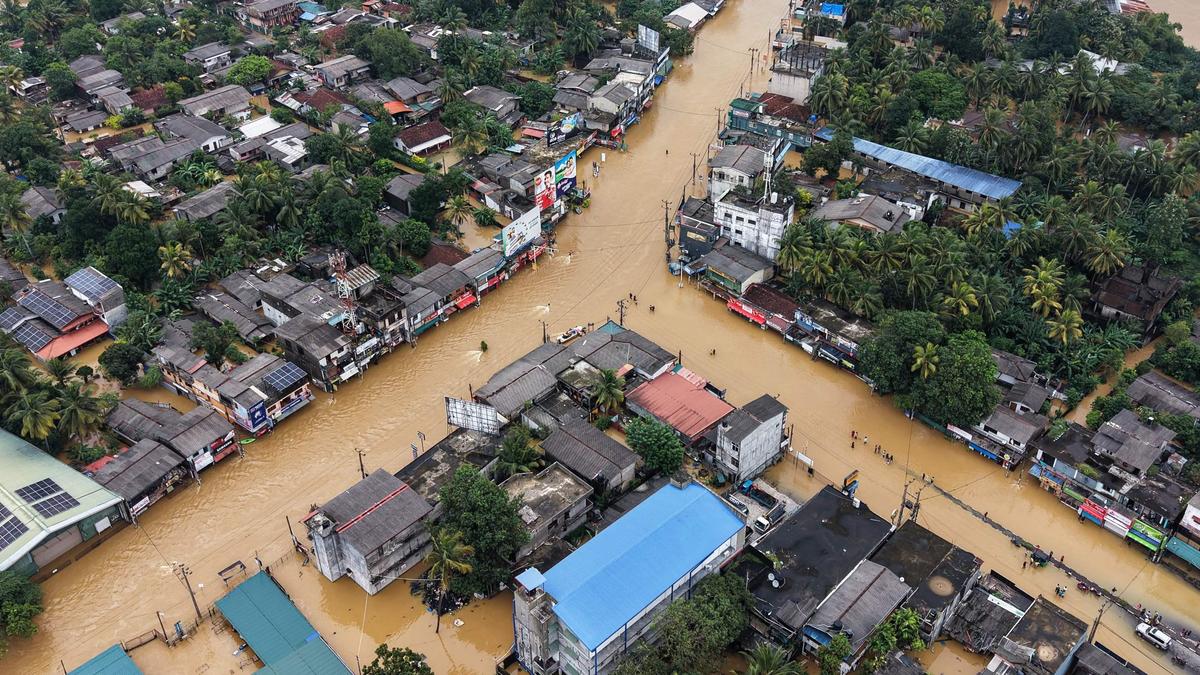
As the extent of devastation from Cyclone Ditwah begins unfolding in Sri Lanka, amid a mounting death toll — 479 confirmed deaths till date — the island is bracing for a daunting period of recovery from what appears to be its worst natural disaster since the Indian Ocean tsunami of 2004.
Reports of rescue missions finding entire villages beneath the earth in some locations have raised fears of a further increase in the death toll, even as 350 people are still reported missing.
A United Nations-backed ‘Rapid Needs Assessment’ flagged high risk of food insecurity, severe crop damage, and widespread destruction of crucial infrastructure after torrential rains and landslides battered the entire island. The central and southern hill country, where a large number of Malaiyaha Tamil estate workers — one of Sri Lanka’s poorest communities — reside and work, is the most affected region, with the highest fatality count emerging from Kandy, Badulla, Nuwara Eliya, Kegalle and Matale districts.
The assessment, based on data and inputs from many local and international NGOs, said as of December 1, 2025, at least 78 roads and 15 bridges were damaged, nearly 3 lakh buildings remained inundated, and over 65,000 power outages and telecom failures were reported.
Supply chains of essentials, including vegetables, are badly hit, triggering an increase in vegetable prices by 30%–200% due to limited supply and widespread crop damage, it noted.
R. Ravindrakumar, who leads a farmers’ organisation in the northern Kilinochchi district, said some of the paddy crop in the area escaped the disaster because it was in the early sowing stage of the farming cycle. “But vegetable farms have been destroyed everywhere. This means the country will definitely run out of supply. Usually, when it is off season in Nuwara Eliya (Central Province), the supply from the north would compensate, and vice versa. But now, all regions have been affected,” he told The Hindu. Local vegetable markets in Colombo sold carrots at LKR 3000 (nearly ₹ 880) per kg this week.
Further, health service delivery remains affected across all 25 districts, with several facilities inaccessible or functioning at reduced capacity, the assessment pointed out. “So many primary health centres have been severely affected – preventive and curative care is not available in the affected areas,” said Vinya Ariyaratne, who leads Sarvodaya, a community-based development organisation that is part of the ongoing rescue and relief efforts. The main challenge, he said, was that several areas in the hilly regions remain inaccessible even now. “There is no physical access because roads are fully destroyed. There is no phone access too, because of the disruption in communication lines,” Dr. Ariyaratne said, adding that the armed forces’ role in reaching aid to such areas has been “crucial”.
Many civil society groups on the ground acknowledged the daunting task facing the Anura Kumara Dissanayake administration, while pointing to the need for better coordination in its early response.
Menaha Kandasamy from the Ceylon Workers Red Flag Union — an organisation of tea and rubber plantation workers — said the interior parts of Kandy district are still fraught with risks. “So many roads have slipped into the soil, the hills look like they could slide any moment, so we fear if the area can withstand another bout of rain that has now been predicted,” she told The Hindu, after a visit to some estates and safety centres in the district on Wednesday. “The government is doing its best to ensure that relief, especially nutritious food, reaches even the most remote parts, that is reassuring. But there is a need for medicines, better hygiene and sanitation,” she added.
While some workers employed in relatively less affected estates have been able to resume work, many others were still out of work. “It is still early, and we need a good assessment of the hills before workers can return to pluck tea,” Ms. Kandasamy said.
Meanwhile, several countries including India, Pakistan, UAE, are rushing humanitarian aid to Sri Lanka, while others have pledged financial assistance to rebuild the country, whose relative stability after the 2022 economic crash is now shaken.
“We often think of the tsunami as the biggest natural disaster we faced as a country. But even then, only the coastal districts were affected,” Dr. Ariyaratne recalled. “Rescue efforts were not as complex, supply chains and communications in the rest of the country were intact. But now, the entire island is devastated, 22 out of 25 districts are disaster zones. Recovery is going to be very, very challenging,” he said.
Published – December 03, 2025 10:27 pm IST

