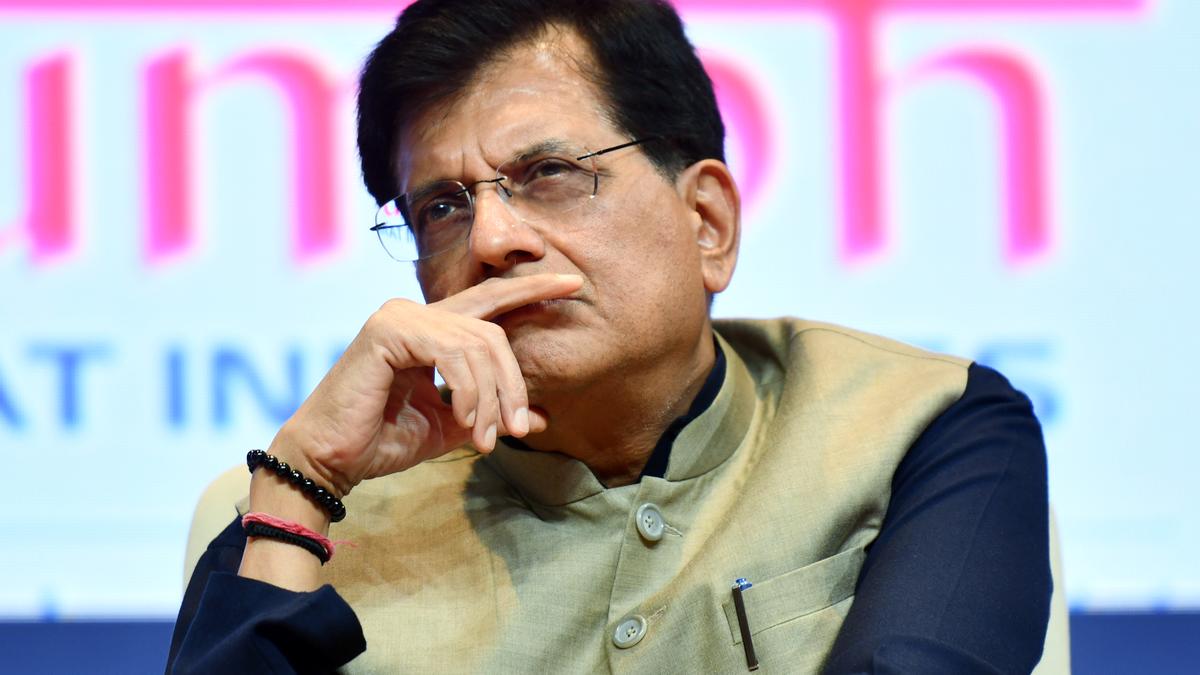
Recently, while speaking at the Startup Mahakumbh in New Delhi, Union Minister of Commerce and Industry Piyush Goyal said that startups were not innovating enough and were limiting themselves to grocery delivery. Are Indian startups not scaling up on innovation? Thillai Rajan and P.K. Jayadevan discuss the question in a conversation moderated by Ashokamithran T. Edited excerpts:
We have to be bigger, better, bolder: Union Commerce and Industry Minister Piyush Goyal message to Indian Startups
Commerce and Industry Minister Piyush Goyal on Thursday asked the Indian startup community to shift their focus from grocery delivery and ice cream making to to high tech sector like semiconductor, machine learning, robotics, and artificial intelligence.
He also said there is a need for more Indian investors into the startup ecosystem.
“Are we going to be happy being delivery boys and girls… Is that the destiny of India… this is not startup, this is entrepreneurship… What other side is doing — robotics, machine learning, 3D manufacturing and next generation factories factories,” Goyal said here at the Startup Mahakumbh, comparing the nature of Indian startups with that of Chinese.
The minister said the new startups should focus on preparing the nation for the future.
“Do we have to make ice cream or chips?” he asked.
He also underscored the evolving role of startups in driving India’s economic and technological growth.
He assured that the government will handhold and support those who face challenges in their startup journey, encouraging them to persevere and try again.
The minister stressed the need for increasing domestic capital investments, stating that a strong foundation of indigenous investment is crucial to reducing dependency on foreign capital and ensuring long-term economic resilience.
Goyal emphasised on the need to attract more domestic investors to strengthen India’s capital base and ensure self-reliance.
Video: PTI
| Video Credit:
Businessline
Do you agree with Piyush Goyal’s remarks?


Thillai Rajan: Startups thrive where the ecosystem helps them. Startups are engines of innovation, but are they innovating enough? That means, are they looking at commercialising science and technology-based innovation? If you consider innovation as a spectrum, people always consider science and technology as the highest order of innovation. I’m not saying that is right or wrong; I’m merely stating a fact. From that perspective, data shows that a healthy share of startups qualifies under the deep tech sector. So, there is adequate activity and interest among startups to venture into deep tech sectors.
But the question is, are they scaling up? The capital requirements of the deep tech startups are higher in the initial phase. No revenues come in during that phase, where the level of risk is very high. So, who can provide this amount of capital? The Startup India Seed Fund scheme gives about ₹50 lakh (for activities such as market entry, commercialisation, and scaling up), but that’s not adequate; there has to be follow-up funding. Today, there is realisation that there has to be private sector capital provided after the initial government support.

How do venture capitalists define innovation for the purpose of funding?
Thillai Rajan: By innovation, we mean the benefits it will give to users. Are users going to benefit? Are they going to get a new experience from using this product? Will the consumer pay a premium for accessing the products and services? It is to assess the impact that it can create on people. In this regard, there are two points to be made. The first is to ask whether the innovation gives any competitive advantage that can be sustained over a long period of time. For example, a patent gives a competitive advantage. If that is not available, it will not attract investors’ interest because the capital will not get returns. The second could be in terms of the market. It may be a great innovation, but unless it addresses a need in a growing market, there will not be many backers for it. So, these largely determine which innovations get commercialised and which ones do not.
What has been the result of the Startup India push? Has it borne fruit?
P.K. Jayadevan: Yeah, absolutely. Everyone wants to start a company these days, which is a huge shift in mindset compared to earlier.
But if you compare India to the U.S., you will find that the U.S. shifted manufacturing to China when it had trouble with Japan. China was where it could find cheaper labour. China saw that as an opportunity to create employment, grow its own market, and also learn from American companies. It built its own telecom networks, micro-satellites, etc. China had a very nationalistic view of technology. Because it’s a closed ecosystem, it always wanted to be more self-reliant with respect to technology. So, the ecosystem matured much faster. China’s consumption economy also grew in a big way. About $12,000-15,000 per capita GDP is really good for a digital economy. We are still around $3,500. We don’t have that kind of money to spend. We have cash-rich companies but they hesitate to invest, which is not the case in other ecosystems. That’s where we are lagging. The India consumption story has to move forward. For that we need some enabling criteria.
Are you speaking about some sort of an import substitution for capital?
What prevents startups from going up the value chain or becoming bigger?
Do you think governments in India have not started taking startups seriously?
India is a very unequal country. The upper middle class in urban areas want quick deliveries, domestic helps, electricians, etc. But the first wave of tech in India saw more broad-based growth. Have startups benefited only a few?
Thillai Rajan: The first wave of entrepreneurship was more unidimensional. Much of it was IT, software. But today, there is an emphasis on all sectors.
For every Aether, there is a Byju’s. What do startups have to do to make sure they become an Aether?
P.K. Jayadevan: I would say set a very high bar of corporate governance and innovation.
Thillai Rajan, Professor and Head, Research Centre on Startups, Indian Institute of Technology, Madras; P.K. Jayadevan, author, communications professional, and former journalist