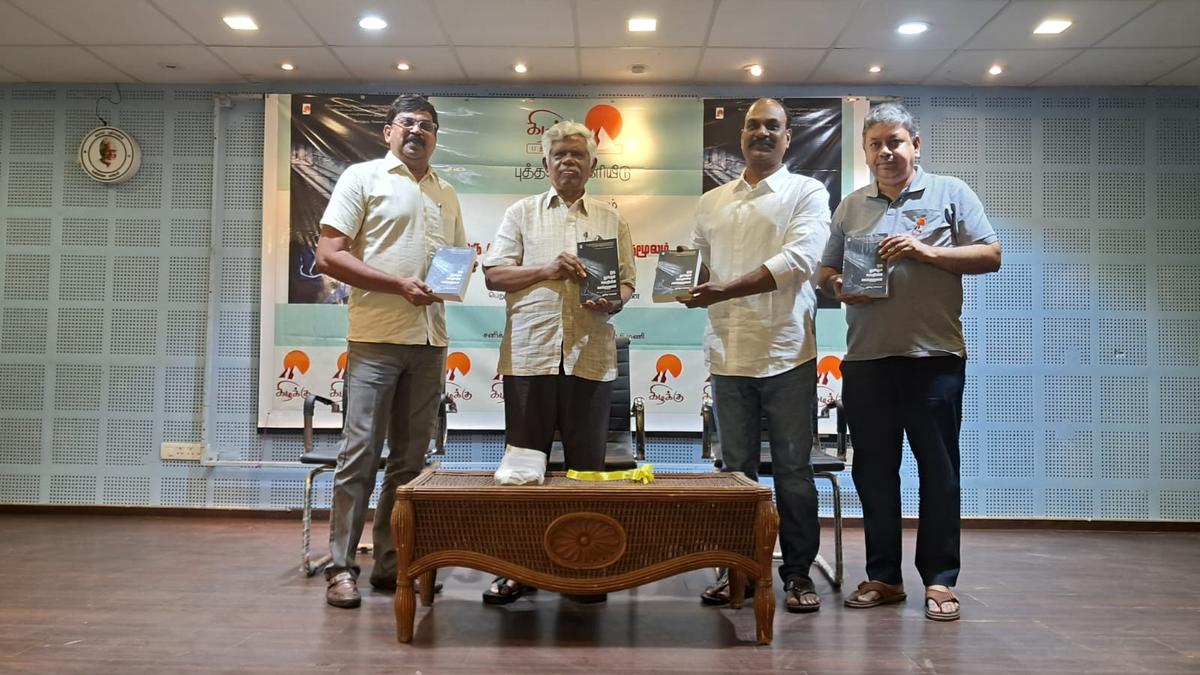
Writer Meeram Moideen, Justice K. Chandru, Selvam, and Badri Seshadri launching the book Oru Thooku Kaithiyin Vaakumoolam in Chennai on Saturday.
| Photo Credit: Special arrangement
It was a rare book launch. Selvam, the author of Oru Thooku Kaithiyin Vaakumoolam (Testimony of a Death Convict), was once condemned to death for a murder. The death sentences handed to him and his friends, Radhakrishnan and Shiekmeeran, were later commuted to life imprisonment by the President, on the condition that they spend the rest of their lives behind bars. With special permission from prison authorities, Selvam was allowed to step out briefly to attend the launch of his book in Chennai on Saturday. The presence of Selvam’s wife Jenila and his son among the audience lent a touch of poignancy to the event. Selvam’s written speech was read out at the event.
Justice K. Chandru, retired judge of the Madras High Court, who wrote the foreword, released the book and writer Meeran Moideen received the first copy. Badri Seshadri of Kizhakku Pathipagam, who was arrested two years ago for his comments against the judiciary, had a chance encounter with Selvam in the Tiruchi jail and went on to publish the book.
Justice Chandru said he read the book in a single sitting and decided to write the foreword because Selvam had written the truth. “I checked the book to see whether he had recorded the fact that inmates are segregated based on their caste and lodged together in the cells of Palayamkottai prison. He has indeed recorded it,” said Justice Chandru, who has delivered judgments on jail reforms. He said the prison system should be a reformative and not a retributive justice system. He called upon the people to write letters to the government in support of Selvam.
The gripping book, which could rival any crime thriller, goes far beyond Selvam’s personal story and his 31 years in prison. It provides a detailed account of the turf wars that engulfed Kanniyakumari district in the late 1980s. From its pages emerges a transformed Selvam — a reformed prisoner, a skilled cook, a voracious reader, an Right To Information (RTI) Act activist, and an expert on prison rules, regulations, and judgments relating to death and life sentences.
“Destroying a fellow human being is a cruel act. How does it occur to a man to destroy another man who was like him in flesh and blood?” Selvam writes. “It happens because of time, vengeance, ignorance, anger, brutal feelings, and greed for land and gold.” He penned these lines on a night when he and his friends discovered their names were missing from the list of prisoners whose death sentences had been commuted to life imprisonment by the President in 2010.
In another deeply personal reflection, Selvam dwells on the impact of his fate on his family: “How will Jenila, who depends solely on me, lead her life? How will my children earn their livelihood? Whom will my dear Dutto (son) complain to when Jenila slaps him? Will his desire to sleep holding my hand go unfulfilled?”
A native of Therkuthamaraikulam, Selvam might otherwise have led a normal life. His life took a dramatic turn after he moved to Puthukudiyiruppu, a feared territory in the district — often likened to Sicily. It was said a person under attack could escape harm simply by claiming to be from Puthukudiyiruppu. Many of the gangsters involved in turf wars and revenge killings hailed from there, often joined by notorious criminals from elsewhere in Godfather-style executions. They carried sickles and country-made bombs rather than modern weapons. There were betrayals, and the police frequently pitted one gang against another, eliminating targeted gangsters. Only police records can reveal how many lives were lost during this violent chapter.
Writing about the deaths of two major gangsters — Lingam, who was killed inside the Nagercoil sub-jail, and Sahul Hameed — Selvam said they had violated the unwritten law of sparring the family members of rival gangs who had no part in the conflict.
Selvam has spent time in almost all central prisons in Tamil Nadu, constantly questioning authorities about prisoners’ rights and seeking details through applications filed under the RTI Act. He knows every jail superintendent and warden, how many prisoners die each year, and the profiles of all notorious gangsters across the State. “Although a life sentence is often presented as a humane alternative to the death penalty, it is in fact one of the cruellest punishments in the world,” writes Selvam, who kissed his son before heading back to the Vellore prison.
Published – December 21, 2025 11:31 pm IST