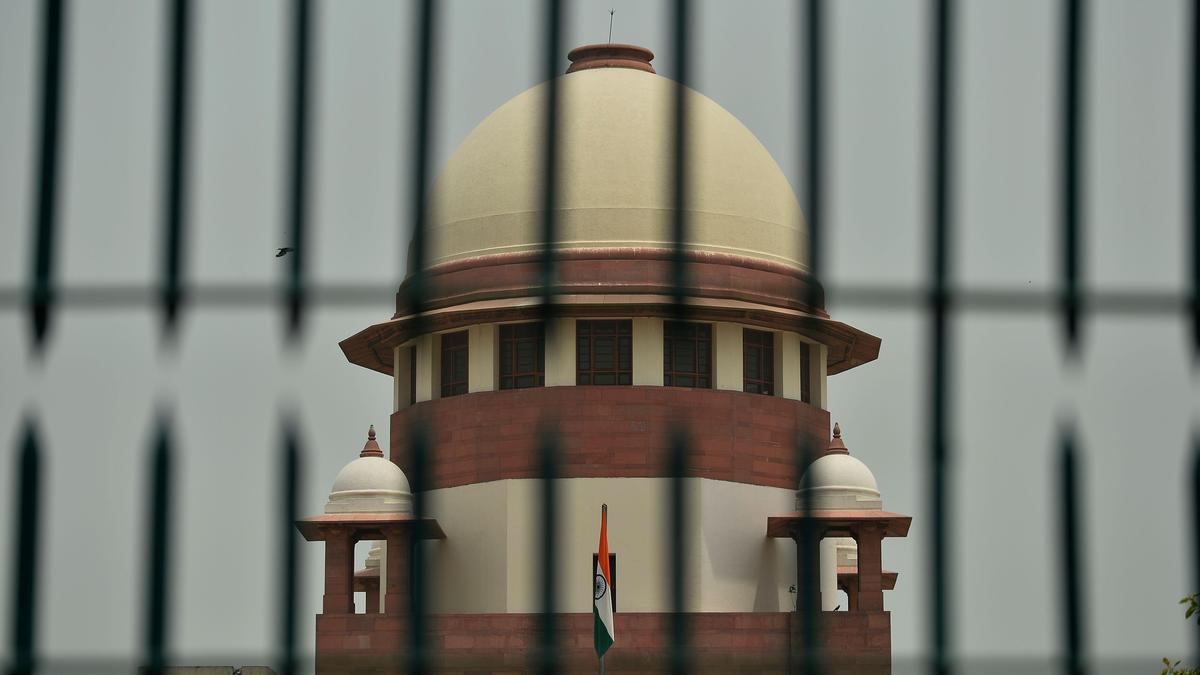
On November 18, 2025, in CREDAI vs Vanashakti, through a 2:1 majority, the Supreme Court of India reviewed and recalled its judgment from May this year, where it had declared notifications permitting persons to secure ex post facto environmental clearances (ECs) as illegal. The original judgment was hailed as a landmark moment, as a rare instance of the Court grounding its rhetoric in enforceable discipline. But the Court has now asserted, with a strong dissent from Justice Ujjal Bhuyan, that its earlier ruling misinterpreted binding precedents and failed to appreciate that retrospective ECs may, in some situations, further the cause of public interest.
Our immediate reaction might well be to ask how? To answer this, the Court employs a wholly circular logic. As the then Chief Justice of India, Justice B.R. Gavai put it, to entirely deny retrospective clearances undermines public welfare because it could well compel authorities to halt or tear down completed projects that had begun without prior permission. Thus, the illegal act is, by itself, turned into a justification. The fact of a violation — of a project unlawfully commenced without an EC — winds up forming the rationale for granting the very clearance that the law requires in advance. In other words, the rules become fungible, to accommodate a fait accompli.
Also read | The dismal state of India’s environment
An undoing of a reasoned judgment
For somewhere nearing half a century, the Supreme Court has spoken in soaring terms about the right to a clean and healthy environment. Through numerous judgments, it has located this promise within Article 21 of the Constitution of India’s guarantee of a right to life. It has cited the precautionary principle — which requires the state to adopt protective measures even when scientific evidence about an environmental risk is uncertain — as a binding norm. It has also acknowledged that ecological degradation burdens both the present and future generations. It has enunciated a right against the harms of climate change, and it has appealed to principles of intergenerational equity and sustainable development as constitutional goals.
So grandiose have these pronouncements often been that this body of law is seen as one of the Court’s more progressive feats. But abstract doctrines take us only so far. They serve little purpose if they are not meaningfully applied to real world violations.
Worse still, they collapse entirely when the Court undoes its own carefully reasoned judgments. That is precisely the worry with the judgment in CREDAI. It turns non-compliance from an offence into an argument, and dismantles, in the process, the foundations of environmental regulation.
At its core, India’s environmental laws mandate prior EC for certain industrial and development projects of specified sizes and types.
This requirement, instilled through the Environment Impact Assessment (Notification) of 2006 has been watered down at least twice over. In 2017, the Ministry of Environment, Forest and Climate Change issued a notification permitting those who had commenced work on site without an EC or expanded production beyond the limit of the EC, to apply for and secure a retrospective licence within six months from March 14, 2017. In 2021, the Ministry issued what it described as an “Office Memorandum” and instituted a “Standard Operating Procedure” allowing projects in violation of the law, where the window available under the 2017 order to apply could not be availed, to be regularised, by paying penalties and costs.

The basis of the original ruling
The Court’s original ruling, authored by Justice A.S. Oka, struck down both the 2017 and 2021 notifications. In doing so, the judgment returned to first principles and situated the controversy within the long arc of India’s environmental jurisprudence. It traced the trajectory from the Stockholm Conference of 1972 to the enactment of the Environment (Protection) Act, 1986, and then to the Environmental Impact Assessment (EIA) frameworks of 1994 and 2006, each measure constituting a building block in a regime that aims at preventing harm rather than condoning and regularising violations.
The verdict saw the insistence on a prior EC as no procedural formality. On the other hand, it insisted that this formed a central pillar in our statutory design. The EIA regime requires public hearings, scientific studies, expert appraisal and conditional approvals before a project begins, because the idea is to prevent irreversible harm. A prior EC ensures that project viability is assessed considering ecological limits. It ensures that economic momentum does not predetermine environmental outcomes.
The original judgment also drew upon long-standing decisions, including the verdict in Common Cause vs Union of India (2017), where the Court held unequivocally that retrospective clearances are “detrimental to the environment and could lead to irreparable degradation of the environment,” and the M.C. Mehta cases, which asserted that even the renewal of a mining lease required previous approval. The logic was clear: if the law demands scientific scrutiny first, but construction proceeds sans such examination, the consequence cannot be a backdated validation of the illegality.

Equally significant was Justice Oka’s account of the Union Government’s own conduct. Before the Madras High Court, the State’s lawyers gave a categorical undertaking that the 2017 notification allowing ex post facto clearances was a one-time measure. That assurance was recorded and relied upon by a constitutional forum. Therefore, one would think the government would bind itself to its solemn commitment. But as the 2021 memorandum demonstrated, it was only too keen to liberalise compliance even further, allowing even those who had not submitted applications during the allotted time to seek retrospective validation.
Regrettably, the review judgment looks beyond all this. It frames for itself a narrow question: would enforcing prior scrutiny inconvenience those who have already violated the law? In so asking, it shifts the goalposts from principle to expediency, marking, as Justice Bhuyan points out, a clear retrograde step.
The dissenting opinion also lays bare the various other inconsistencies in the majority’s approach. It points to the chief justification for repelling predated ECs: the idea that our laws are built to anticipate harm rather than accommodate it. Replacing prior scrutiny with backdated lenience dismantles the guardrails that the Court itself helped construct over decades.
If the fact of a violation becomes grounds for erasing its consequences, any incentive to comply disappears. Project proponents will be happy to proceed without an EC, secure in the knowledge that the government, aided by the court, will help normalise their lapses through the payment of fines rather than the imposition of any serious consequences. In effect, what is rewarded is unlawful conduct with a declaration that the sheer scale of the wrongdoing compels the law to bend.
A further weakening of accountability
The review judgment’s implications for environmental governance are stark. First, it hollows out the EIA process. A sense of fait accompli attaches itself to the requirements of public participation, expert appraisal and scientific evaluation. Scrutiny becomes ceremonial. Second, compliance is treated as voluntary. The state’s regulatory hand weakens, and enforcement loses its deterrent force.
But, ultimately, the most troubling consequence of the judgment is the signal it sends. We are living in a time of intensifying climate change and ecological fragility. But India’s top court wants to dilute the already-flailing tools to ensure accountability. For an institution that has long prided itself on pioneering environmental protection, the review marks a decidedly disquieting step backwards.
The Court will now have to reassemble to hear the challenges anew. When it does so, it will do well to remember that the validity of the two notifications is not the only thing at stake here, but also the credibility of India’s rule of law.
Suhrith Parthasarathy is an advocate practising in the Madras High Court
Published – December 04, 2025 12:16 am IST