

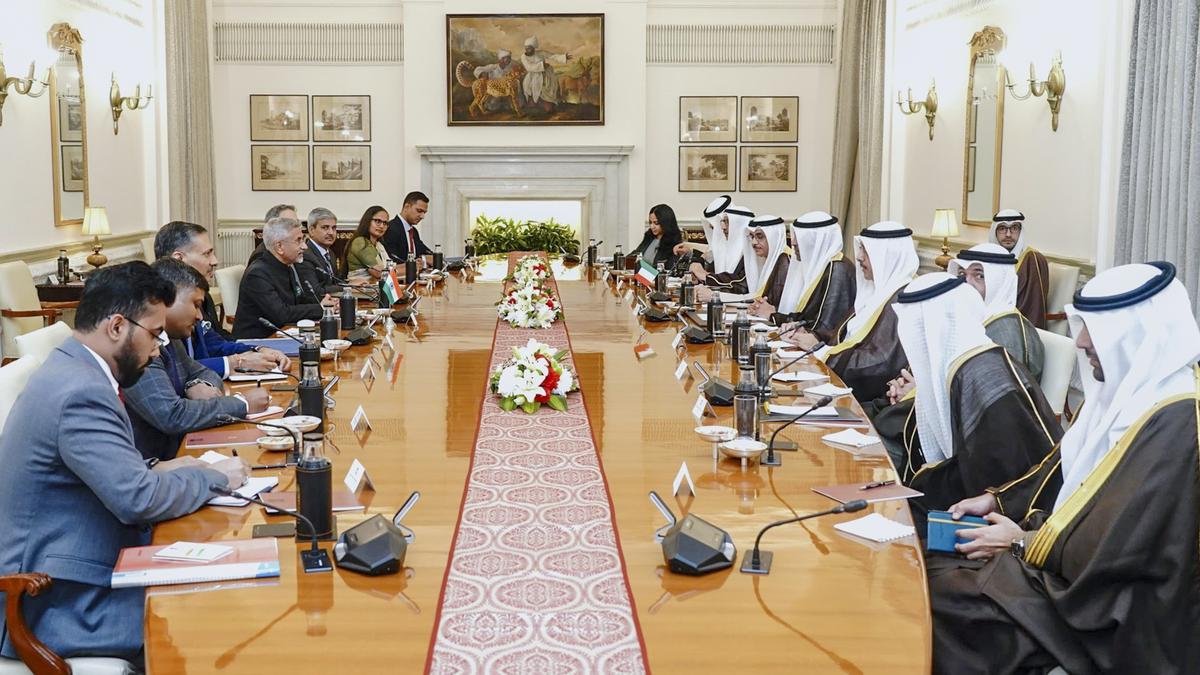
India’s External Affairs Minister S Jaishankar meeting Kuwait’s Foreign Affairs Minister Abdullah Ali Al-Yahya and other delegates, in New Delhi, in early December
| Photo Credit: PTI
The Prime Minister, Narendra Modi, is set to visit Kuwait on December 21-22. The visit will be the first by an Indian Prime Minister in 43 years, the last being the visit by Prime Minister Indira Gandhi in 1981. Mr. Modi was scheduled to visit Kuwait in January 2022, but the visit was postponed due to concerns about COVID-19.
The visit holds great significance not only for the bilateral ties but also the region, which is going through a very difficult phase of conflict and transition. Mr. Modi has visited all the other countries in the Gulf Cooperation Council (GCC) over the past 10 years, some more than once, and not having visited Kuwait was seen as a gap in India’s West Asia engagement. This visit aims to not only plug this gap but also give a boost to the rather stagnant ties between the two countries which, otherwise, have much potential for a strong engagement.
A country with strategic significance
Why Is Kuwait important? Despite being one of the smallest countries in the region, it holds significant strategic importance. Located at the north-east end of the Persian Gulf, it shares borders with Iraq and Saudi Arabia and hosts important American military bases. It is the only monarchy in the region which has experimented successfully with democracy. On regional issues, it has generally maintained a neutral stance and has often been the interlocutor in resolving disputes.
Its wealth is owed primarily to its vast oil reserves, which are sixth-largest globally. It is also one of the founding members of the Organization of the Petroleum Exporting Countries (OPEC).
It also has one of the largest basket sovereign wealth funds. These funds, managed by the Kuwait Investment Authority (KIA), have grown at an impressive rate and are currently estimated to be $924 billion (in March 2024), the fourth largest in the world after Norway, China and the United Arab Emirates (UAE).
Untapped potential, existing links
India and Kuwait have always enjoyed friendly ties, built on a strong foundation of history and cultural bonds. India was one of the first countries to establish diplomatic relations with Kuwait following its independence from the British Protectorate in 1961. In fact, the Indian rupee was a legal tender in Kuwait till 1961.
Trade and people-to-people ties have traditionally been the main anchors of the bilateral ties. India has consistently been among the top trading partners of Kuwait, with the total bilateral trade with Kuwait during FY 2023-24 being $ 10.47 billion. During FY2023-24, Kuwait was the sixth largest crude supplier catering to about 3.0 % of India’s total energy needs. The KIA has invested indirectly in India with estimated investments of more than US$10 billion.
During the COVID-19 pandemic too, India and Kuwait demonstrated a strong sense of brotherhood. India provided two lakh vaccine doses. During the second wave of COVID-19 in May 2021, Kuwait provided 282 oxygen cylinders, 60 oxygen concentrators, ventilators and many other medical supplies to India.
People-to-people ties form the other firm anchor. Out of a population of almost 4.9 million, around 1 million Indians not only form the largest expatriate group in Kuwait but are also among the most trusted. As a special gesture, a ‘Festival of India’ was organised in Kuwait in March 2023. A weekly Hindi radio programme, ‘Namaste Kuwait has been started by Kuwait National Radio since April 2024. And, 26 schools in Kuwait with over 60,000 students, follow the Central Board of Secondary Education curriculum of India.
When tragedy struck on June 12, in the form of a fire in a residential building in Kuwait killing over 40 Indians, Kuwait rendered help and repatriated their mortal remains quickly.
Areas to elevate ties
Despite enjoying mutual trust and goodwill, India’s ties with Kuwait — like with many others in the Gulf region — have not been able to transcend to the next level. Mr. Modi’s visit, therefore, offers the perfect opportunity to set things moving. The signing of a comprehensive strategic partnership agreement with Kuwait could be the ideal start. An agreement on defence cooperation could be signed too. India has invited Kuwait to join the International Solar Alliance (ISA) and the Coalition for Disaster Resilient Infrastructure, which Kuwait is likely to accept. An agreement between KIA and the National Investment and Infrastructure Fund (NIIF) in India could be mutually beneficial and give impetus to growth in India. Like the UAE, Kuwait could become an important partner for storing strategic oil reserves in India.
From India, helping Kuwait in building its infrastructure under Kuwait’s ‘Vision 2035’ could be a good initiative. Setting up institutes of higher education, such as the Indian Institute of Technology and the Indian Institute of Management, and modern hospitals in Kuwait could boost people-to-people ties. Kuwait’s request for additional seats for its airlines from India (in addition to 12,000 seats per week allotted), could be considered as a special exemption, despite Kuwait not fulfilling the required quota. Cooperation in space programmes including launching satellites for Kuwait would make good headlines too.
The scope for Kuwait-India ties is huge and the wish list endless. Hopefully, this visit will provide the perfect platform to kick-start a golden era in this very important bilateral relationship.
Rajeev Agarwal, retired colonel, is a former Director in the Ministry of External Affairs, a former Director in Military Intelligence (International Relations) and a former Research Fellow, Manohar Parrikar Institute for Defence Studies and Analyses, New Delhi (IDSA), New Delhi.
Published – December 21, 2024 12:08 am IST

