

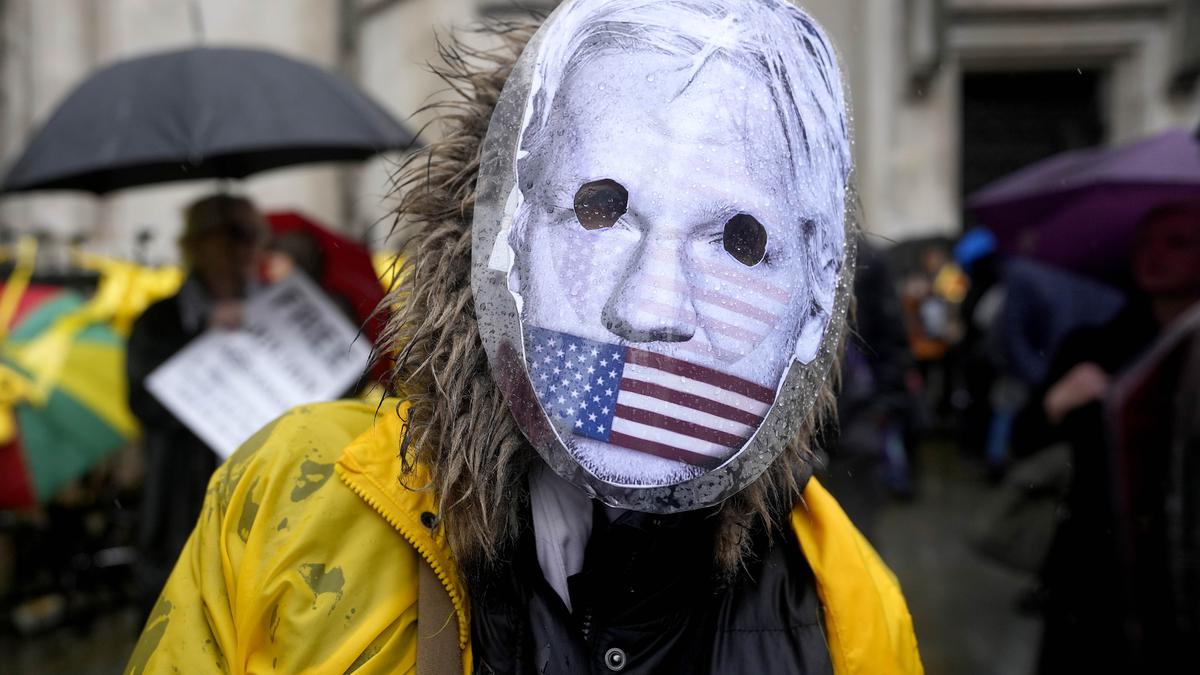
A protester supporting Julian Assange stands at the Royal Courts of Justice entrance in London on February 21, 2024. Julian Assange’s lawyers are on their final U.K. legal challenge to stop the WikiLeaks founder from being sent to the United States to face spying charges.
| Photo Credit: AP
WikiLeaks founder Julian Assange should face espionage charges in the United States because he put innocent lives at risk and went beyond journalism in his bid to solicit, steal and indiscriminately publish classified U.S. government documents, lawyers for the American government argued February 21.
The lawyers spoke before Britain’s High Court in response to a last-ditch bid by Mr. Assange’s defence to stop his extradition from the United Kingdom to the U.S.
Mr. Assange’s lawyers are asking the High Court to grant him a new appeal — his last roll of the legal dice in the saga that has kept him in a British high-security prison for the past five years. The judges overseeing the case reserved their decision at the end of the two-day hearing, and a ruling on Mr. Assange’s future is not expected until March at the earliest.
The 52-year-old Australian has been indicted on 17 charges of espionage and one charge of computer misuse over his website’s publication of a trove of classified U.S. documents almost 15 years ago. American prosecutors allege Mr. Assange encouraged and helped U.S. Army intelligence analyst Chelsea Manning steal diplomatic cables and military files that WikiLeaks published, putting lives at risk.
Assange damaged U.S. security
Lawyer Clair Dobbin told the High Court that Mr. Assange damaged U.S. security and intelligence services and “created a grave and imminent risk” by releasing hundreds of thousands of documents — risks that could harm and lead to the arbitrary detention of innocent people, many of whom lived in war zones or under repressive regimes.
Ms. Dobbin added that in encouraging Ms. Manning and others to hack into government computers and steal from them, Mr. Assange was “going a very considerable way beyond” a journalist gathering information.
Mr. Assange was “not someone who has just set up an online box to which people can provide classified information,” she said. “The allegations are that he sought to encourage theft and hacking that would benefit WikiLeaks.”
Politically motivated prosecution, say supporters
Mr. Assange’s supporters maintain he is a secrecy-busting journalist who exposed U.S. military wrongdoing in Iraq and Afghanistan. They have long argued that the prosecution is politically motivated and he won’t get a fair trial in the U.S.
Mr. Assange’s lawyers argued on the first day of the hearing on Tuesday that American authorities are seeking to punish him for WikiLeaks’ “exposure of criminality on the part of the U.S. government on an unprecedented scale,” including torture and killings.
Lawyer Edward Fitzgerald said Mr. Assange may “suffer a flagrant denial of justice” if he is sent to the U.S. Ms. Dobbin rejected claims that the charges are a “tool of oppression” to punish Mr. Assange for his political opinions. She said the prosecution is based on law and evidence, and has remained consistent despite the changes of government in the U.S. during the legal battle.
She added that the First Amendment does not confer immunity on journalists who break the law. Media outlets that went through the process of redacting the documents before publishing them are not being prosecuted, she said.
Mr. Assange’s lawyers say he could face up to 175 years in prison if convicted, though American authorities have said the sentence is likely to be much shorter.
Mr. Assange was absent from court on Wednesday and Tuesday because he was unwell, WikiLeaks said. Stella Assange, his wife, said he had wanted to attend, but was “not in good condition.” Mr. Assange’s family and supporters say his physical and mental health have suffered during more than a decade of legal battles, including seven years in self-exile in the Ecuadorian Embassy in London.

