

 BBC/Passion Planet
Lying on his side on a dark summer night earlier this year, Sir David Attenborough is watching a hedgehog snuffling around an urban garden.
“I think they’re lovely things,” he says softly, with a chuckle.
His voice blends boyish wonder with the wisdom of his 99 years – each in equal measure.
Considered by many as the most famous broadcaster and conservationist of our time, Sir David has circled the globe for 70 years to show us the brilliance of the natural world.
Now, in a new one-off documentary, he has come home – to London.
Gaby Bastyra, executive producer at Passion Planet, which made the film, said Sir David “could live anywhere in the world… but he’s always come home to London”.
The programme, she says, is an “appreciation of his place – and he loves it”.
So can the capital’s wildlife compare to the broadcaster’s encounters with mountain gorillas in Rwanda, the mimicry of a lyrebird in Australia or a blue whale breaching beside his small boat?

 BBC/Passion Planet
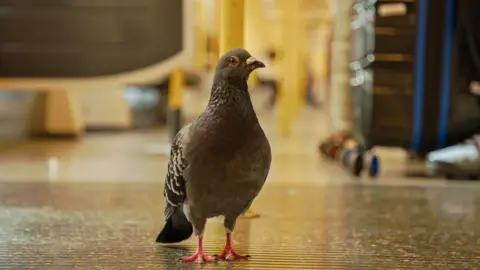
Well, Wild London is abundant with animal curiosities: from pigeons hopping on to the Hammersmith and City line to a snake colony by a canal.
Sir David also draws our awareness to the dramas happening every day among and above us in this city of about nine million people.
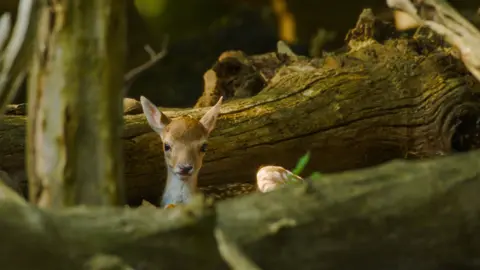
In one scene, there are glimpses of a bullish, noisy beast through the summer leaves.
This is not a preying tiger in the Indian jungle – but a happily mooching Dalmatian dog in Dagnam Park, Romford, unknowingly closing in on a days-old fallow deer fawn.
David Mooney, chief executive of the London Wildlife Trust, which co-produced Wild London, said he was completely “enthralled” by that “juxtaposition”.
“That’s not to say that dogs are a problem. It’s just wildlife is interacting with us at all times,” he said.
“The raw experiences of nature are something that at London Wildlife Trust we’ve been talking about for a long time.”
 BBC/Passion Planet
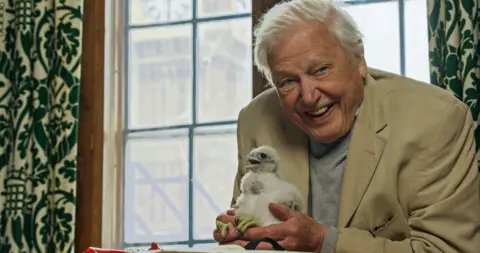
Perhaps the most poignant moments in Wild London, broadcast months before Sir David turns 100 years old, are where he shows particular tenderness towards the animals he meets.
At the Houses of Parliament, he holds a peregrine falcon chick while it is ringed for identification.
It tips its head back to look up at him as he says to it softly: “Now we can recognise you anywhere – yes, yes you.”
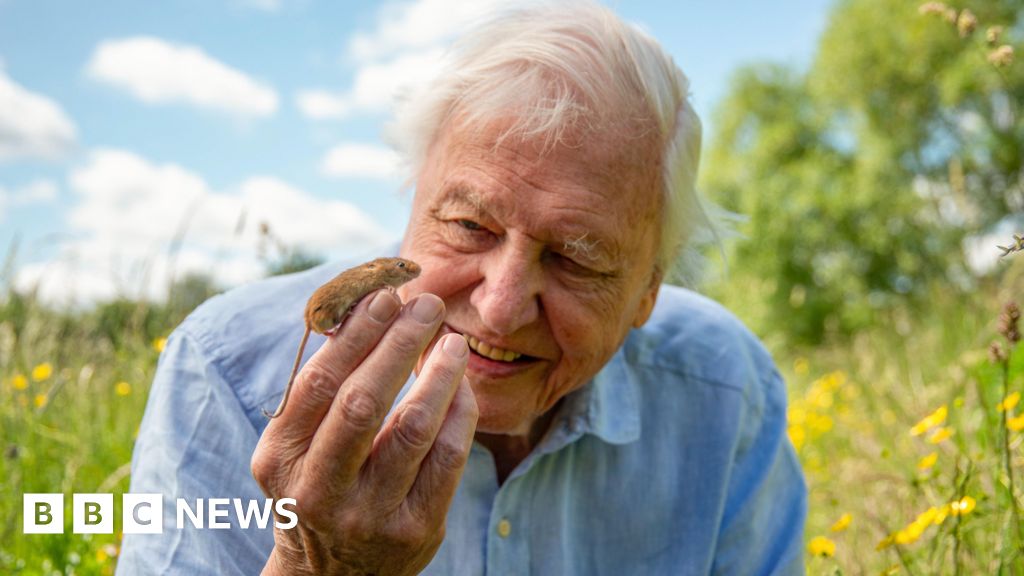
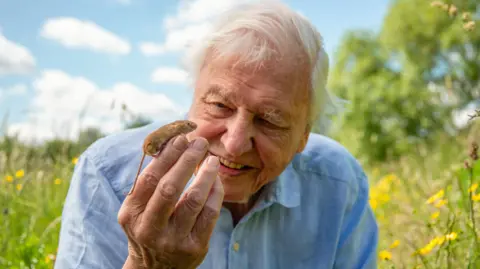
In Greenford, west London, Sir David gently cradles a tiny harvest mouse before releasing it into a meadow.
He encourages it to scramble on to a wildflower, with an affectionate: “Welcome to your new home – there you go.”
It doesn’t want to leave the safety of his cupped hands.
Joe Loncraine, director of Wild London, has worked with Sir David on several other nature documentaries.
He said: “There were some moments I think that deliver the kind of interactions with him and an animal that I hadn’t seen in a while.
“There was something about the warmth that came across. And I think his enthusiasm for what was happening was so infectious.”
 BBC/Passion Planet
Sir David was greatly impressed by The Ealing Beaver Project, which he says in the film, has had such a “positive impact” in west London.
He observes: “If someone had told me when I first moved here that one day I would be watching wild beavers in London, I would have thought they were mad. But there they are, right behind me.”
He uses this as an example of us “securing a brighter future for both animals, and us, too” in our unique metropolis – the world’s greenest major city.
Mr Mooney said: “His message is: people have to take note of it – if people notice it, they will begin to love it – if people love it, they’ll want to protect it. And if people protect it, we’ll be on a path to nature recovery.”
Wild London, coming late in such a revered canon of nature documentaries, is Sir David’s way of nudging us to marvel at the nature on our doorsteps, amidst the frenzy of daily life.
Mr Loncraine sums up: “We can be rushing about our jobs, commuting to work, picking the kids up from school, going to the shops – and not really notice.
“There can be really quite beautiful animals right there – so it’s just about taking that moment to have a look.”

