

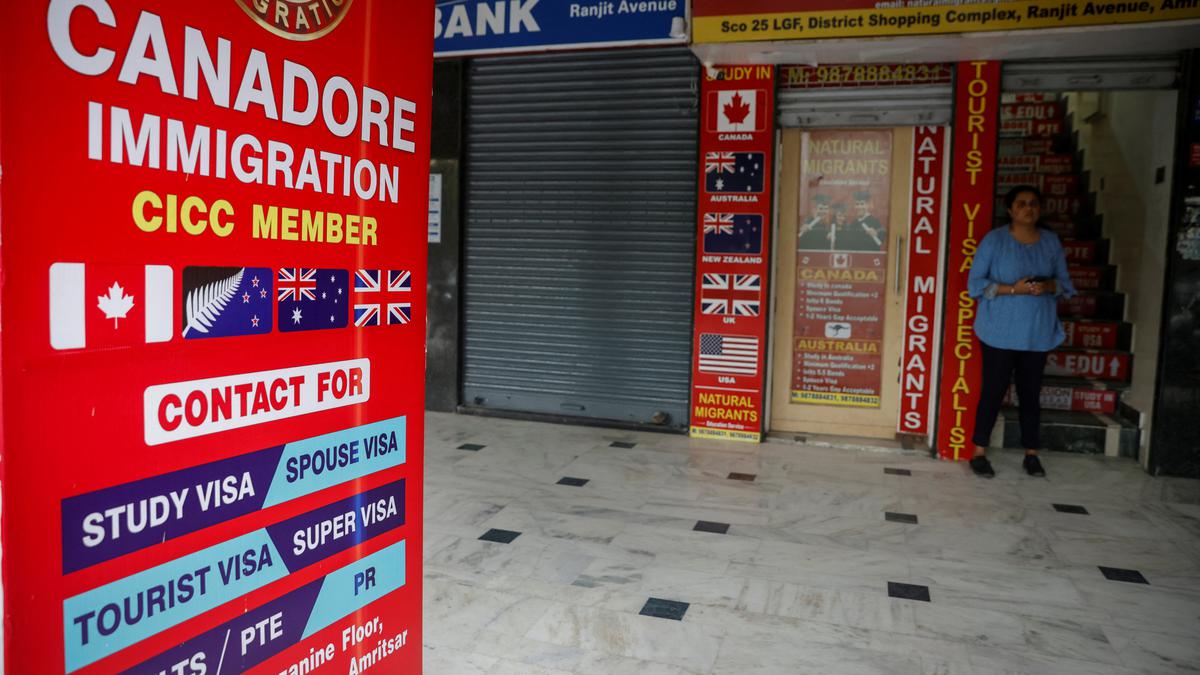
An immigration consultant office in Amritsar. File
| Photo Credit: Reuters
The story so far: Migrating abroad, especially to English-speaking countries, is set to become harder for Indian students aspiring to pursue a higher education, what with countries such as Canada and the U.K. tightening rules to seek admissions to universities.
What are the new set of changes?
Following the political turmoil between India and Canada, the Canadian government in December 2023 issued revised requirements that it said are ‘to better protect international students.’ The foremost of these was to upwardly revise the Guaranteed Investment Certificate (GIC) amount from 10,000 Canadian dollars, which amounts to ₹6.15 lakh, to over double at 20,635 Canadian dollars, close to ₹12.7 lakh. In another instance, the U.K. announced that come 2024, international students will be restricted from bringing in dependant family with them as they pursue their studies. Countries such as Germany and Australia too have gradually increased the GIC amount by approximately 10% annually. As on May 2023, the amount required to apply for a German visa is 11,208 euros which is ₹10 lakh, up from the earlier cap of 10,000 euros.
Higher education experts say that an amount as low as ₹6.15 lakh is not enough for a student to survive in an expensive country like Canada. “Canada had earlier kept a low GIC threshold to attract students, but the government realised that this was not enough to keep up with rising housing costs, inflation. While other countries like Germany and Australia gradually increased the amount by 10% year-on-year, the Canadian jump of 100% came as a shocker because the hike occurred in one go,” said Ankur Dhawan, president of ed-tech start-up UpGrad Abroad.
Which students have been hit the most?
In the latest tweak of rules, Canada has said that it is restricting the total number of study permits or student visas it plans to issue to 3.6 lakh (earlier this was nearly four lakh). India alone used to send up to 1.4 lakh students to Canada, approximately 80% percent of whom went to study diploma level courses there.
Earlier, aspirants looking to migrate to Canada would take any diploma as the ‘study abroad’ option, essentially as a passport to migrate to the country in poorly equipped educational institutions, while a spouse visa work permit would allow their spouses to work while the aspirant studied. People would take on hefty loans to fuel this move. Now Canada has stated that while they will issue a spouse visa, the spouse will not have a work permit. Akshay Chaturvedi, CEO of LeverageEdu, opines, “In some sense it’s a great step towards solving Canada’s ‘diploma mills’ problem, it will shut down bad institutions and also de-incentivise agents who engage in shoddy practices.”
How are tightened rules affecting students?
While Canada aims to rein in its burgeoning ‘diploma mills’ problem, it has eased norms for masters program students to come in. Masters students can apply for a three-year work permit after their course is complete. However, the stricter guidelines have put those who want to seek a Bachelors’ degree in Canada in the lurch.
Take for instance, 21-year-old Manvir Singh, a resident of Rajnandgaon in Chhattisgarh who during the years from 2022-2023 was enrolled in the University of Yorkville and completed his first two years of bachelors in Business Administration (BBA) remotely. Mr. Singh was supposed to get admitted for his third-year on-campus studies from May 2024. Mr. Singh who has deposited his third-year fees of $15,000 and has submitted a GIC of $20,900 has now been advised by the University to put his visa application on hold. “All visa applications of students wanting to go to study in Canada are on hold till March this year, as universities need to figure out how to send attestation letters to students which will have to be secured from the Canadian government,” Mr. Singh said.
What about other foreign countries?
UpGrad Abroad analysed data of 25,000 aspirational students who showed interest in studying abroad. While 18% of this pool was interested in studying in Canada during the data collected between January to July last year, this demand dropped by half to 9.3%, in the data analysed between July and December, last year.
On the contrary, a destination like Germany, which had initially been in demand with nearly 17% students, is now attracting demand from 32% students. Apart from Australia, New Zealand, Ireland, the Netherlands and Finland, Mr. Dhawan added that newer destinations like Taiwan and Israel are also emerging in the list of potential study abroad destinations as they want to attract Indian talent to their countries.
- Migrating abroad, especially to English-speaking countries, is set to become harder for Indian students aspiring to pursue a higher education, what with countries such as Canada and the U.K. tightening rules to seek admissions to universities.
- Following the political turmoil between India and Canada, the Canadian government in December 2023 issued revised requirements that it said are ‘to better protect international students.
- While Canada aims to rein in its burgeoning ‘diploma mills’ problem, it has eased norms for masters program students to come in. Masters students can apply for a three-year work permit after their course is complete. However, the stricter guidelines have put those who want to seek a Bachelors’ degree in Canada in the lurch.

