

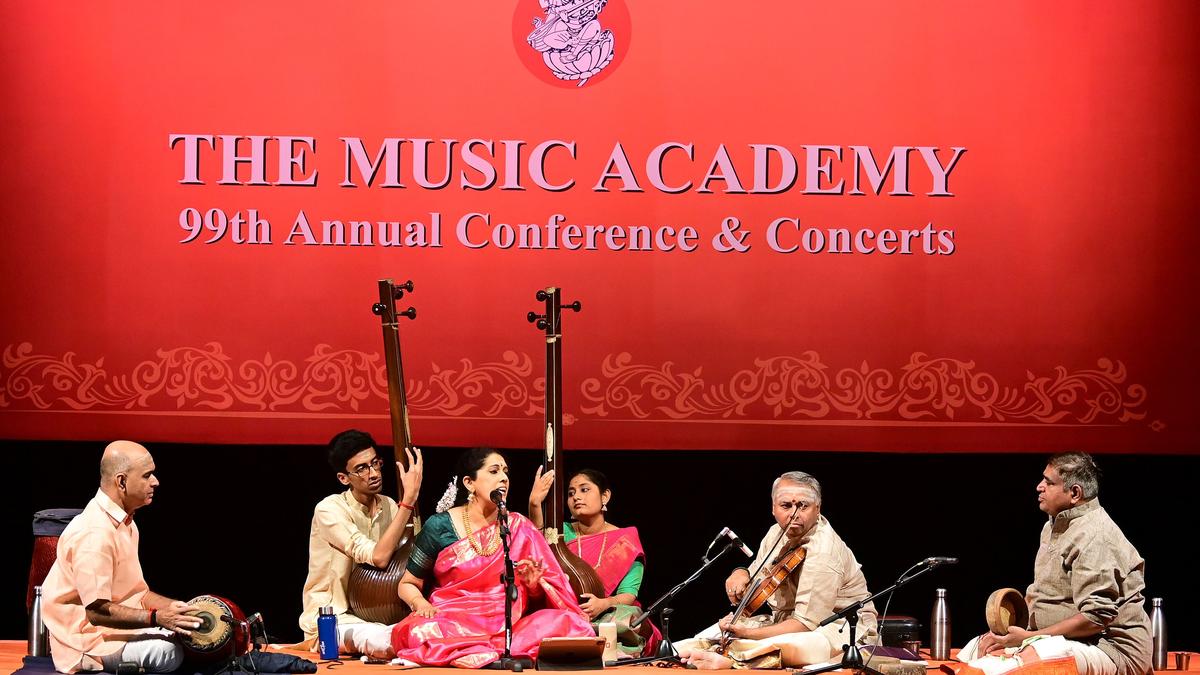
Amritha Murali at The Music Academy concert.
| Photo Credit: Courtesy: K. Pichumani
Some concerts resonate beyond music, shaped as much by lived journeys as by the notes that unfold on stage. For Amritha Murali, her recital at The Music Academy was one such defining moment. She took the dais with violinist and Sangita Kalanidhi-designate R.K. Shriramkumar, her mentor of over two decades.
That this significant concert fell on a Thursday and opened with Dikshitar’s guru-vaara kriti ‘Bruhaspathe’ in Ataṇa, set to Tisra Triputa, lent the evening a sense of inevitability. Amritha’s spontaneous acknowledgement of the day’s significance, shared after the song, heightened the moment.
Senior percussionists N. Manoj Siva (mridangam) and C.P. Vyasavittala (kanjira) completed the ensemble, embellishing the recital with their expertise.
Amritha continued with Tyagaraja’s rare Sanskrit kriti ‘Mamava satatam’ in Jaganmohini. After rendering the song, built around vocatives and steeped in poetic beauty, she capped it with swarakalpana in two speeds.
Well-spaced phrases, flowering with the raga’s characteristic gamakas and suffused with a pleading tone, marked the Anandabhairavi alapana. There was little hint of the surprise in store as Shriramkumar completed his solo turn. When Amritha began ‘Nee samana deivamu’ in Rupakam — a composition on Kamalamba seldom heard before, offered in place of the listed kriti ‘Marivere’ — it evoked Syama Sastri’s lyrical style and gait. The suspense deepened as she embarked on niraval at the pallavi opening, each phrase brimming with melodic allure. The ensuing swara exchanges in second speed shimmered with perfect accord, carrying the kriti to a vibrant close. Amritha revealed the composer — Shriramkumar.
The celebrated shloka ‘Kasturi tilakam’ from Krishnakarnamrutam, was sung as a prelude to Dikshitar’s ‘Chetasri balakrishnam’ in Dwijawanti-Rupakam, bringing out the raga’s immersive quality. A brief, sweet violin reprise flowed into the kriti, and Amritha’s rendition underscored its languid grace. Tyagaraja’s ‘Patti viduva radu’ in Manjari followed, setting the stage for more elaborate explorations.
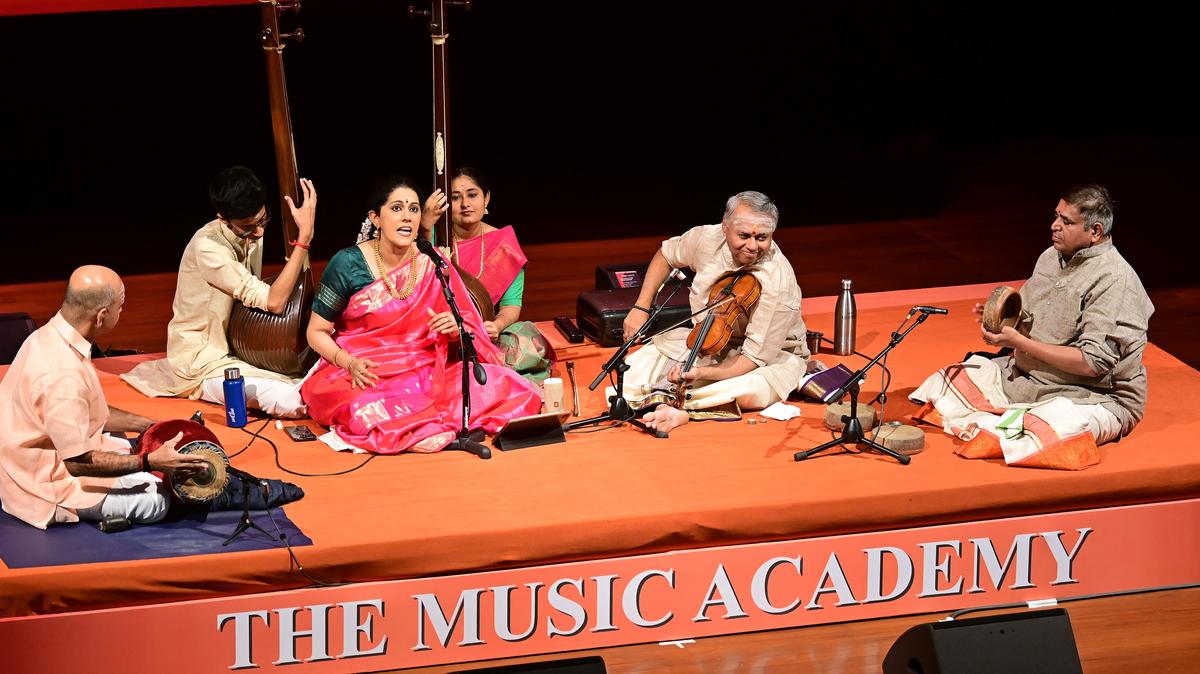
Amritha Murali accompanied by Sangita Kalanidhi-designate R.K. Shriramkumar (violin), N. Manoj Siva (mridangam) and C.P. Vyasavittala (kanjira).
| Photo Credit:
Courtesy: K. Pichumani
The main suite was Kamboji, and Amritha began the raga alapana on a serene note in madhya sthayi, unfurling its contours through absorbing, gamaka-laden phrases and looping movements. Dwelling in the upper register, she punctuated it with nimble forays. The violin essay added its own measure of charm. A third Dikshitar kriti emerged — the relatively rare ‘Sri valmikalingam’ in Khanda Ata tala.
After rendering the kriti with elan, Amritha presented a niraval on the charanam line ‘Shankaram somakulambika amboja madhukaram’. The phrase carries the raga mudra and portrays Shankara as the honey-bee to the lotus, Goddess Somakulambika. Well-nuanced swara exchanges then gave way to the rhythm-rangers Manoj and Vyasavittala, who revelled in exploring the uncommon tala arithmetic. Showcasing versatility and clarity, they wove engaging patterns through their dialogue, culminating in a lively korvai.
Amritha unveiled another new composition by Shriramkumar — a pallavi in Kapi, set to Misra Triputa (Chatusra nadai) in two kalai, once again on Kamalambika. After brief delineations of the ragam and tanam that evoked Kapi’s karuna rasa, she took up the pallavi ‘Karunatmika pinakadhara priya maam paathu sarvada — kamalambika’, meaning “May Kamalambika — the embodiment of compassion and beloved consort of the bow-bearing Shiva — protect me at all times.”
Notably, the raga mudra is derived from the final syllable of ‘karunatmika’ and the opening of ‘pinakadhara’. The karuna rasa, intrinsic to Kapi, further resonates with the opening epithet ‘karunatmika’. Equally striking in the rendition was the ragamalika segment, thoughtfully aligned to the theme and tradition. Highlighting the distinct handling of Kapi in the Tyagaraja and Dikshitar paramparas, it traversed ragas sharing the name but differing in melodic identity — moving from Kapi to Devakriya, Saraswati Manohari, Kalavati and Ritigowla.
The well-ideated concert befitting the occasion concluded with a Thayumanavar verse in ragamalika virutham, followed by the song ‘Angai kodumalar’ in Chenchurutti and Nadanamakriya and the Thiruppugazh ‘Kumaragurupara’ (Ragamalika-Misra Chapu).
Published – December 24, 2025 03:20 pm IST

