

The Boxing Day Test at the Melbourne Cricket Ground isn’t just a cricket match. It’s a social gathering, a coming together of peoples, a spectacle that is often the best way to bring the curtain down on a year of compelling action. It generates a buzz and an enthusiasm akin to a home side contesting the final of a global tournament; the energy is constant and infectious, the air crackling with electricity and bonhomie, all with no little help from Bacchus.
It’s a stop on the cricket calendar eagerly awaited for reasons beyond cricket, though the sport is invariably the driving force. And yet, here we are, on the scheduled day three of five, engaged in post mortems and critiques, wondering how such a fiercely anticipated showpiece devolved into a damp squib.
Upwards of 90,000 people crammed the marquee stadium, affectionately called the ‘G’, on each of the two days that witnessed play. The action was frenetic, furious, maybe even fascinating. Test cricket, particularly, is meant to be an equal contest between bat and ball, with the odds slightly tilted in favour of the latter. The MCG provided anything but that as the fourth Ashes Test got over before you could say Steve Smith and Ben Stokes in the same breath.
Vocal critics
Smith and Stokes have been among the vocal critics of a grass-laden knoll that made batting impossibly hazardous. One cursory look at curator Matt Page’s creation was enough for both captains to jettison any distant thoughts of fielding a specialist spinner. Both sides went seam heavy, hoping to rely on part-time spinners if the need arose. That need, as we all know now, hardly did.
In all, the Boxing Day showdown lasted 852 deliveries. That’s 142 overs, condensed into two days of fast-forward frenzy, culminating in a nervy four-wicket win for the visiting side. You’d think that the captain of a team that had won a Test down under after 5,468 days would be delighted at the outcome. But Stokes, the maverick with the heart of a warrior, minced no words as he slammed the playing surface, unequivocally laying into the green carpet.
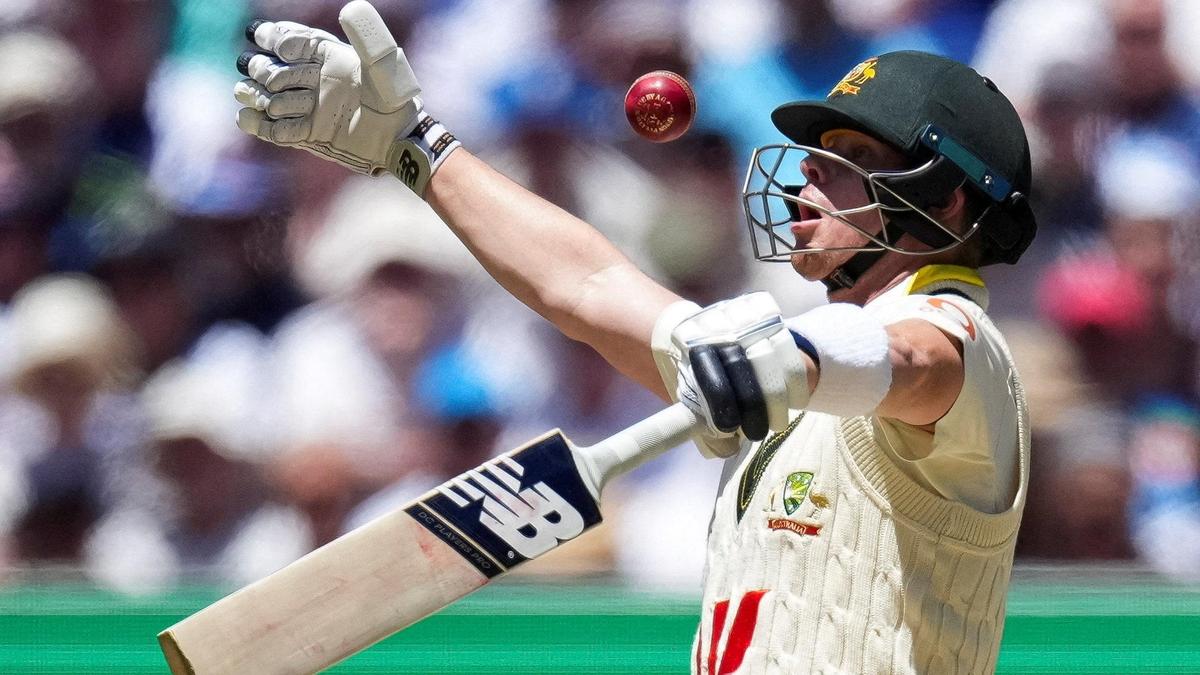
England skipper Ben Stokes was critical of the Melbourne track.
| Photo Credit:
Reuters
“Being brutally honest, that’s not really what you want. Boxing Day Test match. You don’t want a game finishing in less than two days. Not ideal,” Stokes thundered, before adding, “I’m pretty sure if that was somewhere else in the world, there’d be hell on. Not the best thing for games that should be played over five days.”
At the press conference where he made these comments, the all-rounder was asked if ‘somewhere else in the world’ was directed at spin-friendly pitches in the subcontinent. “Your words, not mine,” was the riposte.
Much-needed victory
For England, this victory was much needed after the flak they have received over their preparations coming into the Ashes, their insipid performances in the first three matches, and an alleged drinking binge when on vacation in the long gap between the third and the fourth Tests. It has reignited, if only just, their World Test Championship prospects; on the other hand, Australia have surrendered their hitherto all-win record, undone by the 11 millimetres of grass that Page, in his infinite wisdom, laid out for pacers from both sides to feast on.

Even in isolation, a 142-over Test that saw 36 wickets crumble inside two days for just 572 runs scored is an alarming development. Combine it with what happened at the Optus Stadium in Perth five weeks previously, and it is clear that Cricket Australia (CA) must start to ask its member units how things have been allowed to come to such a pass. In the first Test that usually sets the tone for the rest of the series, Australia raced to an eight-wicket victory on the back of an outrageously freakish century by Travis Head. The irrepressible left-hander took his chances on being promoted as an opener in Usman Khawaja’s unavailability, though 123 off 83 deliveries can hardly be dismissed as chancy.
Until the Head carnage that decisively settled the contest, the ball had once again been the dominant entity. The first three innings of the Test yielded a frugal 468 runs in 112.5 overs. The hectic rate of scoring — England went at 5.23 and 4.73 an over in piecing together 172 and 164 respectively — was due to the fact that no batter felt he could trust the pitch, that he had to lash out before the ball with his name on it arrived at some stage. Harry Brook’s 52 in the England first innings was the only knock of any substance, until Head tore prediction sheets to shreds by making a fourth-innings target of 205 appear tiny and grossly inadequate.
Falling like ninepins
As many as 19 wickets fell on day one at the Optus; the MCG topped that with 20, both first innings ending before stumps and the hosts even getting to bat for one over in the second innings. Even accounting for the fact that batting standards have dipped somewhat in recent years, these are unacceptable numbers. How can such diabolical statistics not attract sanction and censure and penalties to go with the ridicule that is already ruling the social media waves?
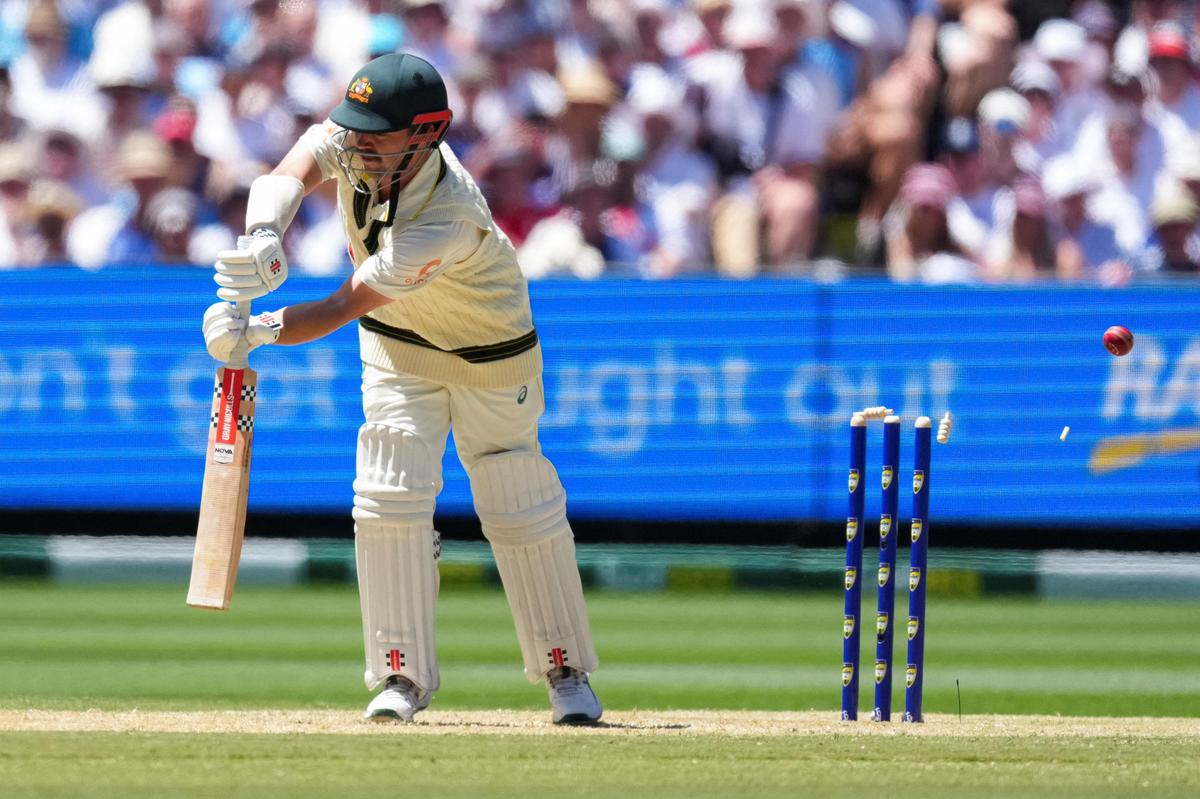
Australia’s Travis Head is bowled by Brydon Carse in the Melbourne Test.
| Photo Credit:
Reuters
CA chief Todd Greenberg didn’t hold back as he reflected on the second two-day finish in four games. “A simple phrase I’d use is short Tests are bad for business,” he remarked. “I can’t be much more blunt than that.” Greenberg donned his financial rather than cricketing hat, perhaps dismayed by the potential $6.7 million loss that didn’t allow him to ‘sleep well’ after the first day of the MCG fiasco. But he did strike the right note. Hopefully, he will now put the (much reduced) money where his mouth is and embark on course correction, sooner rather than later.
Australia once was the perfect place to play cricket in simply because of the vast differences in the nature of the playing surfaces across the huge country. The hallowed WACA ground in Perth — replaced by the Optus in December 2018 — and the Gabba in Brisbane tested technique and mettle, courtesy pace and bounce. The Adelaide Oval was largely a very good batting surface before starting to help the spinners as the game went on, the Sydney Cricket Ground was the most spin-friendly of the lot and the MCG was a combination of The Oval and the SCG.
Consequently, in a long series, or even in a three-match showdown, cricketers of every ilk had the opportunity to showcase their wares. They could rely on their skills to make an impact instead of riding their luck and hoping for the best, like has been the case in the last few years. The MCG and the SCG have totally changed in character, and there is a similarity to the tracks, most of them drop-in, that have dulled some of the charm of Test cricket in Australia.
The convenient and lazy reasoning for this development will be the quest for the World Test Championship (WTC) points, but Australia have been picking up points in most venues. If they missed out on qualifying for the inaugural final in 2021, it was less because of cricketing inadequacies and more due to their tardy over-rates. The docked points for slow over-rates allowed New Zealand to sneak ahead of them and into the final, where the Kiwis schooled India in Southampton. Australia have contested each of the next two finals, winning against India in 2023 and going down to Temba Bavuma-inspired South Africa at Lord’s this summer.
Do they need external help to bolster their chances? Sure, every team will welcome the opportunity to make the most of home advantage. But by producing decks with 11mm grass, aren’t they selling themselves short, much like India have been doing by rolling out turners of dubious bounce at home that their batters aren’t equipped to flourish on and which have brought opposition spinners of modest skills into the equation more and more?
Greg Chappell, the wonderfully articulate former India coach, once told this writer that if the stakeholders themselves are disrespectful of the game, it is impossible to expect the fans to be energised by Test cricket. “When the game itself denigrates the longest form of the game, it is understandable that the public might not be as stimulated by it, which is a great shame because I still think the greatest form of the game is the long form,” he said. “We’ve allowed the game to be showcased poorly, and it is no surprise to me that we have probably got a generation of people that never really understood what the attraction of Test cricket is.”
Chappell was referring more to ‘your 550 plays my 600’, which used to be the case in the subcontinent for long when winning wasn’t as important as not losing. That was in the pre-WTC era; now the onus is on results and therefore ‘doctored’ pitches designed to maximise the benefit of playing in one’s backyard, though we have seen, especially in India in the last 14 months, how spectacularly the best-laid plans can unravel.
Stokes has stoked the fire by talking about ‘somewhere else in the world’ during his takedown of the MCG surface. In a way, he was echoing Rohit Sharma’s thoughts of January 2024, when the then Indian Test captain lambasted the Newlands track in Cape Town after it was the scene of another two-day game. Interestingly, like Stokes, Rohit too was on the winning side on an abomination of a surface where the chances of succeeding with the bat were less than those of winning a lottery. After Mohammed Siraj helped bowl South Africa out for 55 on the first morning and India completed a seven-wicket on the second afternoon, Rohit let loose: “We saw what happened in this match, how the pitch played. I honestly don’t mind playing on pitches like this. As long as everyone keeps their mouth shut in India and don’t talk too much about Indian pitches.”
Point taken, Rohit, though at the end of the day, it must not be about where the pitches are below-par, or which aspects of the sport are taken out of the equation. Test cricket owes its most passionate stakeholders, the uncelebrated fans, respect and gratitude. Two-day games are hardly the way to showcase that.

