

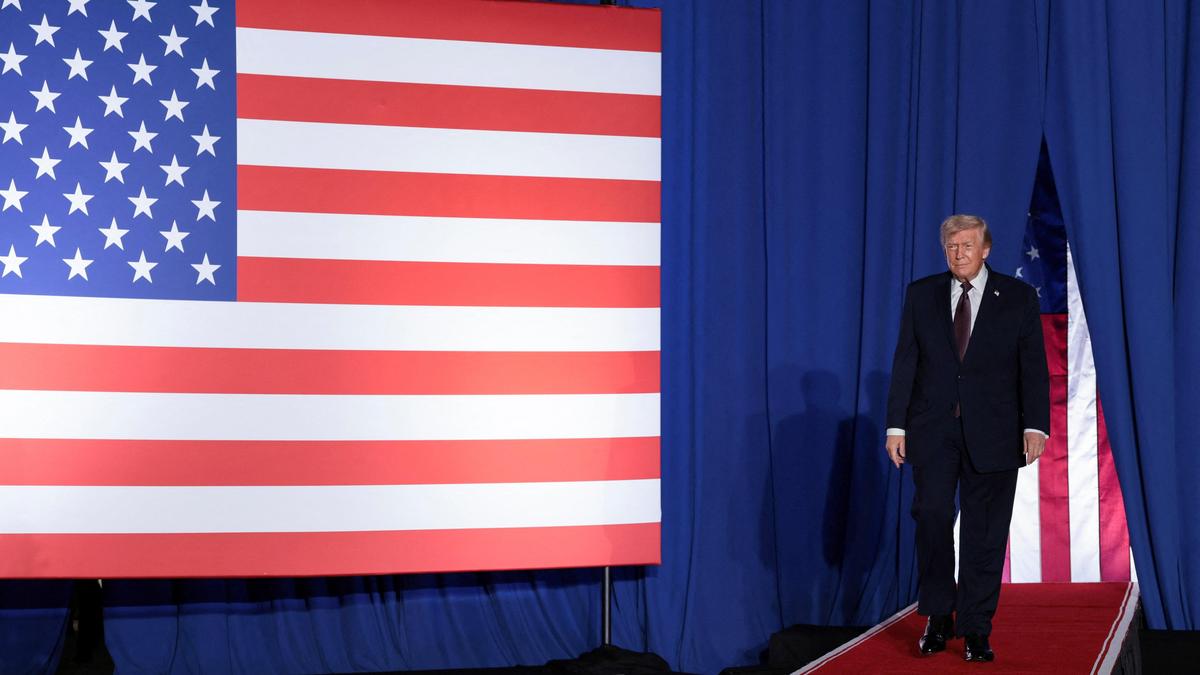
U.S. President Donald Trump signed into law the National Defence Authorisation Act (NDAA) on December 19, 2025.
| Photo Credit: Reuters
Two days after Parliament cleared the SHANTI Bill, which allows private participation in India’s nuclear sector and eases liability norms by capping operator liability for a nuclear incident to ₹3,000 crore, U.S. President Donald Trump on Friday (December 19, 2025) signed into law the National Defence Authorisation Act (NDAA) advising the U.S. Secretary of State to work with the Indian government and “…align (India’s) domestic nuclear liability rules with international norms”.
The NDAA, signed every fiscal, is a key law through which the U.S. decides the annual budget and expenditures of its Department of Defense. This financial year, considered from October 2025 to September 2026, a portion of the voluminous document says that the Secretary of State “… shall establish and maintain within the U.S.-India Strategic Security Dialogue, a joint consultative mechanism with the Indian government to assess the implementation of the 2008 Indo-U.S. nuclear deal” and “…align (India’s) domestic nuclear liability rules with international norms”.
The development comes after the Parliament cleared the Sustainable Harnessing and Advancement of Nuclear Energy for Transforming India (SHANTI) Bill which repeals existing legislation governing nuclear activity – the Atomic Energy Act, 1962, and the Civil Liability for Nuclear Damage (CLND) Act, 2010. This was despite several appeals and a walkout by many Opposition parliamentarians in the Lok Sabha to refer the SHANTI Bill to a parliamentary panel for greater scrutiny.

The Bill aligns India closer to the Vienna Convention on Civil Liability for Nuclear Damage and makes it consonant with the Convention on Supplementary Compensation for Nuclear Damage. It is such an alignment that the NDAA 2026 encourages.
While the NDAA is presented every year in the U.S. and India finds a mention in the NDAA of previous years for defence and security matters, this is the only time – as per a perusal of previous NDAA by The Hindu – at least since 2016, that India has been specifically mentioned in the context of the 2008 nuclear agreement as well as “nuclear civil liability rules”.

The Opposition, which had termed the SHANTI Bill ”vendor-driven”, slammed the Centre on Saturday over the U.S. law. “Now we know for sure why the Prime Minister bulldozed the Shanti Bill through Parliament earlier this week that, among other things, did away with key provisions of the CLND Act, 2010… It was to restore SHANTI with his once good friend,” Congress Rajya Sabha MP Jairam Ramesh said in in a post on X. “The SHANTI Act may well be called the TRUMP Act – The Reactor Use and Management Promise Act.” He also appended a photograph of the page of NDAA 2026 with the reference to India.
SHANTI encourages private companies to participate and potentially allows foreign funding to flow into India’s nuclear sector. It removes the links to ‘supplier liability’ – or the circumstances under which an operator of a nuclear power plant can statutorily claim recourse from a supplier of components if it resulted in a nuclear accident. This is a controversial clause with a history but also said to be one that has frozen foreign participation, particularly American and French nuclear technology, into India.
Published – December 20, 2025 08:18 pm IST

