

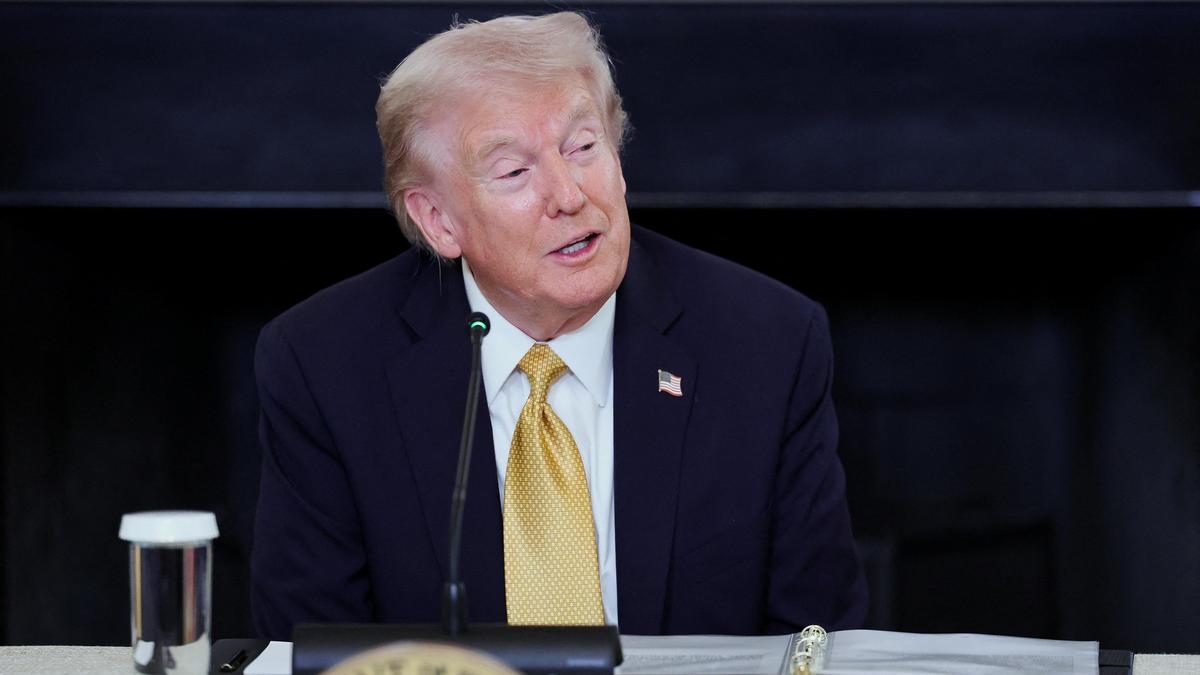
At 89 seconds from midnight according to the doomsday clock and after 33 years of a moratorium on nuclear testing, the United States President, Donald Trump, announced that the U.S. would be resuming nuclear weapons testing. This adds yet another confusing and alarming policy to a growing assortment of such policies under Mr. Trump’s belt.
The timing of the announcement is not coincidental. Mr. Trump’s post, on Truth Social, came after Russia announced the successful test of a ‘nuclear-capable cruise missile’. It also came the same day as Mr. Trump’s meeting with China’s President Xi Jinping. Given the current state of the international order, the implications of this move are likely to be widespread.
Speculation about the beginning of another arms race has already begun and the state of the global nuclear non-proliferation architecture is likely to be determined by what happens in the months ahead. While the details of what kind of testing the U.S. intends to carry out are unclear, this is likely to be perceived as a massive shift in U.S. nuclear posturing.
Effect on power equations, dynamics
On the obvious power equations, U.S.-China and U.S.-Russia dynamics are likely to be directly impacted. Since the announcement on testing, a spokesperson from China’s Foreign Ministry has urged the U.S. to ‘abide by its commitments to the comprehensive nuclear test-ban treaty (CTBT)’.
If the U.S. fails to do so, China and Russia could both potentially resume their nuclear testing. It would allow them to try out new and advanced weapons (such as low-yield ‘tactical’ nuclear weapons), without being held responsible for being the ones to break the moratorium.
The New START Treaty, which limits the number of strategic warheads and delivery vehicles that the U.S. and Russia can deploy, will expire in February 2026. If the U.S. resumes testing, a successor agreement will become even more challenging to negotiate. Coming to the less obvious implications of the resumption of nuclear testing, 50 years of nuclear arms controls are now likely to be under strain. While the CTBT never entered into force, the moratorium on testing served like a tacit agreement, which all major powers (apart from North Korea) have voluntarily abided by since the 1990s. Now, as the U.S. sets a precedent for breaking the moratorium, other countries apart from China and Russia could use this as justification for conducting their own nuclear tests.
This move also undermines the premise of the Treaty on the Non-Proliferation of Nuclear Weapons (NPT), which bound countries to commit to nuclear disarmament in pursuit of a safer, non-nuclear world. By ratifying the NPT, nuclear weapons states agreed to pursue negotiations towards nuclear disarmament, and non-nuclear weapons states agreed never to acquire nuclear weapons.
Resuming nuclear testing is likely to be perceived as a move in the exact opposite direction and invalidates the so-called ‘grand bargain’ of the NPT. Non-nuclear states can now openly argue against maintaining their status in the interest of their own security, with nuclear powers publicly breaking their end of the bargain.
Impact on global environment
U.S. nuclear testing will also fundamentally alter the global security environment. With the U.S. potentially working toward the development of more advanced weapons systems, other countries have an incentive to do the same to remain technologically competitive. If China also resumes testing, it will set alarm bells ringing in India. And if India were to decide to test again, the domino effect would push Pakistan in the same direction, leading to instability in the subcontinent. Also, uncertainty may push U.S. allies to question the reliability of its extended deterrence. The hope is that states that have historically advocated for disarmament should reiterate their position. Still, it is more likely that states will also have to reconsider their respective security environments and re-evaluate their postures.
Today, we live in a world that is, by and large, governed by leaders who did not live through the World Wars or witness the horrors in Hiroshima and Nagasaki. This distance from history makes it easy to forget the sheer destruction that took place, and become more open to the idea of nuclear proliferation — even if it is at a ‘tactical’ level.
Need for a global dialogue
Less-than-subtle threats have become increasingly common in war-time rhetoric, and this latest move, by Mr. Trump, is only another step in a dangerous direction. Instead of a rapid arms race, which many alarmist pieces have already heralded, Mr. Trump’s announcement has the potential to be detrimental to non-proliferation and disarmament regimes that took decades to build. But if the situation is managed with good judgment, it can herald the strengthening of the same regimes that Mr. Trump’s actions are threatening to destroy.
With the NPT up for review early next year, perhaps a binding commitment from other signatory countries to global no-first use would steer things in a safer direction.
Additionally, with the expiry of the New START soon, the U.S. and Russia, and additionally China, should initiate a dialogue that focuses on trilateral arms control, which can set a precedent for the rest of the world. In order to restore faith in the NPT’s ‘grand bargain’ and reinforce nuclear arms control, there is an urgent need for global dialogue that reiterates a commitment to disarmament.
One can only hope that President Trump’s unfettered access to social media led him to slip up and post something that the U.S. will definitely not implement in a moment of weakness. Yet, in the much more likely event that the U.S. does resume testing, the rest of the world should not fall prey to Mr. Trump’s questionable policy choices at the cost of its own stability and security.
Adya Madhavan is a researcher at the Takshashila Institution
Published – November 01, 2025 12:08 am IST

