

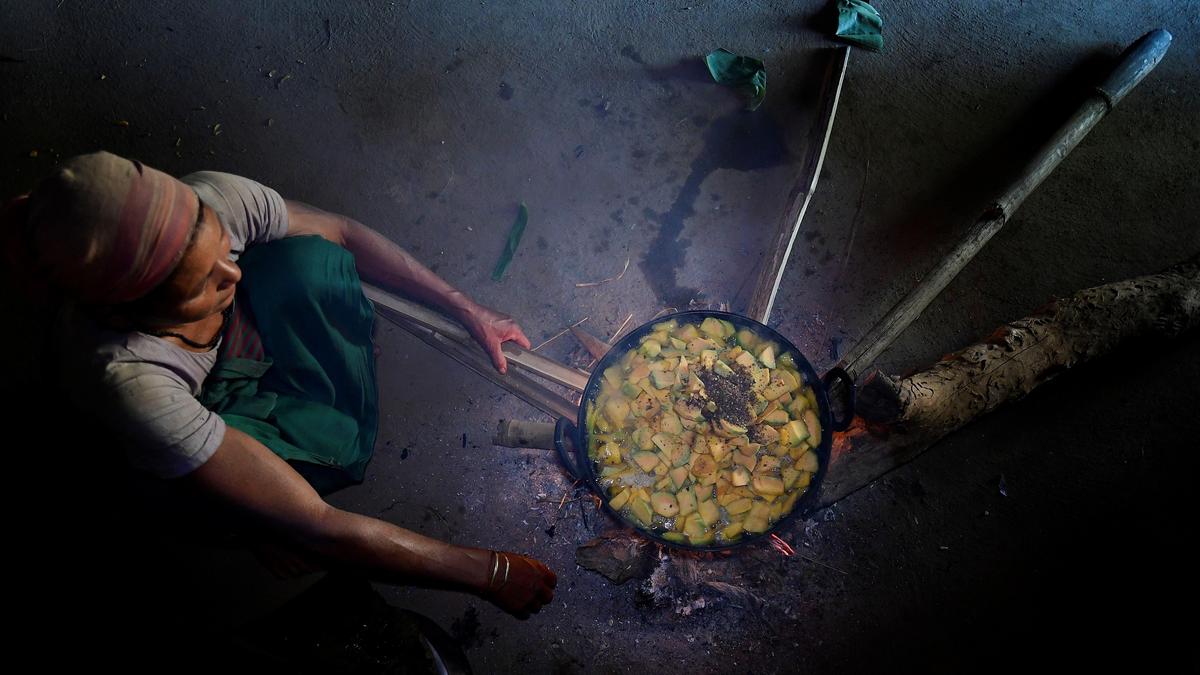
In the poem, The Woman’s Labour (1739), Mary Collier writes: “When Harvest comes, into the Field we go, And help to reap the Wheat as well as you. Or else we go to the Ears of Corn to glean; No Labour scorning, be it e’er so mean; But in the Work we freely bear a Part, And what we can, perform with all our Heart.” It is a powerful way of pointing to how women’s labour often goes unseen. A 2023 United Nations report showed that globally, women spend 2.8 more hours than men on unpaid care and domestic work. The struggle to count women’s labour continues.
While domestic labour has increasingly entered the public discourse, the emotional and mental labour in sustaining relationships, managing household dynamics, and supporting the well-being of others continues to go largely unacknowledged. This uncounted labour which plays a critical role in the smooth functioning of families and societies, is rarely measured or rewarded.
Also Read | Women shifting from unpaid domestic work to paid jobs: government survey
Shirin Rai, a professor, argues that “…many who cope with this work in contexts of poverty and of violence, are constantly told that their everyday labour — both paid and unpaid to maintain the rhythms of life-ecology do not count in/as production. … as a global society, we fail to recognise this labour in our everyday lives, and we continue to deny its appropriate inclusion in discourses about work, in our national budgets, and in policy frameworks”.
This raises a critical question: what structural and ideological forces render this labour unseen and undervalued? Feminist scholars such as Isabella Bakker, Nancy Fraser and Shirin Rai have argued that economic and policy priorities have long marginalised care work by framing it as secondary to “productive” labour traditionally performed by men.
The privileging of male breadwinner employment, the relentless focus on GDP growth, and the emphasis on physical infrastructure investment over social infrastructure have all contributed to the systemic devaluation of care-related work. These priorities often result in the diversion of public resources away from services that support caregiving, such as childcare, elder care, and mental health services domains that are disproportionately occupied by women.
Also Read | For women, unseen battles at workplace
Antonella Picchio, a professor at Cambridge, argued that “the biological aspects of human reproduction were used to hide the historical and social aspects of the gender division of labour. The separation between the process of production and that of social reproduction of labour between men and women took new forms and shaped new power relationships within the traditional context of women’s subordination”. Thus, in our view, the act of non-inclusion of women’s direct and indirect labour is a continuation of the subjugating practice of considering women’s labour as non-productive. A closer look at global legislation and statutes reveals that the efforts to recognise women’s labour institutionally are very scattered.
Few countries have introduced laws, constitutional provisions or policies recognising unpaid care work/domestic/emotional labour. Article 338 of the Bolivian Constitution recognises that work at home is an economic activity that creates added value and produces social welfare and wealth. Housewives are entitled to social security in accordance with the law. Trinidad and Tobago has the Counting Unremunerated Work Act, 1996 requires the statistical authorities to measure unremunerated work (housework, caring for children/elderly/disabled), break it down by gender, and assign a monetary value. Similarly, Argentina enacted a law recognising employment contracts for domestic workers where women can get pension credits (equivalent to social security contributions) for unpaid care work they have done raising children. But no law and policy recognises the mental and emotional labour put in by women to run the economy and the family.
DATA | More women join the labour force, but are they really employed?
In India, there is still no legal framework that recognises or compensates this form of unpaid work, despite it being the backbone of families and, by extension, the economy. However, courts have begun to challenge this silence. In Kannaian Naidu and Others vs Kamsala Ammal and Others (2023), the Madras High Court ruled that a wife who performed household duties and cared for the family contributed, albeit indirectly, to the acquisition of family assets. Therefore, she was entitled to an equal share in the property. These efforts to recognise women’s labour must be accompanied by a structural reconfiguration of gendered social relations, wherein men actively participate in and co-shoulder care responsibilities. Without such a transformation, the burden of unpaid care work will remain disproportionately feminised. It will either continue to constrain the full participation of women in the formal economy or force women from marginalised socio-economic locations to sustain the reproductive labour of households where other women from dominant groups engage in formal employment.
Any revaluation of labour must also encompass the often invisible factor of emotional labour, which plays a critical role in sustaining households, communities and broader economic systems, yet remains systematically unacknowledged in policy and practice.
Rajesh Ranjan is a Chevening Scholar. Vrishti Shami is a lawyer-researcher who writes on policy and law. The writers acknowledge the help of Professors Rachel Rose, Eve Dickson, Shirin Rai, and Chris Newfield, and also Prof. Vanza Hamzic and Rashmi Satyal for inputs
Published – January 05, 2026 12:42 am IST

