

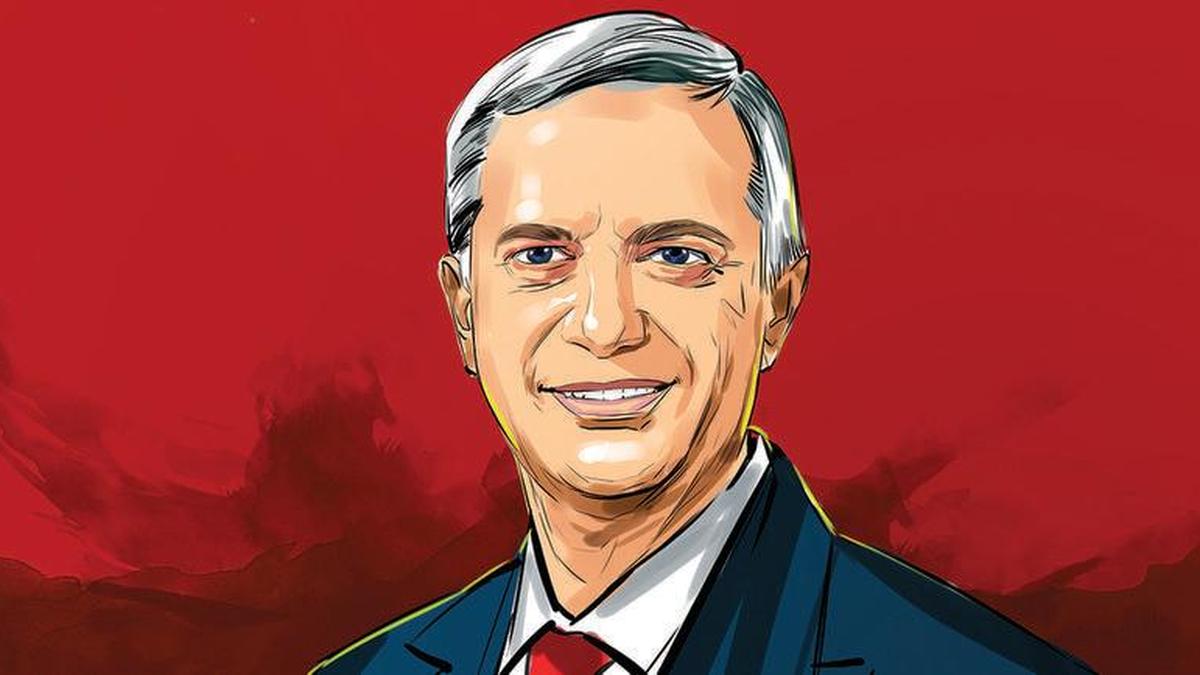
Chile’s next President is hardliner José Antonio Kast, marking the latest conservative shift in South America, where right-wing leaders recently prevailed in national elections in Bolivia and Ecuador, as well as the midterms in Argentina.
The 59-year-old seasoned politician defeated leftist candidate Jeanette Jara in the presidential runoff, winning 58% of the vote. Ms. Jara, Labour Minister under the outgoing President, Gabriel Boric, won 41.84% of the vote. This marked Chile’s first presidential election with mandatory voting and automatic registration of eligible voters.
Mr. Kast was born in Santiago in 1966 to German immigrants; his father was a Nazi party member and army lieutenant from Bavaria, who decamped to South America after the Second World War and set up a business in Paine. Mr. Kast has stressed that his father was forced to enlist.
As a law student at the Pontifical Catholic University of Chile, Mr. Kast was an admirer of General Augusto Pinochet, the military dictator who seized power in a 1973 coup. In 1988, a referendum was held to determine Pinochet’s continuity in power; Mr. Kast campaigned for the yes vote. He said in later years that if Pinochet had been alive,“he would have voted for me”.
The Pinochet ties ran deeper. His elder brother Miguel Kast was a Minister and Central Bank president during Pinochet’s regime, mooting for neoliberal economics as part of a grouping of Chilean economists known as the ‘Chicago Boys’.
Mr. Kast’s entry into politics came later. He first practised law and founded a legal firm. After meeting conservative thinker Jaime Guzmán, Mr. Kast entered local politics in 1996. He ran for Mayor of the city of Buin, coming in second and becoming a councilman. In 2002, he entered the Chamber of Deputies, representing the right-wing Unión Demócrata Independiente (UDI).

In 2016, he resigned to run for presidency as an independent candidate, garnering less than 10% of the vote. He ran again in 2021, this time under the banner of the hardline Republican Party that he founded in 2019. He lost to Mr. Boric, but gained 44% of the vote.
In 2025, Mr. Kast was more prepared. The Chilean public was concerned about increasing crime rates and immigration, and Mr. Kast’s far-right, anti-immigration platform resonated with them. While Chile remains one of the safer countries in South America, a rise in organised crime and economic turbulence prompted increasing disaffection towards Mr. Boric’s liberal policies, and a dip in his approval ratings. Mr. Boric was precluded from running for a second term, but a vote for leftist candidate Ms. Jana may have been viewed as a continuity vote for his policies.
‘Order and security’
Promising to create “order, security and trust”, Mr. Kast outlined measures reminiscent of Donald Trump’s immigration rhetoric: the building of border walls and electric fences, detention centres and increased military presence on borders, particularly those to the north with Bolivia and Peru. Mr. Kast also mooted the idea of a force modelled on the U.S. Immigration and Customs Enforcement to root out illegal immigrants, numbering over 330,000 and primarily from Venezuela.
He pledged a crackdown on crime, saying he would deploy the military force to high crime areas. Mr. Kast also said he would build more prisons, reportedly inspired by El Salvador President Nayib Bukele and his prison complex design.

A devout Catholic, Mr. Kast is against same-sex marriage and abortion, saying previously that he would repeal abortion rights (which are limited). His platform did not spotlight these issues, however, giving greater weight to national security and economic measures. Mr. Kast assured a return to a free-market economy, with deregulation and corporate tax cuts. He also promised spending cuts worth $6 billion within 18 months.
His policies place him even further to the right than the last right-wing President, Sebastian Pinera of the UDI, who voted against Pinochet in the 1988 referendum and had presided over the legalisation of same-sex marriage. “Here, no individual won, no party won — Chile won, and hope won,” Mr. Kast said in his victory speech. “Chile will once again be free from crime, free from anguish, free from fear.”
Mr. Kast will be sworn in on March 11, and has already met with Mr. Boric at La Moneda, the presidential palace in Santiago. Mr. Kast will have his work cut out with no absolute majority in either house of Congress. Mr. Kast married María Pía Adriasola Barroilhet in 1991, and has nine children, including José Antonio Kast Adriasola, an elected member of the Chamber of Deputies.
Published – December 21, 2025 01:29 am IST

