

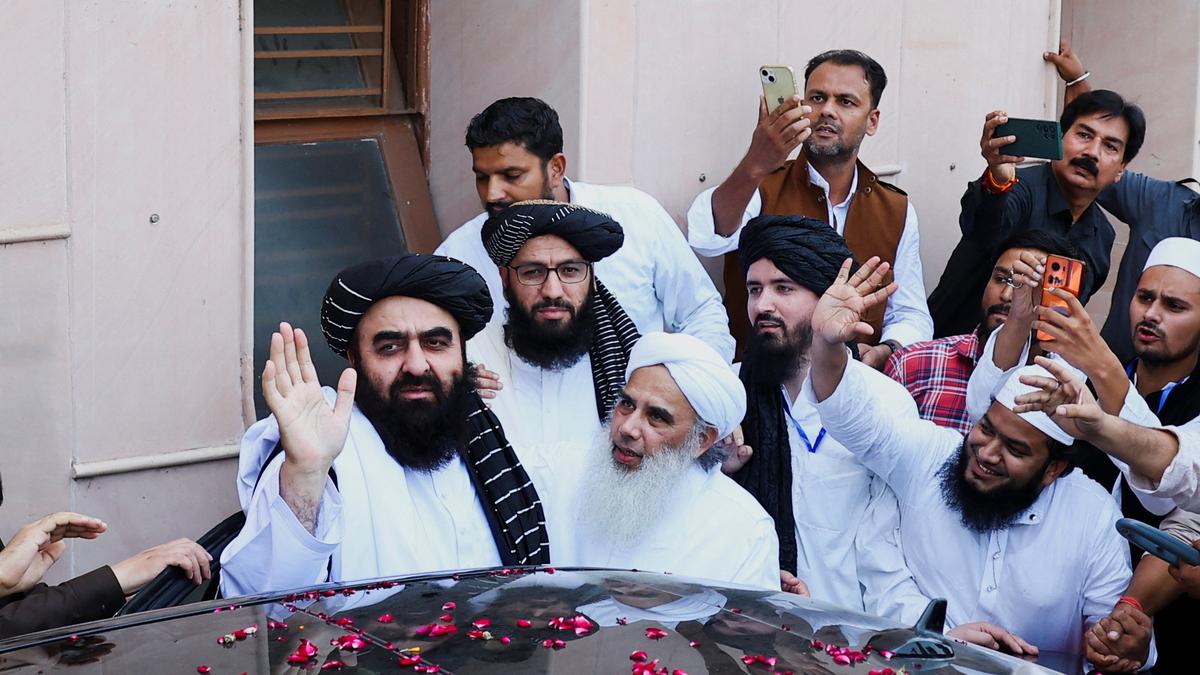
The visit of Afghanistan’s Acting Foreign Minister Amir Khan Muttaqi and its attendant excitement in mainstream and social media are now over. But this is only the beginning. What must follow is a step-by-step engagement, with the single objective of stabilising a devastated country, and, in the process, ensuring that New Delhi projects its credentials as a humanitarian force to reckon with. In these days of rampant war and war mongering, that counts. In addition, there are issues of strong security interests, that in fact, need not be a zero sum game with Pakistan. In fact, it might just deliver a certain stability to Pakistan as well, provided that it is ready to accept it.
Terror and the realities on the ground
The joint statement between the two sides, which angered Islamabad, only reiterated the Taliban’s immediate condemnation of the Pahalgam attack (April 2025), and, similarly, reiterated promises by Kabul to never allow its territory to be used against India. That promise has been made often to the international community. This has been acknowledged by the United Nations Security Council Sanctions Monitoring Committee Report which commends the Taliban’s actions against the Islamic State-Khorasan (IS-K), even while it questions Kabul’s actual capability in countering it — given the reclusive Mullah Haibatullah’s penchant for running a parallel regime from Kandahar.
The report also notes that while the leader of the Tehreek-e-Taliban Pakistan (TTP) leader, Noor Wali Mehsud, received funds from the Taliban, Kabul was hesitant to act against it, out of fears of allying itself with the IS-K.
In short, Pakistan’s demands that it act against the TTP are not naive but deliberate propaganda. Rawalpindi knows its Afghanistan. While the Taliban are no saints, they are also not the crafty terrorist sponsors Rawalpindi would have everyone believe. However, getting rid of that narrative requires actions on the ground, which is where India could come in. One line of activity is to ensure that the Taliban’s mostly successful drug eradication programme is knit into crop substitution programmes and that there is an end-to-end process which ensures farmers security and exports. This is urgent as reliable reports indicate an uptick in cultivation, even as meth labs sprout across the country. Given the huge drug seizures along India’s borders, a comprehensive training programme by the Narcotics Control Bureau would be highly desirable. The brute force being used now to counter narcotics actions is hardly helpful to the Taliban.
Editorial | Talking to Taliban: On India-Afghanistan ties
For Kabul to ‘normalise’, it needs the absolute basics of any city. A recent report notes that Kabul may be the first city in the world to completely run dry by 2030. Years of war have taken their toll on projects. India’s reiteration of an earlier offer to build the Shahtoot dam on the Kabul river will cause alarm in Pakistan, given a reported drop of 16% in flows. The Kabul river is a part of the Indus river system, and logically should be made part of a new treaty so that all differences are ironed out. In other words, there should be a deal that benefits all, which Islamabad will find difficult to refuse. A water-starved country is hardly the most desirable neighbour.
Education for all
The issue of women’s education is paramount. The few Taliban leaders who did support it such as Abdul Baqi Haqqani who were in favour of women’s education were quickly replaced by hardliners such as Mawlawi Habibullah Agha.
Changing this cruel practice is vital in not just reframing the Taliban but also India’s outreach. As of now, India has announced 1,000 e-scholarships for students through the Indian Council of Cultural Relations which is nowhere enough. The online option needs to be extended to all major colleges, giving them a special dispensation in terms of foreign exchange regulations.
This may also be focused on areas where India is planning to make investments. For instance, in the joint statement, mining is a key area of interest. Therefore, skills need to be developed in the country, so that a minimal Indian presence is necessary, and which creates employment in the country.
The goal of a stable country
Finally, though it is standard practice now to talk of a ‘whole of government’ approach, this rarely happens in practice. While the National Security Council Secretariat is meant to do this, it needs to be strengthened so that all arms of the government, including finance, water and power, are all working towards a specific objective — to ensure that Afghanistan stays friendly and stable.
This objective needs to remain constant across governments so that the fundamental principle of ‘selection and maintenance of aim’ is achieved with the objective of ensuring that India’s relevance remains permanent and is not part of shifting policies. But there is a key problem. The Pakistan army has no stake at all in ensuring the stabilisation of Afghanistan given its continuing desire to dominate the Taliban. Ordinary Pakistanis do, and most of them are Pashtuns with business and family ties across the border.
Potential revenues from Afghanistan trade and transit is estimated at $10 billion. None of this will matter as long as Pakistan remains a security state. If a country that is repeatedly labelled as the cradle of terrorism needs to be changed, the so-called international community has to work on systemic change in Pakistan. Democracy is not just a nice aspiration. It works, almost every time.
Tara Kartha is a former Director, National Security Council Secretariat
Published – October 18, 2025 12:08 am IST

