

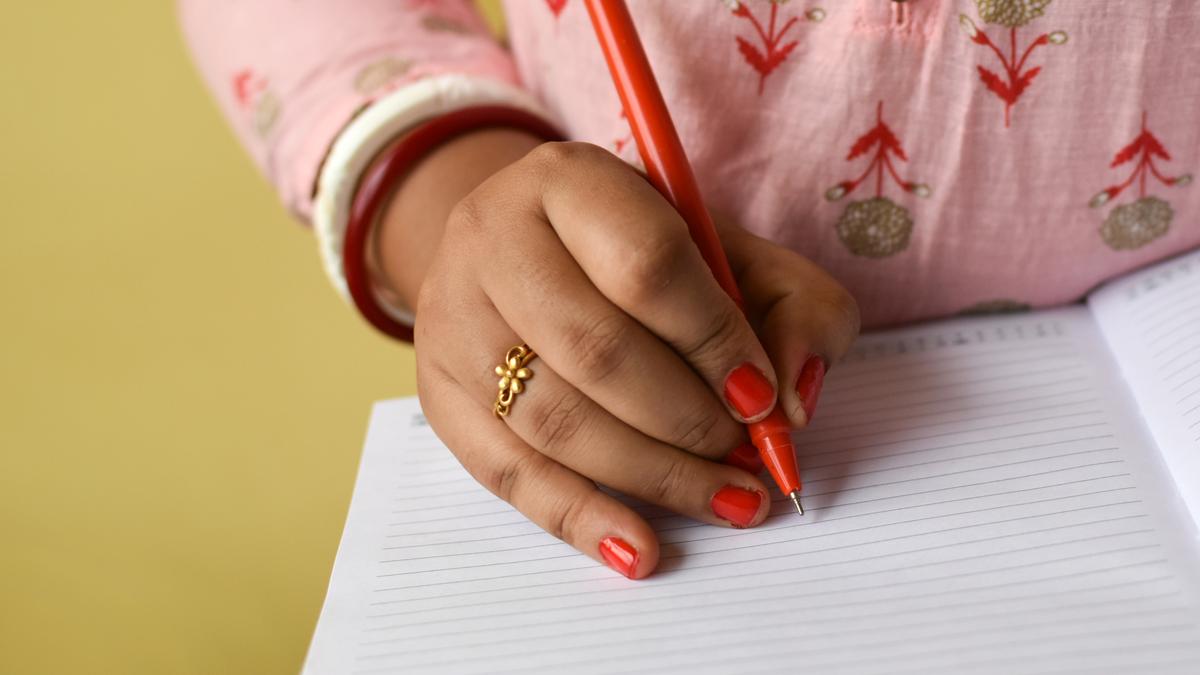
Close up of an Indian woman’s hands writing in notepad with pen placed on hand. Selective focus on pen and fingers.
| Photo Credit: Getty Images/iStockphoto
In the second week of February 2017, I reached a hotel in Moradabad at 8 p.m. The first phase of polling for the Uttar Pradesh Assembly elections had just concluded and there were six more to go. Having spent the entire day in the field talking to voters, I looked forward to some food and rest.
At the dimly lit check-in desk, the receptionist, a man in his mid-40s, asked, “Are you alone?” The question, and the tone in which it was said, instantly raised my hackles. “Yes,” I replied firmly, trying to inject authority into my voice. I am not sure whether that fooled him. It certainly didn’t fortify me. I grabbed the keys, waiving off the hotel staff who wanted to carry my luggage, and ran to my room. I locked the door and placed a chair against it. Looking back, I wonder if I was overreacting, convinced that solo women travellers are always at risk. Maybe not. I am okay not knowing the answer.
For the upcoming Assembly polls in Bihar, I travelled across three cities from Gaya to Darbhanga. The setting was not very different from Moradabad. The reception, however, was very different. No one questioned me or asked why I was travelling alone. There were no curious stares, no condescending remarks, no words of caution. I felt safe.
This experience was not limited to Bihar. As a woman traveling alone to Tier-1 and Tier-2 cities, I have noticed a perceptible change in the demeanour of hotel staff. I saw this during my travels for the 2024 Lok Sabha elections as well. The reception was mostly neutral.
There were other heartening signs as well. At Darbhanga, the market was shutting down for Chhath celebrations the next day. Only a few dhabhas were open. I sat alone to eat a meal. On the table next to me, two young women sat down and ate with abandon, happily asking for second helpings. It felt good to watch them.
In July, I was in Bihar for a story on the Special Intensive Revision exercise, conducted by the Election Commission of India to “clean up” the electoral rolls in the State. The Opposition had called for a bandh. Our car was stuck on the highway, somewhere between Purnia and Madhubani. There was a long traffic jam. I was getting anxious about losing time and not being able to talk to enough people. I got out of the car to talk to a group standing at a tea shop. They told me that a booth-level officer was at their village. One of them agreed to drop me there on his motorcycle. I had only my phone and diary with me. I went along. From there, another group took me to another village just so I could speak to more people. When I called my photographer from there, I realised that I had travelled some 7 kilometres with strangers from the place where the cab was stuck. But not for a moment did I feel unsafe.
This is not to say that the world has suddenly become safe or that my anxieties related to my gender have vanished. I still plan my trips meticulously — booking hotels in advance and charting routes carefully. I make sure to stop in reasonably large towns where I can find clean, safe accommodation. It often means I can’t take detours or make unscheduled stops. Before leaving for Bihar, I spoke to several male colleagues who were also covering the elections. Their itineraries were not as rigid as mine. In contrast, a young female reporter from a news portal called me from Patna, worried about finding a safe hotel in Seemanchal.
I am aware that the first generation of women reporters crossed higher barriers, travelling to the farthest corners without giving in to the farce of wearing socially acceptable clothes or limiting themselves to “softer beats”. They opened the doors for us. I am glad that field trips for women reporters are no longer the heroic adventure they once were.
We have certainly come a long way. But we still have a long way to go.
Published – November 07, 2025 01:10 am IST

