

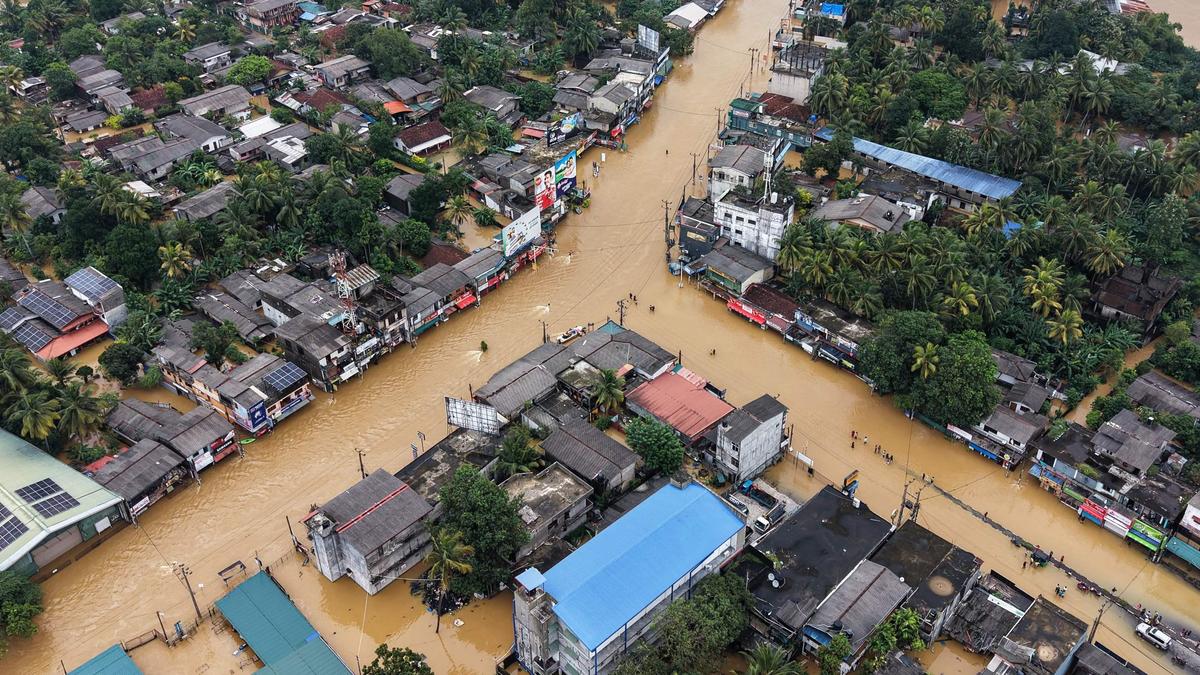
People often discuss India’s big metros as if they belong to the same category. Mumbai, Delhi, Kolkata and Chennai are similar in age, scale and cultural importance and all four appear in rankings of “global” or “liveable” cities. Yet, anyone who has lived in them knows how much the security that they offer their residents during cyclones or extreme monsoon days differs. That divergence is not just an Indian curiosity but points to a deeper problem with how we define and measure “modern” urban life, and which recent floods across Sri Lanka, Indonesia, Thailand, and the Philippines made clear.
The UN-Habitat City Prosperity Index combines productivity, infrastructure, quality of life, equity, environmental sustainability and urban governance into a single picture. The Global Liveability Index scores cities on stability, health care, culture and environment, education and infrastructure. The City Resilience Index focuses on how well cities withstand and recover from shocks, including extreme weather, across health and well-being, economy and society, infrastructure and environment, and leadership and strategy.
While these approaches acknowledge that economic output, public services, social inclusion and environment all matter to urban welfare, they do not yet add up to a coherent way to judge whether a city actually affords its residents a “developed” life in a world in which the climate regularly breaches new extremes.
The Asia floods
Cyclone Ditwah brought intense rain to Sri Lanka, triggering flooding and landslides that killed over 400 people and displaced tens of thousands in Colombo and in densely populated countryside settlements. In Indonesia, cyclonic storms triggered floods and landslides across Sumatra, killing hundreds and destroying villages in river valleys and on steep slopes. Southern Thailand, including the city of Hat Yai, experienced rainfall reported to be the heaviest in centuries. The resulting floodwaters were several metres deep while national leaders also acknowledged failures in warning. In the Philippines, Typhoon Kalmaegi inundated parts of the Visayas region, including Cebu, leaving dozens dead and lakhs displaced.

Hat Yai and Cebu are secondary cities integrated into national economies. Hill towns near Colombo are similarly linked to the capital’s labour and commodity markets. Yet, many of the affected settlements do not appear on the major indices. This is because liveability rankings typically cover capital regions and a small set of global hubs while global city indices focus on financial and research functions. The first flaw is that the places that absorb much of the real risk of rapid urbanisation due to a changing climate are often excluded from the systems by which “modern” urban life is assessed.
Shortcomings in liveability indices
Where data does exist, the floods reveal a more structural problem. The grey infrastructure in the most affected places was designed for weaker storms and was quickly overwhelmed by more than 300 mm of rain in 24 hours. Early warning and evacuations were only partial, leaving families in south Thailand reportedly trapped on upper floors for two days. Landslides in Sri Lanka also struck at night.

However, liveability indices record whether a city has hospitals, schools, parks, and public transport but are nearly silent on whether drainage networks can handle 21st century cloudbursts, whether hillsides are free of construction, and whether there are safe and accessible alternatives to informal housing. Prosperity indices may measure the share of households in “durable” housing, yet rarely differentiate between a brick house on a stable terrace and one cut into an unstable slope.
These gaps matter because the assessment paradigms have become part of the way States and investors decide where to deploy capital. A city that scores well on connectivity and business climate may also pay scant attention to drainage or slope stability, yet still attract more investment, even if that investment deepens exposure in floodplains or unstable hillsides. Public officials who are aware of what “moves the needle” prioritise airports, metro lines, and waterfront promenades, all of which signal modernity, while the less visible work of desilting canals, maintaining culverts, enforcing building codes and relocating people towards sites of lower risk remains politically thankless.
The inequity
Because most indices use city-wide averages, they misprice risk and shift it to those with the lowest capacity to bear it. Rising land values and expanded infrastructure in flood-prone areas show up as higher prosperity and better access. When extreme rain arrives, wealthier residents benefit from better mobility and services and can often protect themselves with insurance while peri-urban settlers scramble in structures that crumble or flood first, even though they too live in a city assessed to be “modern”.

International funds and technical assistance programmes often require cities to produce certain plans and indicators; cities that can already do this, which are typically larger and more prosperous, become the main recipients of adaptation support. Projects are then designed to satisfy reporting requirements, not necessarily to address the most acute local hazards. Eventually, the media and urban elites adopt the vocabulary of “top-10 most liveable”, “world-class” or “smart” cities while planning curricula and engineering standards adopt global indices as reference points, embedding their biases into the next generation of urban professionals.
mukunth.v@thehindu.co.in
Published – December 04, 2025 12:08 am IST

